
Data Sovereignty and Interoperability




SAP and Its Dominant Market Position
In mid-2026, the European Commission concluded proceedings against SAP, thereby fundamentally altering the competitive landscape in the market for ERP maintenance and support. Under case number AT.40823, the EU competition authority accepted legally binding commitments from SAP to settle a formal antitrust proceeding under Article 102 of the TFEU.
The proceedings were preceded by an investigation launched in September 2025, in which the Commission preliminarily determined that SAP was abusing its dominant market position in on-premises ERP software to systematically hinder third-party maintenance providers such as Rimini Street, unduly restricting customers’ freedom of choice, and imposing artificially inflated support costs.
Revision of the SAP Price and Terms List (PKL)
The commitments accepted by the EU—which are now enforceable in court—compel SAP to undertake a fundamental revision of its contractual support guidelines and its Price and Terms List (PTL). As a key element, SAP must abandon the principle of support uniformity and clarify so-called “landscape splits”: In the future, customers will be allowed to divide their SAP system landscape into independent, commercial installations and decide separately for each part whether to continue with the expensive manufacturer support, engage a more affordable third-party maintenance provider, or discontinue support for unused components entirely.
Until now, SAP has prohibited customers from mixing different support levels or providers and has required them to sign the same contract for their entire installed software base.
Cancellation Rights for Shelfware
The EU ordered SAP to accept expanded, discount-neutral termination rights for its existing customers regarding unused licenses (shelfware). Under clearly defined, objective scenarios, existing SAP customers can now cancel licenses and the associated maintenance fees without SAP artificially inflating the cost of remaining licenses by retroactively eliminating existing volume discounts (prohibition on re-discounting).
These special cases include products in the final maintenance phase—known as “Customer-Specific Maintenance”—during which SAP provides only limited services; implementation projects that have demonstrably failed due to SAP’s fault; customer bankruptcies, significant workforce reductions of 10 percent or more over a two-year period, and divestitures, in which licenses can be transferred to the buyer without transfer fees and without loss of discounts, or unused remaining licenses can be terminated without replacement.
Relaunch of the Maintenance Base and Return to Operations
In addition, SAP must actively offer broader access to Single-metric contracts starting at a contract volume of 500,000 euros, which allows customers to reduce their maintenance base by up to 20 percent per year as usage declines while still retaining the right to use the software for an unlimited period of time.
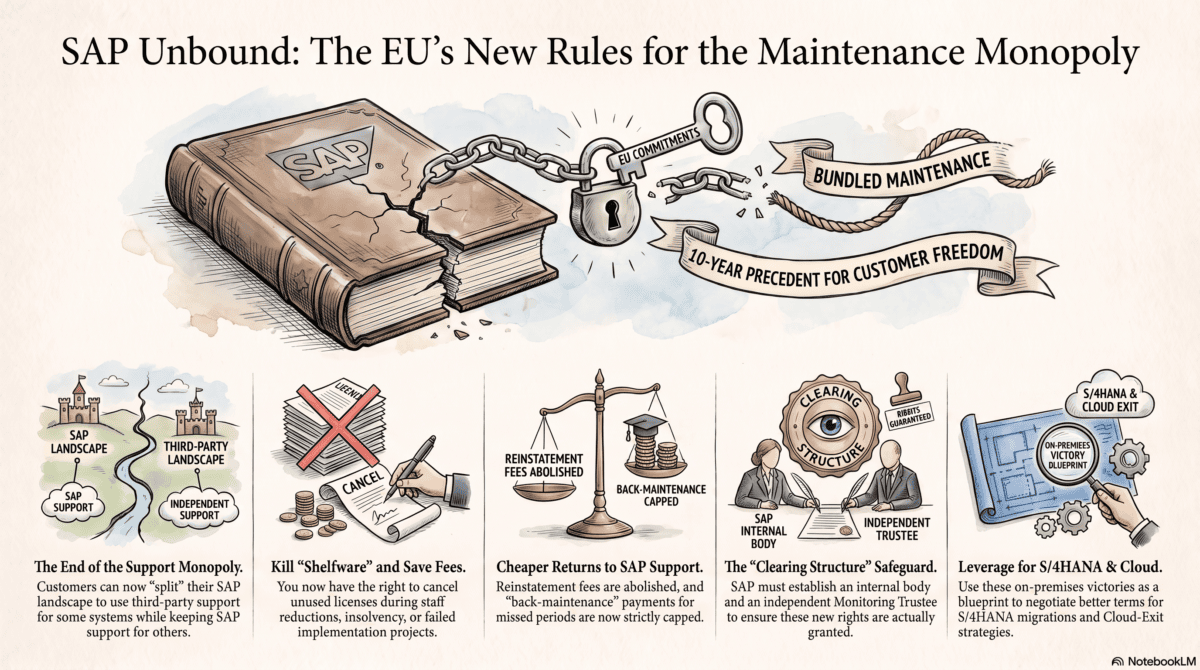
Re-enrolling in SAP Support after a hiatus will also be significantly more affordable: The infamous reinstatement fee is being completely eliminated, and retroactive maintenance payments (back maintenance) are being drastically capped at the lower of six months’ worth or half of the fees accrued during the period without maintenance.
To ensure independent oversight of these rules in the event of a dispute, SAP is establishing an internal clearing structure as well as an external monitoring trustee who reports to the EU; employees of this clearing structure are expressly prohibited from being part of the sales department or from receiving compensation tied to sales.
Economic leeway and new bargaining power
From the perspective of an existing SAP customer, this decision offers unique financial flexibility and a massive boost in bargaining power. The „aura of ambiguity“ and the legal intimidation tactics SAP used to discourage its existing customers from switching to third-party maintenance providers are now a thing of the past. Switching support providers is now officially recognized as a legitimate option.
Anyone who simply wants to keep an ECC legacy system running until the end of official maintenance in 2030 (or, by utilizing customer-specific maintenance, beyond that until 2033/2025) can cancel manufacturer support, save up to 50 percent on maintenance fees through third-party providers, and invest this freed-up budget directly into the actual technical modernization. Since returning to SAP is no longer an irreversible one-way street due to the elimination of reinstatement penalties, the risk of a temporary withdrawal from support is reduced to a minimum.
A Win for SAP On-Prem
However, E3 Magazine’s analysis of this EU agreement also reveals the Walldorf-based company’s business strategy: SAP has made a concession to the EU Commission on a battlefield that the company is gradually withdrawing from anyway. The commitments relate explicitly and exclusively to the traditional, declining on-premises maintenance business.
In the cloud-based future championed by SAP CEO Christian Klein—specifically, “Rise with SAP” or “Grow with SAP”—licenses and support are inseparably bundled into a monthly or annual subscription fee. Consequently, in the cloud, there is no longer a maintenance monopoly in the traditional sense that could be broken up!
Anyone who fails to pay their cloud subscription fees immediately loses the right to use the service and access to their data. This effectively opens up the on-premises past in a regulated manner, while the actual cloud future remains off-limits to alternative maintenance providers.
SAP's Cloud Future Remains Uncertain
This has implications for the migration strategy to S/4 Hana and the concept of the Autonomous Enterprise. IT decision-makers must no longer allow themselves to be pressured by the looming deadline of the end of ECC maintenance in 2027 or 2030 into signing unfavorable Rise contracts that would deprive them of their valuable, perpetual Onon-premise usage rights.
Thanks to the expanded third-party maintenance options, existing customers can continue to operate their legacy systems risk-free at their own pace and design their S/4 roadmap without artificial time pressure. When the time comes to migrate to S/4 HANA, companies should increasingly evaluate “Bring Your Own License” (BYOL) scenarios on neutral hyperscaler infrastructure or flexible hybrid infrastructures. In this way, they retain legal ownership of their licenses and maintain a technical and contractual safety net for a potential exit from the cloud.
Autonomous Enterprise and API Policy
For the visionary Autonomous Enterprise—which is based on the interplay between Joule, the Knowledge Graph, and Agentic AI—the EU decision serves as an important regulatory foundation. It demonstrates that antitrust oversight mechanisms also apply to dominant software platforms.
SAP is currently attempting to artificially restrict the direct extraction of data by third-party systems and autonomous AI agents through a highly restrictive API policy set to take effect in April 2026, in order to force customers into its own BTP and Datasphere ecosystems. Since EU Competition Commissioner Teresa Ribera explicitly emphasized that this decision should be understood as a warning against similar anti-competitive behavior in the cloud markets, user groups and customers must now be highly vigilant.
Any discriminatory interface regulation through which SAP favors its own applications, such as IBP, over third-party licenses exhibits the same anti-competitive lock-inas the now-prohibited maintenance practices and should be consistently documented and reported to regulatory authorities. Only through such an unyielding, proactive defense of one’s own data sovereignty and interoperability can we prevent the autonomous company of the future from mutating into a hermetically sealed and unaffordable commercial trap.

 Deutsch
  English
  Español
  Français