
DSAG at a Crossroads Between SAP and the Community




The Internal and External Challenges Facing DSAG e. V.
As the voice of more than 4,000 member companies from Germany, Austria, and Switzerland, the DSAG user association faces enormous, multifaceted challenges. The greatest challenge lies in navigating a deeply divided customer base and managing the relationship between SAP and DSAG. The task now is to engage in a constructive and critical dialogue—without hesitation—because the era of unquestioning acceptance and vendor lock-ins is over.
The Migration Backlog and the On-Premise Dilemma: Although SAP has announced that support for ECC 6.0 will end by the end of 2027 and 2030, respectively, empirical surveys by DSAG—such as the 2026 Investment Report—show that the majority of user companies still prefer to run their S/4 systems on-premises or in the private cloud. SAP’s attempt to force its loyal existing customers into the standardized public cloud has effectively failed in the German-speaking region. Consequently, the DSAG user association must defend the interests of a broad base of users who are vehemently resisting the threat of vendor lock-in.
An alarming trend emerged in the 2025 Investment Report. Of the more than 4,000 members contacted, only 243 companies felt motivated to complete the joint questionnaire from DSAG and SAP. This sobering response rate is interpreted within the community as a clear sign of disinterest, disillusionment, and a creeping shift away from the company. Furthermore, in other studies, only 38 percent of existing customers reported having a positive attitude toward SAP and its products, while 56 percent described their attitude as neutral to very negative.
Risk of Watering Down the Message: Criticism is growing within the SAP community regarding a possible softening of the DSAG’s stance. While the 2024 conference in Leipzig still featured lively discussions in workshops lasting several hours on the legal pitfalls of Rise contracts, critical voices at the 2025 conference in Bremen complained that uncomfortable topics were increasingly being „watered down and weeded out in a timely manner.“ The fact that DSAG canceled the „Licenses and Contracts“ theme day for 2026 and had to hand off this educational work to external community formats prompted a need for internal clarification.
DSAG members and the entire SAP community must continuously defend themselves against SAP’s new attempts to impose licensing restrictions and technical barriers. The most recent example is the SAP API Policy (V.4.2026a), issued in April 2026. This policy regulates interface traffic, restricts traditional RFC connections, and prohibits the direct bulk export of data to third-party systems or AI agents unless such data is routed through SAP’s expensive in-house BTP or BDC platforms. DSAG board members such as Jens Hungershausen, Michael Bloch, and Stefan Nogly are publicly speaking out against this attempt to establish a „closed shop“ and block ODP interfaces for competitors, denouncing the abuse of a dominant market position.
The AI Debate: Between Hype, Licensing Pitfalls, and the Risk of Hallucinations
A central focus of the DSAG Congress in Cologne is a critical examination of SAP’s AI strategy (SAP Business AI) and the “Autonomous Enterprise” paradigm. At first glance, willingness to invest appears to be growing: 45 percent of DSAG members give AI significant consideration in their IT budgets, and 48 percent see high potential benefits. Upon closer inspection, however, a deep divide becomes apparent between SAP’s marketing fairy tales and the reality on the ground.
The findings of the DSAG Investment Report 2026 show that 43 percent of companies have already implemented specific AI use cases. DSAG CEO Jens Hungershausen succinctly articulated the critical warning sign for SAP: The vast majority of these AI projects are being implemented using non-SAP solutions such as hyperscaler AI, Databricks, or independent platforms. Users are turning to generic language models because the native SAP Copilot Joule, as a cloud-only service, fails to address the on-premises reality of most customers.
The DSAG user association strongly warns that SAP is attempting to position itself as the exclusive gatekeeper for enterprise AI. By artificially tying AI functions to high-priced cloud subscriptions (such as Rise Premium Plus) and monetizing them through unpredictable BTP capacity units or AI token pricing, there is a risk of uncontrollable cost explosions: Cloud Bill Shock! Added to this is the usage-based expiration logic in the BTP Cockpit, where prepaid points expire at the end of the year without replacement.
DSAG emphasizes that reliable artificial intelligence requires a fully harmonized and clean database. A large language model operates probabilistically; if it encounters unclean master data or outdated custom code (SAP Clean Core) in the ERP core, the AI “hallucinates” and accelerates the collapse of operational processes. The comprehensive monitoring and transparent framework conditions for large language models demanded by DSAG are currently missing from the contracts.
The derisive mockery of the BDC as „Business Data Complexity“: The BDC (SAP Business Data Cloud) —the vendor-provided data foundation for AI and knowledge graphs—is derided as “Business Data Complexity” by the user association DSAG and the independent SAP community due to its confusing licensing, OData call restrictions, and contractual complexity.
A Constructive Partnership or an Irreconcilable Conflict of Interest?
The relationship between DSAG and SAP’s senior management can currently be described as a tense diplomatic stalemate. On the one hand, the two organizations are bound by decades of close organizational ties and a shared commitment to collaboration. On the other hand, there is a glaring divergence of interests.
While SAP is driven by the stock market, celebrating all-time highs in its stock price and forcing the company to meet rigid cloud revenue targets (SaaS ARR), DSAG members in the SME sector are struggling with tight budgets, a shortage of skilled workers, and the physical maintenance of their business processes. While SAP board members such as Thomas Saueressig and Philipp Herzig paint a picture of a glorious future for the self-sufficient company at conferences, the user association calls for realistic planning certainty, freedom of choice, and a pragmatic dialogue on equal footing.
A New Era for DSAG Following the Election of the Executive Board at the General Meeting
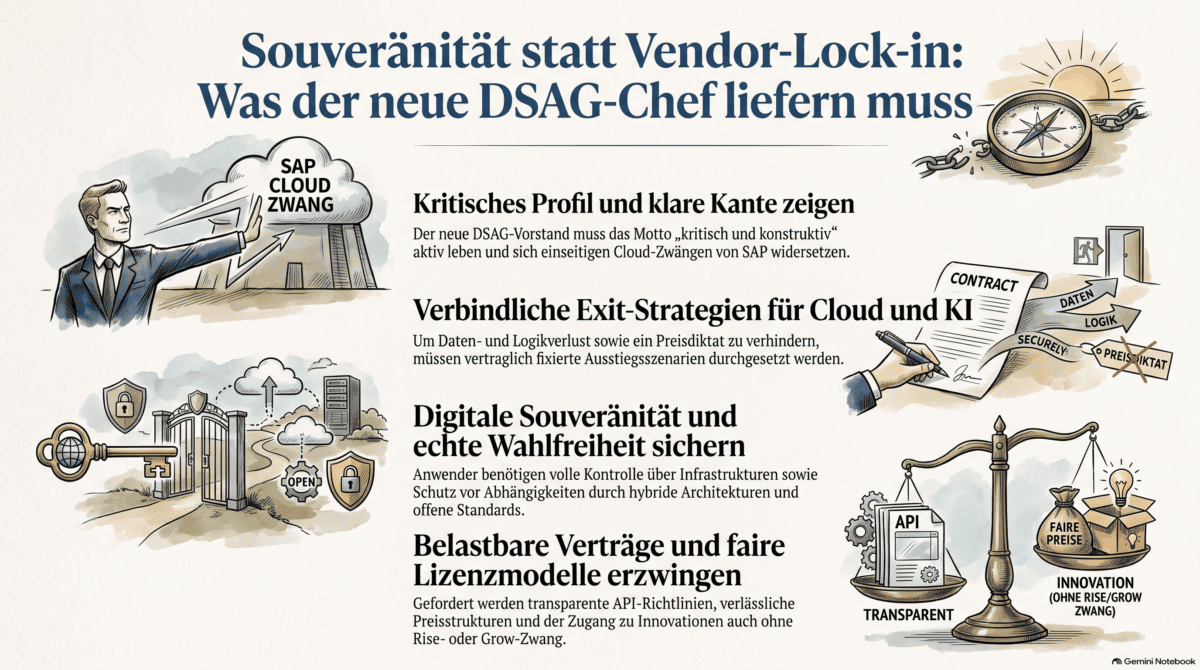
In the coming years, DSAG should transform itself from a mere source of feedback into a robust guardian of digital sovereignty. Where SAP attempts to exclusively lock companies’ semantic knowledge within the BTP/BDC, the user association should insist on open standards, unrestricted data portability, and robust AI and cloud exit strategies. Without the right to leave a cloud system at any time without losing data or functionality, existing customers and DSAG members will become captive taxpayers of SAP’s ERP pricing model.
The 2026 DSAG Annual Conference in Cologne offers members and the SAP community a clear call to action: Don’t let yourself be swayed by vendors’ marketing fairy tales—instead, stake your claim—Claim Your Ground!
DSAG members should take advantage of the Cologne Congress Forum to build vendor-independent networks and independently control the pace of transformation. Existing SAP customers should not allow themselves to be pressured into hasty decisions, whether by the end of support or by cloud-based approaches. Instead, they should explore hybrid or composable ERP approaches.
Existing integrations must be legally and technically safeguarded. Unilateral API restrictions or unpredictable tolling models must not be accepted. Furthermore, artificial intelligence, agentic AI, vector databases, and knowledge graphs must not be exclusively tied to proprietary cloud monopolies but must be based on open standards (such as W3C-RDF, SPARQL, or an MCP server) in order to permanently safeguard the digital sovereignty of DSAG members. We must elect an activist DSAG chairperson!

 Deutsch
  English
  Español
  Français