
Business Data Fabric and Business Data Complexity




SAP Pilot: Data Fabric
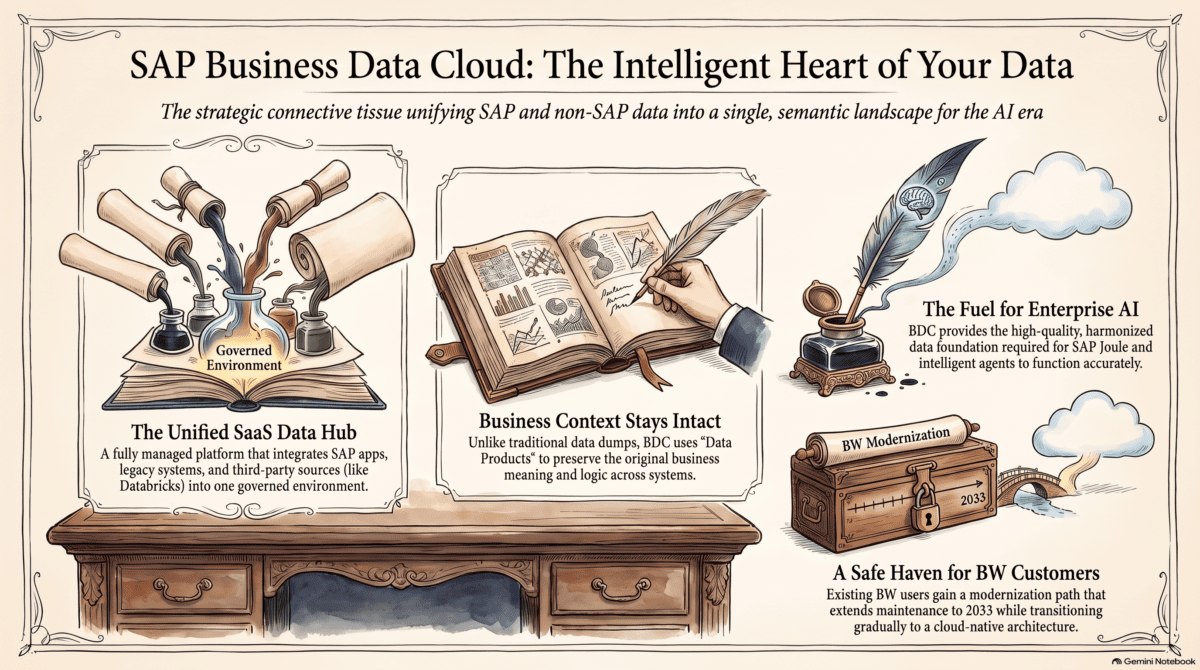
Technically, SAP BDC functions as a so-called Business Data Fabric, which aims to harmonize the fragmented ERP data silos—that have developed over time within enterprise landscapes—between transactional systems such as S/4, SuccessFactors, Concur, or legacy ECC systems, as well as external data sources, and to integrate them into a unified, semantically enriched business context.
From a critical perspective, however, the introduction of the BDC also represents SAP's official admission that earlier in-house developments, such as the resource-intensive SAP Data Hub, have failed in the market and that SAP has neglected the areas of master data management and big data analytics for years.
Databricks, Snowflake, and others.
The most important component of SAP BDC is its partnership with Databricks: Under the name SAP Databricks, the data intelligence and lakehouse platform is directly integrated into BDC. Synchronization is performed via delta sharing through an interface called Zero-copy Connectivity, enabling data engineering, Apache Spark workloads, and machine learning to be executed on SAP data without having to physically copy the data.
This ecosystem is complemented by SAP Snowflake and SAP BDC Connect for Snowflake, which enable existing SAP customers to access data products bidirectionally and in real time and to build AI applications in the Snowflake AI Data Cloud. In addition, the BDC ecosystem offers native integrations with Google BigQuery for scalable cloud analytics, Collibra for enterprise-wide data governance and metadata lineage, Confluent for real-time data streaming, and DataRobot for automated machine learning processes. This partnership strategy marks a shift away from the traditional, rigid Extract-Transform-Load (ETL) approach in favor of a federated data architecture, in which data remains virtually linked at its source.
Business Data Complexity
In practice, however, this theoretical concept has met with considerable skepticism and sharp criticism from the German-speaking SAP user association DSAG. Although former DSAG Chief Technology Officer Sebastian Westphal and DSAG CEO Jens Hungershausen generally view the establishment of a Data-as-a-Product philosophy and the technical openness to established lakehouse architectures as fundamentally the right move, the SAP community derisively refers to the BDC as „Business Data Complexity“ due to its confusing licensing and contractual terms.
A DSAG survey of its member companies reveals a serious lack of awareness and understanding: 31 percent of the companies surveyed were completely unfamiliar with the BDC, and only a meager 15 percent stated that they were truly familiar with the solution. The DSAG strongly demands that the BDC be designed without any commercial restrictions for all existing customers—regardless of whether they operate in the cloud or on-premises. A major controversy erupted at the DSAG Technology Days 2026 in Hamburg when hidden contract clauses were revealed: BDC users are now subject to strict limits on OData API calls (a maximum of 2,000 calls per gigabyte of compute memory) as well as restrictions on OpenSQL data transfers, which represent a significant functional downgrade compared to previous Datasphere usage.
Business Risks with SAP BDC
The commercial structure of the Business Data Cloud poses significant business risks and unpredictable cost pitfalls for the CFO. Billing for the BDC is no longer based on traditional user licenses, but rather on consumption-based Capacity Units (CUs) or credit models such as the Cloud Platform Enterprise Agreement (CPEA) or the BTP Enterprise Agreement (BTPEA).
The latest Rheinwerk book, „SAP Business Data Cloud,“ soberly points out that companies that have migrated existing SAP BW systems to the BDC (BW Private Cloud Edition) require an enormous amount of costly capacity units just to maintain basic operations.
BDC Bill Shock
In addition, the DSAG, together with licensing experts, criticizes the ruthless expiration logic of these credit models: BTP credits paid in advance expire at the end of the contract year without replacement if they have not been used due to a lack of productive use cases, while any unplanned peak load is immediately billed at full list prices.
This cost structure is complemented by the restrictive SAP API Policy and the Digital Access licensing model: Anyone who attempts to export bulk data from the BDC or the core ERP system to third-party systems will be hit with hefty fees, which is why SAP specifically positions the BDC as a monetized toll booth to keep customers locked into its own ecosystem.
SAP Autonomous Enterprise and Knowledge Graph
In SAP’s strategic vision, the BDC serves as the indispensable data foundation for the so-called SAP Autonomous Enterprise. Autonomous AI agents and the AI copilot Joule rely heavily on reliable, semantically enriched data for their decision-making in order to deliver hallucination-free results in the general ledger.
The SAP Knowledge Graph, introduced in the first quarter of 2025, accesses BDC data products and translates the more than seven million data fields and tens of thousands of entities in the S/4 universe into a machine-readable graph model consisting of nodes and edges.
SAP Vendor Lock-in with BAIP
At the Sapphire 2026 Orlando international customer conference, SAP CEO Christian Klein announced the next stage of this evolution: the merger of BTP, the Business Data Cloud, and the AI Foundation into the new SAP Business AI Platform (BAIP). Within this overall framework, S/4 assumes the role of the transactional general ledger (system of record), SAP BTP provides the technical extension infrastructure, SAP BDC—as the Business Data Fabric—orchestrates universal data products across cloud boundaries, and SAP Business AI forms the cognitive intelligence layer for process automation.
For an existing SAP customer, the bottom line is: Although BDC offers a modern architecture for data harmonization, it poses significant risks due to opaque usage fees and contractual vendor lock-in; therefore, IT decision-makers must consistently decouple their data architecture and meticulously review the commercial terms before signing.

 Deutsch
  English
  Español
  Français