
Value-Add-in




From the perspective of critical educational work and journalistic observation of the SAP market, the history and future of GIB serve as a case study in how pragmatic, mid-market expertise can defy the pretensions of lofty corporate architectures.
From an add-on to a value-add-in in the core digital ERP system: GIB’s roots lie in traditional inventory planning and procurement optimization within the SAP R/3 and Business Suite 7 environments. Early on, GIB’s experts recognized that simply delivering software on a „plug-and-play“ basis was bound to fail if silo mentality, information gaps, and conflicting departmental goals prevailed within a company. The self-critical mantra coined in 2006—„With our software, we manage the misery“—marked a turning point: From then on, GIB no longer saw itself merely as a code provider but increasingly took on an advisory and long-term educational role within the SAP community to uncover the „skeletons in the closet“ of the supply chain and break down unhealthy process patterns.
„For us, end-to-end in the supply chain doesn’t primarily mean the technical linking of process steps, but rather the end-to-end operational management from demand to delivery,“ explains GIB Managing Director Björn Dunkel in an E3 interview. „Many companies already have a wide range of integrated systems. The real challenge lies in making the right decisions every day when demand changes, materials are missing, or capacity becomes tight,“ says Björn Dunkel, drawing on his many years of successful work in the SAP community, and he adds: „For GIB, end-to-end therefore means transparency and control throughout the entire supply chain. What matters is not that data flows from A to B, but that the right people can make the right decisions at the right time—or that, in the future, these decisions will increasingly be made automatically.“
The company is making a historic shift this year under the slogan „GIB goes GIB“: The parent company, ifm, has separated the supply chain software division from the rigid corporate structures. GIB is once again operating on the market as an independent, agile software company, while ifm continues to provide strong financial backing as a major shareholder. The revival of the GIB brand marks not so much a technological fresh start as a sharpened market positioning. The transition from a traditional add-on provider to a value-add-in for SAP S/4HANA had already taken place in recent years. However, within the corporate structure, this development often remained unclear to the market. As an independent SAP specialist, GIB can now once again clearly communicate where its strength lies: in the optimization and operational management of complex supply chains directly within the SAP core, based on the same master and transaction data and without the need for additional data silos.
Focus: Supply Chain Essentials
Under the leadership of Björn Dunkel—CEO, visionary, and chief product manager behind the core product GIB SCX (Supply Chain Excellence)—the „new“ GIB is also reorienting itself. Dunkel’s stated goal is to clearly position the company as a specialized software provider with an absolute focus on supply chain essentials and measurable business results. Dunkel rejects rigidly prescribed operating models and advocates a pragmatic, agnostic platform philosophy: The software flexibly adapts to the customer’s preferred operating model—from on-premises to private cloud to public cloud.
In an E3 interview, CEO Dunkel clarifies: „Supply chain planning deals with the question of what optimal supply should theoretically look like. Supply chain management, on the other hand, encompasses the operational implementation and control of day-to-day business. Many solutions on the market today focus on strategic or tactical planning. However, the real added value only arises when a plan is translated into operational actions. That is precisely where GIB’s traditional strength lies. We help companies actually translate plans into operational excellence and implement them directly in the SAP system.“ At the heart of Dunkel’s philosophy are the cybernetic APEO principle (Analyze, Plan, Execute, Optimize) and the user-centered information provision model CLUI (Context-based, Location-based, User-based Information). Instead of overwhelming users with a flood of countless isolated metrics, GIB relies on the GIB-SCX indicator. This indicator condenses process quality top-down into a single control variable and, via guiding systems (guiding functions), provides direct recommendations for action regarding where in the SAP system corrective action is needed. For Dunkel, the human remains the irreplaceable, networked decision-maker (“Human in the Loop”), who is empowered by intelligent heuristics to do the right thing in the right order of priority.
Supplement to the SAP Strategy
In the current era of enterprise resource planning (ERP) software, existing SAP customers are facing a turning point marked by a discrepancy between prescribed ERP architecture and the harsh reality on the factory floor and in logistics centers. While SAP is driving the transition to the cloud and heralding the age of the self-sufficient enterprise (Autonomous Enterprise and SAP Knowledge Graph), those responsible for supply chain management, logistics, and procurement are confronted with a completely different set of complexities: Geopolitical upheavals, fragile global supply chains, unpredictable fluctuations in demand, and the ongoing shortage of skilled workers make mastering intralogistics and cross-organizational value-added processes an existential priority.
Amid these challenges, GIB, a software specialist based in Siegen, South Westphalia, has held an exceptional and prominent position within the SAP community for decades. GIB has historically been deeply rooted in the SME sector within the SAP community and enjoys a high level of credibility among over 1,000 customers with more than 2,000 SAP systems under management worldwide.
„We don’t see ourselves as competitors to SAP, but rather as a complement to SAP’s strategy,“ emphasizes Björn Dunkel. With solutions such as IBP, Ariba, and other cloud offerings, SAP often addresses strategic, cross-organizational, or long-term planning processes. „GIB focuses on the operational supply chain directly within the core ERP system. Our unique selling point is that we start right where thousands of schedulers, buyers, and planners work every day. Our solutions are closely integrated with the SAP core, compliant with Clean Core, and take effect immediately. While other solutions first need to be integrated, orchestrated, and implemented organizationally, our customers are already working productively with our tools directly within their operational processes,“ says CEO Dunkel, speaking from experience gained through many successful customer projects.
Understanding this specific market position requires a close examination of the strategic development the company has undergone. After years of being organizationally integrated into the global automation group ifm, the company carried out a remarkable carve-out this year under the concise guiding principle of regaining its independence. This step back toward independent agility does not mark a departure from its previous values, but rather a sharper focus on the essential requirements of its client companies. For existing SAP customers, this repositioning offers guidance in times when many IT decision-makers are seeking direction in the jungle of SAP IBP, BTP billing models, Clean Core requirements, and unclear AI promises.
SAP Clean Core
And Björn Dunkel clarifies: „For us, Clean Core is not a marketing term, but a fundamental architectural decision. Our strategy is to avoid making unnecessary modifications to the SAP core and instead provide extensions that adhere closely to standards, are upgradeable, and are future-proof. All new developments at GIB are consistently guided by SAP’s Clean Core principles. In doing so, we use modern extension approaches via APIs and cloud-enabled technologies without losing the tight operational integration with ERP processes.“
The “Clean Core” principle implemented by SAP sets a fundamental course for future SCM, logistics, and procurement systems. Over the course of decades, countless customer-specific Z-developments, modifications, and user exits were programmed—particularly in the MM, PP, and SD modules—to accommodate specific business requirements. This historical legacy is now coming back to haunt us, as it blocks a direct migration to S/4 and turns release upgrades into costly large-scale projects. In the logistics sector, a clean core is therefore an absolute prerequisite for keeping systems stable and cloud-ready at all.
GIB tackled this architectural challenge early on and with unwavering determination. As one of the very first ten software partners worldwide, the Siegen-based company received official certification for the Clean Core. Björn Dunkel emphasizes that the commitment to Clean Core does not restrict customers’ freedom to act as they see fit, but rather ensures the protection of system integrity. To obtain this certification, the company’s own software architectures were completely overhauled.
The modern GIB software uses only approved interfaces, avoids unauthorized direct write access to standard SAP tables, and utilizes the ABAP Cloud language version as well as Fiori technologies. As a result, the solutions achieve full compliance with the high requirements of the Level A and Level B architecture standards. For existing customers, this provides absolute peace of mind: Expanding logistics functions via GIB in no way jeopardizes the S/4 system’s upgradeability, regardless of whether it is operated on-premises, in a private cloud, or, in the future, in a public cloud. In collaboration with specialized Clean Core providers, GIB demonstrates how outdated legacy systems can be systematically streamlined without sacrificing the valuable operational planning intelligence.
AI and SCM
„We support customers on their transformation journey, combining process expertise with technical modernization,“ says CEO Dunkel, describing the project approach. „From our perspective, it’s important that companies not only technically migrate existing processes but also actively develop their supply chains further. In doing so, we take a pragmatic approach: standardization where it adds value, and intelligent differentiation where it creates competitive advantages.“
In the current discussion within the SAP community, the topic of AI plays a dominant role. Marketing departments are falling over themselves to use terms like “Business AI,” “Joule,” “Generative AI Hub,” and the concept of the “Autonomous Enterprise.” From GIB’s perspective, however, assessing these developments in logistics and procurement requires a healthy dose of objectivity and rational consideration. AI is not a magical jack-of-all-trades, but rather a mathematical tool for refining structured data.
„AI must generate business value. That’s exactly how we measure every innovation,“ Björn Dunkel explains in the E3 interview. „Today, we see great potential in analyzing complex scheduling situations, prioritizing tasks, and identifying process patterns. A current example is Factory Optimization Excellence, our AI-based solution for intelligent detailed planning and optimization of production control. FOX helps companies dynamically coordinate production orders, resources, and capacities and make better and faster planning decisions based on real-time data.“
Data and Automation
AI and machine learning are particularly well-suited for use in the supply chain in situations where vast amounts of data must be analyzed to identify hidden patterns. These include the automated detection of sales outliers, the dynamic adjustment of safety stock based on historical replenishment fluctuations, and predictive quality inspection at the interface between sensors and production orders.
„Generally speaking, we see AI having the greatest impact where it lightens the workload for operational users in their day-to-day business. It helps make complex relationships transparent, prioritize actions that need to be taken, and provide well-founded recommendations. Humans always remain responsible and retain control over the processes,“ emphasizes CEO Dunkel. „The next step will be the semi-autonomous execution of standardizable processes. AI will take over routine decisions, while users can focus on exceptions, escalations, and value-adding decisions. This requires transparency, governance, and, above all, trust.“
Nevertheless, Björn Dunkel warns against the illusion of a fully self-managing or even self-programming autonomous supply chain. An autonomous system can only perform as well as the quality of the master and transaction data it is fed. If the foundation in the ERP system is flawed, the use of autonomous AI agents will not lead to efficient processes, but merely to a dramatic acceleration of chaos. „Our vision is a supply chain in which users can use intelligent dashboards to see at any time which decisions can be made automatically and where human expertise and contextual understanding remain indispensable,“ Björn Dunkel concluded.
Earlier this year, there was a discussion about whether AI would replace traditional software. Will AI program, manage, and orchestrate better supply chains in the future? Dunkel: „AI will drastically change software development and process control. Nevertheless, successful supply chain excellence will continue to be based on business management knowledge. AI can recognize patterns and make suggestions. However, it does not automatically understand a company’s strategic goals. We therefore expect a symbiosis of human expertise and machine intelligence. The best supply chains will be those that optimally combine both.“
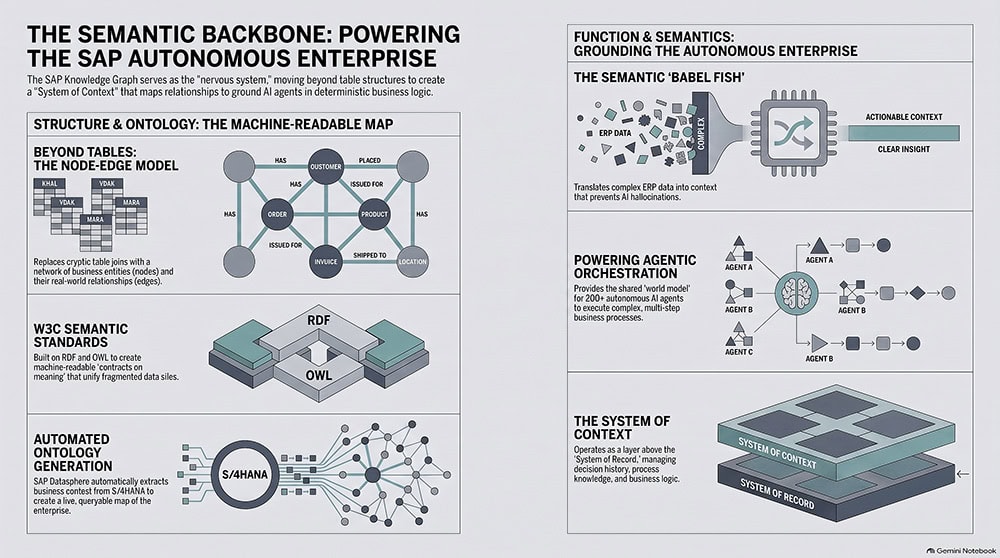
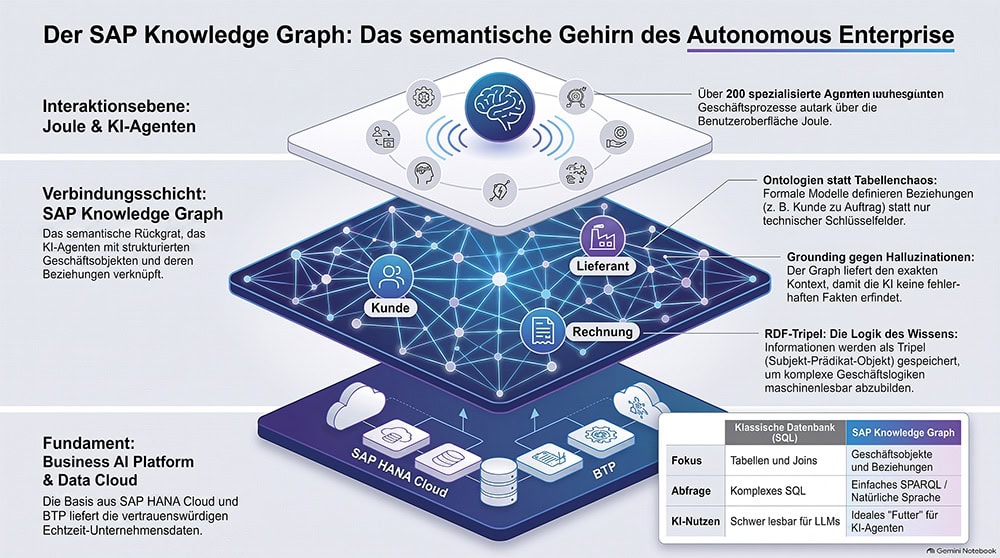
One of the key components of SAP’s new AI architecture is the Knowledge Graph, which is built on the HANA Cloud Graph Engine and serves as the semantic foundation within the Business Data Cloud. The Knowledge Graph bridges SAP’s highly complex and often cryptic metadata model with the natural language models of artificial intelligence. This technology is of significant functional importance for supply chain management, logistics, and procurement.
SAP Knowledge Graph
The Knowledge Graph allows business entities such as suppliers, plants, materials, purchasing contracts, customer orders, and transport routes to be organized into a logical network of relationships. This enables innovative analytical approaches using so-called GraphRAG methods and multi-hop reasoning. For example, if a specialized subcontractor at a foreign location goes out of business, the AI can use the Knowledge Graph to analyze the entire upstream and downstream supply chain in a matter of seconds. It immediately identifies which finished products are affected, which customer orders will be delayed, and which alternative suppliers with valid framework agreements are stored in the system.
When combined with the GIB process indicators, the SAP Knowledge Graph forms the ideal semantic map. The Knowledge Graph ensures that AI agents understand the exact business context and act without making erroneous assumptions, while the GIB-SCX indicator provides the logistical assessment and operational instructions. This prevents AI scenarios from degenerating into isolated gimmicks and instead creates genuine added value for the transparency of the entire value chain.
„We believe in a self-managing supply chain with human oversight,“ explains Björn Dunkel. „Many operational decisions can be automated. At the same time, there will always be situations that require contextual knowledge, experience, and business judgment. Our vision is therefore an autonomous supply chain in which AI handles routine processes and people focus on exceptions and optimizations.“
Simplification and Process DNA
GIB’s future lies in the perfect synthesis of decades of SME process DNA, operational simplification, and modern cloud and AI architecture. GIB demonstrates to the SAP community that true supply chain management must not be stifled in abstract cloud silos, but must take place exactly where the planner makes daily decisions: directly based on data from the core ERP system—transparently, controllably, and with people at the center as confident decision-makers.
„The main challenges remain volatility, a shortage of skilled workers, and increasing complexity,“ says Björn Dunkel, describing the current situation. „Today, many employees spend a significant portion of their time on routine tasks, data analysis, and prioritization. AI will not replace these tasks, but rather transform them. Standard decisions are increasingly being made automatically. The employee’s role is shifting toward managing, monitoring, and handling exceptions. In the future, people will spend less time searching for data and more time making decisions.“
Under the leadership of Björn Dunkel and as part of its organizational independence, the new GIB is positioning itself uncompromisingly as a focused software company concentrating on the essential core tasks of the supply chain. Dunkel’s strategic vision clearly rejects the dogmatism often found in the software industry. Instead of forcing customers into a single operating model dictated by the manufacturer, GIB advocates a platform-agnostic philosophy. GIB’s standard software flexibly adapts to the user’s preferred operating model.
„While many market solutions plan, analyze, or orchestrate outside the core operations, we work directly where decisions about material availability, supply security, and delivery capability are made on a daily basis. Our focus is on In-Stack, Clean Core, and operational excellence,“ summarizes Björn Dunkel. „We view BTP and BDC as valuable technologies that we deploy where they create tangible added value. However, we do not pursue a “BTP-first’ approach. What matters most to us is proximity to the operational processes and users.”
The reference architecture of the future therefore consists of an S/4 core with GIB serving as the operational control layer for the supply chain. AI supports users in routine tasks, prioritizes actions that require attention, and automates standard decisions. „People focus on exceptions, escalations, and value-adding decisions. This is precisely where we see the future of supply chain excellence in the SAP environment,“ says CEO Dunkel.
In summary, GIB’s future role in the SAP community can be described as that of an indispensable, cybernetic anchor for small and medium-sized businesses. Björn Dunkel’s statements and strategy distill the insights gained from over three decades of logistics experience into a clear, pragmatic vision for the future. GIB emerges stronger from the organizational carve-out and is leveraging its newfound independence to address, as an agile software company, the most pressing questions of user companies in the areas of SCM, logistics, and procurement.
„For many companies, ensuring the continuity of business operations was the top priority. Actual process innovation was deliberately postponed to a second phase. This is precisely where we currently see great potential. True value creation does not come from the technical migration alone, but from leveraging the opportunities offered by S/4, modern user interfaces, clean-core architectures, and AI-based assistance systems. For many companies, this is now the phase where a technical conversion becomes a true business transformation,“ says Björn Dunkel, looking ahead.
Economic benefits
Björn Dunkel’s vision is based on three unshakable pillars. The first pillar is an unwavering focus on the essential core requirements of logistics and measurable business benefits. The second pillar is the consistent adherence to the Clean Core principle, which guarantees customers the ability to upgrade their S/4 systems and builds a secure bridge to any cloud environment. The third pillar is the commitment to the central role of people, who—empowered by modern technology, clear metrics, and guided processes—are able to confidently master the complexity of the modern supply chain.
„Our strength lies in modernizing operational supply chain processes step by step, thereby creating immediately measurable benefits in day-to-day business. After all, a successful S/4 transformation isn’t achieved simply when a new system goes live, but rather when dispatchers, buyers, production planners, and supply chain managers can work better, faster, and more efficiently than before. That is why we expect to see a shift in the coming years from pure system modernization toward operational excellence. And that is precisely where GIB’s strength has traditionally lain,“ CEO Dunkel concludes.
And where does Björn Dunkel see GIB’s customers in 2030? „By 2030, most of our customers will be running S/4 and will have established Clean Core architectures. The operational supply chain will be significantly more automated than it is today. AI agents will handle routine decisions. Users will interact with the systems via modern dashboards, digital assistants, and natural dialogs. GIB will serve as the bridge between SAP technology and operational reality. Our goal is clear: We want to be the leading provider of supply chain excellence in the SAP environment. Not by using as much technology as possible, but by using technologies that actually make a difference in day-to-day business. Clean Core. On-Stack. Operationally effective. With AI where it creates real added value.“
To the partner entry:



 Deutsch
  English
  Español
  Français