
Study: Team building between man and machine

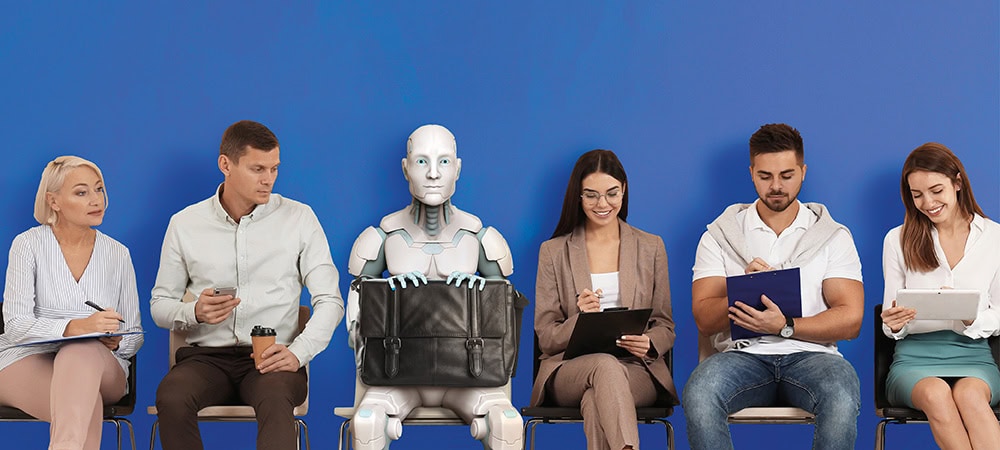


At management level, far-reaching changes to the world of work are expected as a result of the influence of AI - and this will happen in the near future. Employees will have to learn to work side by side with AI agents. And the role of managers will also be redefined. How can humans and machines work together successfully? Together with the Handelsblatt Research Institute (HRI), Valantic asked more than 1,000 decision-makers from companies in the DACH region how AI will change the world of work, markets and companies in the coming years. There seems to be broad agreement on the direct benefits that the use of artificial intelligence will generate in companies: 79% of those surveyed believe that companies that do not consistently integrate AI into their core processes and business models will lose their competitiveness by 2030.
Creativity, empathy, ethics
The „Digital Excellence Outlook - AI at Scale“ study shows that the requirements for human skills in the world of work will change fundamentally by 2030. While analytical and operational tasks will be increasingly automated by AI, 80 percent of the decision-makers surveyed see creativity, empathy and ethical judgment as the most valuable skills of the future. These human skills will not only be crucial for differentiation in an increasingly automated world, but will also become central building blocks for innovation and sustainable corporate success. 82% of respondents are convinced that AI will have a significant influence on decision-making in companies by 2030.
In this scenario, the role of managers will be greatly transformed - away from traditional decision-making processes and towards the critical review of intelligent AI systems. At the same time, the heavy reliance on AI is seen as a challenge: 67% of respondents warn that key human skills such as problem solving, innovation and entrepreneurial thinking could be lost due to automation, which could affect the competitiveness of companies in the long term. Another key change is the introduction of new leadership roles: Four out of five respondents, for example, are convinced that companies will need dedicated AI leaders - such as Chief AI Officers or Agent Workforce Leads - in the coming years to strategically manage the economic and ethical benefits of AI. „Our joint study with the HRI clearly shows that AI will fundamentally change the world of work - not only by automating routine tasks, but also by reshaping decision-making processes and management tasks,“ explains Laurenz Kirchner, Managing Director and Head of the Data and AI Practice at Valantic. „The real challenge is to combine technological progress with the targeted promotion of human skills such as creativity, empathy and ethical thinking. Only companies that take responsibility for the impact of AI seriously will be successful in the long term.“

„AI will fundamentally change the world of work, including through the reorganization of decision-making processes and management tasks.”
Laurenz Kirchner,
Managing Director,
Valantic
People as a competitive factor
The study makes it clear that AI will revolutionize the world of work in the coming years. Managers see AI as the driving force behind the automation of operational tasks and the transformation of business decisions. At the same time, they call for a conscious approach to the risks that dependence on AI can entail. Human skills - from creativity to empathy - could become a decisive competitive advantage. It is up to companies to maintain a balance between technological progress and the promotion of human skills and to adapt strategically to the ethical and economic challenges of the AI age.
To the partner entry:



 Deutsch
  English
  Español
  Français