
SAP Maintenance: The New Win-Win Situation



Threat of Punishment and the SAP Compromise
Faced with the threat of fines of up to 10 percent of its global annual revenue, SAP was forced to issue far-reaching commitments that are legally binding for ten years: Until now, SAP had prohibited the mixing of support models from different providers for various parts of the system landscape, refused to allow the termination of maintenance contracts for unused software licenses, and demanded exorbitant reactivation fees following a temporary suspension of support.
As a result of the EU decision, this maintenance monopoly has now officially been lifted: Customers may now flexibly use third-party maintenance providers such as Rimini Street for legacy ECC systems while remaining with SAP for strategic S/4 infrastructures, and are granted the right to terminate unused licenses in an orderly manner in the event of business downsizing or failed implementations.
SAP Repair Service Procedures for Legacy Systems
But despite all the euphoria in the SAP community, a critical analysis reveals the deeper, business-related implication of this compromise: SAP has made a concession to the European Commission regarding a technical product that is being phased out and is rapidly losing its strategic importance anyway as part of the cloud transformation.
Since support is firmly bundled into the subscription price for the new cloud subscriptions (SaaS), the much-touted freedom of choice in the future of the cloud remains, in effect, firmly locked away. Ultimately, SAP’s concession will only pay off for existing ECC customers who want to continue operating their on-premises systems in their own data centers beyond 2035.
ECC Maintenance vs. S/4 Subscription
For existing customers who give in to intense sales pressure and migrate to the SAP Private Cloud (SAP Cloud ERP Private), a highly complex cost trap—one that is often not fully addressed in the contract—awaits them in the areas of licensing fees and system monitoring.
In the private cloud world, companies are irrevocably moving away from the ownership-based on-premises model and entering into fixed-term rental agreements based on Full Use Equivalents (FUE). These cloud licenses are billed and monitored using automated metering methods such as Private Cloud Automated User Metering and the associated entitlement calculation.
Automated User Metering and Entitlement Calculation
The serious risk for existing customers lies in the fundamental change in the licensing model: While on-premises licenses were primarily based on actual usage in the past, cloud metering is strictly based on assigned permissions.
Since permissions in historically evolved ECC environments were often granted generously and without oversight for reasons of administrative convenience (excessive permissions), an unprepared migration risks causing a cost explosion of 50 to 150 percent. As soon as an occasional user is assigned far-reaching roles by the system, automated metering classifies that user as an expensive Professional or Advanced user, which depletes the valuable FUE pool in the blink of an eye.
Since exchanging on-premises licenses for cloud subscriptions is a one-way process under the terms of the contract, failed transformation projects ultimately find themselves facing the ruins of their ERP system—stripped of their former rights and left defenseless against the pricing dictates of the Walldorf-based company!
The STAR Rules
The technical spearhead for enforcing this authorization-based regime is the STAR (S/4 Trusted Authorization Review) framework marketed by SAP, which is used in remote audits to validate user classifications. However, this seemingly objective audit tool poses risks for existing SAP customers.
Facts researched by the E3 editorial team show that the STAR framework is a deeply unfinished and flawed construct. For example, the algorithms in the STAR report contain serious substantive flaws, causing, for instance, a user with extensive SAP_ALL permissions to be incorrectly classified as a more cost-effective „Functional Use,“ while elsewhere, mere read permissions (display values such as „03“) are incorrectly classified as active, expensive write interfaces (“Engine Use”).
The greatest risk, however, stems from the dynamic nature of the regulatory framework: SAP revises and modifies the STAR criteria on a quarterly basis and entirely at its own discretion. While on-premise customers can specify a particular, advantageous STAR version (such as version 1.67) in their existing contracts with forensic precision, this is impossible in the private cloud. Here, SAP performs the system assessment fully automatically using the STAR rules in effect on that particular day.
Users who have not been manually classified are automatically categorized by SAP during the system assessment according to the latest—and often more restrictive—STAR guidelines, which completely undermines the CFO’s ability to plan the IT budget. Existing SAP customers should therefore never blindly rely on SAP’s STAR self-assessment, but must proactively clean up and redesign their own role and authorization concepts according to the principle of least privilege before any upcoming migration or system assessment. Only by utilizing independent software asset management (SAM) tools and external, specialized licensing and legal counsel can companies effectively counter the threat of being stifled by automated cloud assessments and preserve their business autonomy.
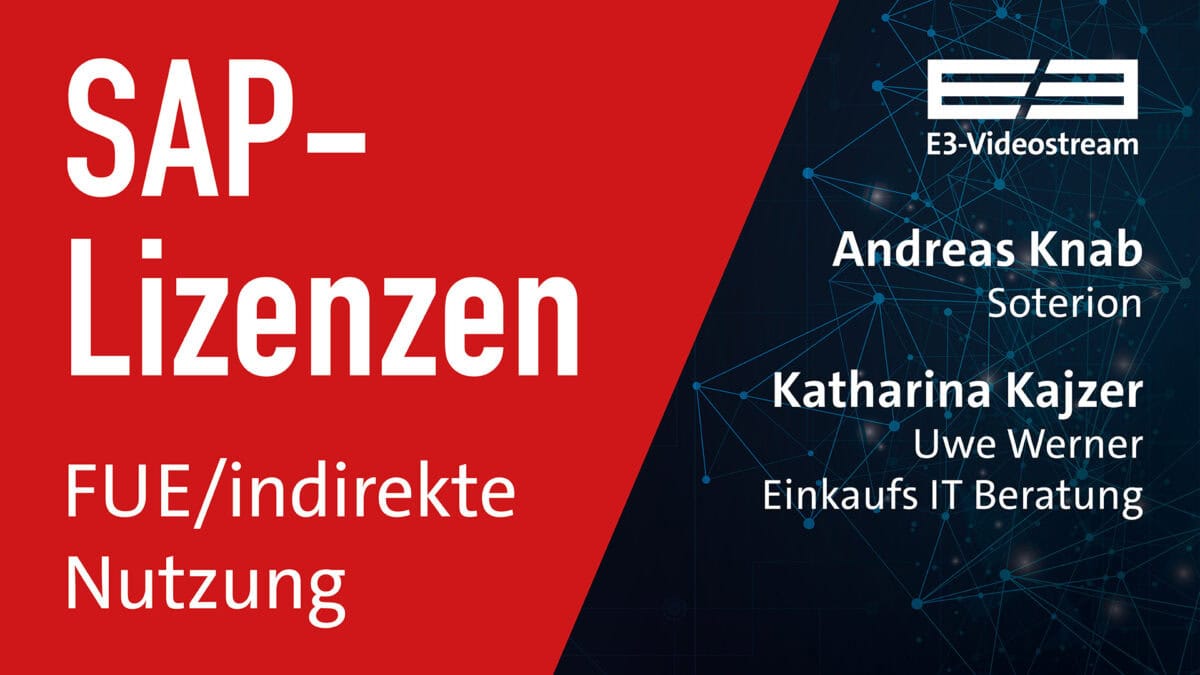
In an E3 roundtable livestreamed on YouTube and LinkedIn on June 22, 2026, we will discuss the new licensing and maintenance situation with Andreas Knab from Soterion and Katharina Kajzer from Uwe Werner Einkaufs-IT-Beratung; see https://www.youtube.com/live/iFPzKOVI4rg?si=XnEMMAmOsUBGkQqk

 Deutsch
  English
  Español
  Français