

SAP Clean Core with Open Source: Curse.org




SAP ABAP Test Cockpit (ATC)
While SAP constantly insists that the digital core of S/4 HANA must remain untouched, existing customers are faced with mountains of custom code (Z-developments) that have accumulated over time and cannot simply be eliminated with the click of a mouse. The standard testing tool, ATC (ABAP Test Cockpit), often proves to be a merciless and inflexible judge in practice. It floods developers with an avalanche of warnings as soon as they access SAP-internal objects for which SAP itself does not provide a stability guarantee—even if these accesses have been running stably for decades and are absolutely non-critical to the customer’s business processes.
Faced with this architectural dilemma, SAP has released a tool whose name borders on real-life satire: Project Kernseife. From a critical perspective, this tool represents SAP’s official admission that its own standard measurement methods for the Clean Core are too crude, too bureaucratic, and simply impractical for real customer projects. SAP has, in the truest sense of the word, developed „soap for the dirty core“ to make the enormous problem of technical legacy debt measurable and manageable in the first place.
Open Source: Curd Soap on GitHub
From a technical standpoint, the Kernseife project is an open-source tool released in May 2025 that is made available free of charge to existing SAP customers via the GitHub development platform (at github.com/SAP/project-kernseife).
The goal of this project is to improve the measurement and control of the Clean Core guidelines and make them manageable for development teams—particularly in terms of extensibility within S/4 Private Cloud and on-premises systems.
The tool fills a functional gap in the standard ABAP Test Cockpit by extending SAP’s rigid testing framework with a custom classification system. Project Kernseife essentially consists of two components: a customized ATC test run based on the official SAP Clean Core tests; and a flexible evaluation matrix that allows developers to define their own classifications for ABAP objects.
ABAP and Clean Core Autonomy
The key advantage for existing SAP customers is that they regain control over the assessment of their code: If ATC flags access to an internal SAP object as a dangerous violation by default (which leads to a flood of warnings), but SAP itself does not provide granular information about this object, the company can use the Project Kernseife to define: In our specific business context, this access is stable and permissible. In this case, the tool overrides SAP’s blanket warning, thereby preventing developers from being overwhelmed by an endless flood of false positives.
Governance and Clean-Core Orchestration with Curd Soap
Curd soap doesn’t fix code; it just makes the mess manageable: It would be a fatal fallacy to believe that using Project Curd Soap automatically cleans up the system. The tool is purely a measurement and governance instrument. It simply shows ECC users more precisely how “dirty” the core actually is and where the real, blocking risks (Level-D modifications) lie, while harmless legacy issues are neatly filtered out. The costly work of code cleanup and refactoring must still be performed by ABAP development teams manually or via third-party AI platforms such as Nova Intelligence or West Trax.
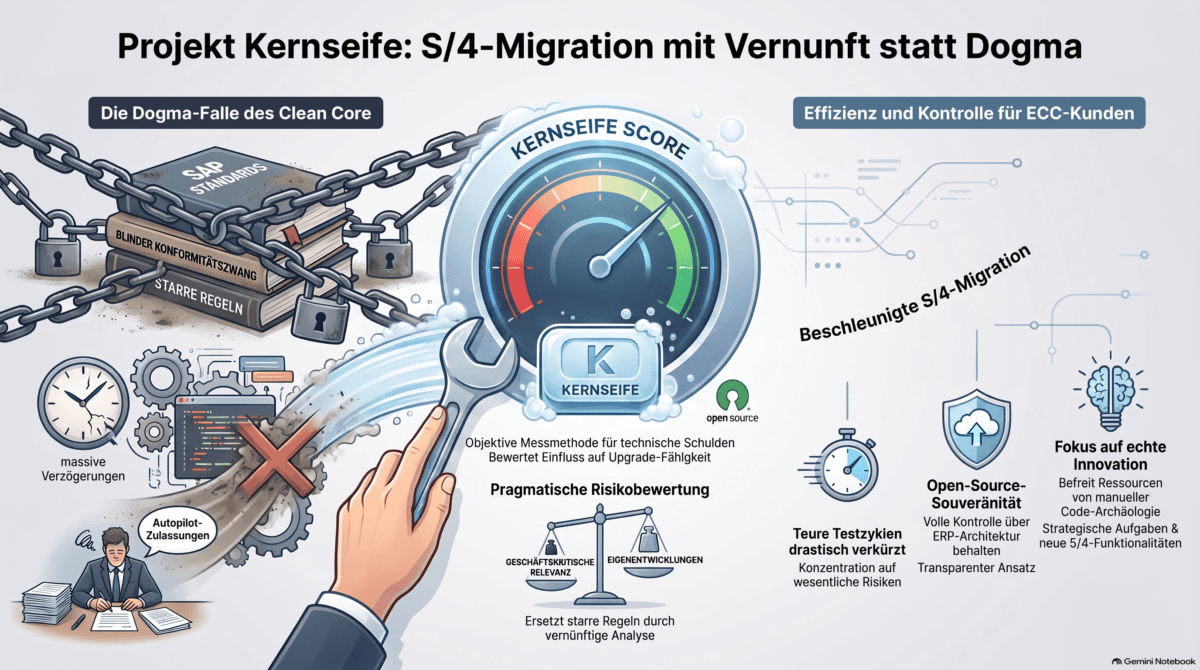
Implementing Project Kernseife requires a functioning Customer Center of Expertise (CCoE) or a strong internal governance structure. Since the tool is based on customer-specific classifications, it is essential to define who within the company has the authority to permanently tolerate an SAP warning. Without a clear approval process and qualified tool administrators, Project Kernseife risks becoming an excuse that developers use to evade the painful but necessary Clean Core requirements by simply silencing critical findings via custom entries.
Journey to the SAP Cloud
The promise of a smooth transition to the SAP Cloud has become one of the most costly myths in modern ERP history among the executive suites of German companies. Under the catchy marketing slogan “Rise with SAP,” the software company touts its S/4 Cloud Private Edition as a risk-free intermediate step for all existing customers who want to combine the technical depth of an on-premises solution with the supposed benefits of cloud computing.
But there is a meticulously crafted web of commercial pitfalls and financial strangleholds that very quickly transforms the alluring cloud into a cost trap that threatens a company’s very existence. From the SAP community’s perspective, it is essential to deconstruct the mechanisms of this private cloud trap so that existing S/4 customers do not unwittingly slide into financial dependence.
The architectural breaking point of this transformation begins right at the commercial foundation: the transition from a one-time capital expenditure (CapEx) to ongoing recurring operating expenses (OpEx). In the traditional on-premise world, existing customers acquired perpetual ownership of their software licenses. Even if a company decided to terminate its expensive maintenance contract with SAP, the legal right to use the core ERP system remained securely locked away in the company’s safe forever.
RISE with SAP
However, by joining the Rise program and agreeing to the associated contract conversion, the customer irrevocably surrenders this valuable asset to the “Gates of Heaven.” They transform from a proud owner into a defenseless tenant whose rights of use abruptly expire at the end of the contract term. Should the company one day be unable or unwilling to pay the rapidly rising cloud subscription fees, there is a risk of losing all control: Once the contract ends, the customer is left with nothing but the raw, unstructured data on the hard drive. Without the associated SAP algorithms—which remain in the cloud—this data is completely worthless for business analytics and day-to-day operations. SAP simply does not provide for a cloud exit.
This new licensing model is governed by the opaque metric of Full Use Equivalents (FUE). SAP likes to present this model as a flexible breakthrough that allows companies to dynamically shift licenses back and forth between different user types—such as Core or Advanced users—within a predefined value pool. However, the devastating cost trap lies hidden in the new measurement method!
Cloud Metrics, STAR, and TCO
While in the traditional ECC environment, licensing was based on the actual, measurable use of the software, in the S/4 Cloud environment, SAP bases its calculations solely on the authorizations assigned within the system. Since permissions have been granted generously and unchecked over decades in organically grown IT landscapes, this permission-based scan leads to massive over-licensing in the event of an unprepared migration. Independent experts strongly warn that this new cloud metric can drive up licensing costs by an alarming 50 to 150 percent, as even occasional users are charged for expensive Professional or Advanced licenses, simply because the system has assigned them broad roles.
The STAR service offered by SAP (S/4 Trusted Authorization Review) offered by SAP turns out to be by no means a neutral optimization tool, but rather an automated classification tool that assigns unclassified users directly to the most expensive license type and thus serves as a lever for costly retroactive licensing.
Another commercial constraint is the contractually stipulated pricing structure. The TCO calculators offered by SAP suggest a stable long-term cost structure, but the fine print omits the automatic annual fee increase of a fixed 3.3 percent, which is listed on the order form according to the principle of a sliding-scale rent.
Over the course of a standard five-year contract, this seemingly small markup adds up to a massive cost increase of nearly 18 percent. But the financial impact reaches its peak when it comes to business-critical system availability.
Service Level Agreement
If the 99.7 percent Service Level Agreement (SLA) included in the SAP standard is not sufficient for existing S/4 customers—for example, because a system outage costs millions every minute in a global just-in-time production, every minute of system downtime costs millions—and if they demand an increase to the industry-standard 99.9 percent, SAP strikes ruthlessly. For this minimal 0.2 percent increase, the company demands an astronomical 50 percent surcharge on the total recurring annual net contract fee for all affected products. For a moderate system landscape with an annual Rise license value of one million euros, this translates to additional, recurring costs of a whopping half a million euros per year—a price-performance ratio that is unparalleled in the entire IT industry.
The situation becomes particularly dire when existing Rise customers consider the project risks associated with an S/4 migration: Here, SAP is forcing its customers to make a risky double payment! The customer must pay for both the conversion service and the ongoing cloud subscription. If unforeseen complications, an acute shortage of skilled personnel, or even a complete halt to the project arise during the course of the project, the ruthless harshness of the cloud contract becomes apparent.
While SAP may, as a gesture of goodwill, waive part of the conversion service fees if a project is canceled, the customer remains contractually obligated to pay the full monthly cloud subscription fee for the unused systems. In this scenario, the existing customer is left facing the ruins of its IT infrastructure: A return to the on-premises world is impossible, as the licenses have already been converted and destroyed, and moving forward into the cloud is blocked due to the failed migration project, while the monthly subscription fees continue to accrue inexorably.
New Technology with Old Problems
This system is accompanied by an uncompromising requirement to use the HANA database. Customers who have operated their ERP systems cost-effectively and reliably for decades on third-party databases such as Oracle or DB2 are facing a sudden and unwelcome change when they migrate to the private cloud: SAP does not recognize the value of their existing database licenses, which expire without replacement, while at the same time a hefty surcharge—usually 15 percent—is imposed for the HANA Runtime Database.
Anyone who also attempts to flexibly connect their data streams to third-party systems or modern AI platforms within a networked supply chain immediately encounters the next toll booth known as Digital Access. Since this indirect use is generally not included in the Rise Private Cloud, every document created via interfaces must be licensed separately. Anyone who wants to avoid this is forced to use the Business Technology Platform (SAP BTP) and the Business Data Cloud (SAP BDC). There, however, users are met with opaque credits that must be paid for in advance and expire at the end of the contract year if unused, while any overage is relentlessly billed at expensive list prices.
From a business perspective, SAP claims that the Rise package in the private cloud can reduce the total cost of ownership (TCO) by up to 20 percent compared to a traditional on-premises installation. However, this claim rarely stands up to detailed scrutiny, as it is usually based on unrealistic assumptions about inefficient in-house data center costs. In reality, the move to the private cloud represents a financial transformation in which existing capital expenditures (CapEx) are converted into ongoing, recurring operating expenses (OpEx). For existing SAP customers, this process is effectively irreversible. By signing the cloud contract, the ERP user relinquishes their valuable, perpetual on-premises usage rights and exchanges them for a volatile lease arrangement, under which—in the worst-case scenario following termination—they are left with useless raw data without SAP’s interpretive algorithms. The path to the S/4 Private Cloud Edition thus proves to be a business minefield on nearly every level. Anyone who trusts the promises of SAP salespeople without a well-founded IT strategy, without specialized legal advice, without independent license measurement tools, and without a solid foundation is not only giving up their digital sovereignty but also risking an uncontrollable explosion in the Total Cost of Ownership for years to come.
 Deutsch
  English
  Español
  Français
1 comment
Harald Post
Hallo Herr Färbinger,
Danke für diesen sehr schön lesbaren Artikel! Die geschilderten Risiken wirken schon beim Durchlesen, als wenn man einen Strick um den Hals gelegt bekommt. Tolle Software, ohne Frage! Aber der Betrieb verschlingt deren Ratiopotenzial u. U. über adäquates Maß. Der Break Even Point, ab dem sich das nicht mehr lohnt, scheint da tatsächlich nicht mehr weit zu sein..
Harald Post