
Operate with confidence. Make sound business decisions.




What matters is not the label, but whether the operating model aligns with the system architecture, transformation strategy, and business objectives.
With SAP S/4HANA, many companies face a twofold challenge: they must modernize their processes and applications while also determining how their future system landscape should be operated. Public cloud, an on-premises data center, and managed hosting differ not only in technical terms; they also influence costs, responsibilities, dependencies, and the company’s operational flexibility for many years to come.
Looking at Cloud Costs from a Long-Term Perspective
Cloud platforms enable rapid deployment and flexible scaling. In practice, however, it can be difficult to plan for ongoing costs. In addition to compute and storage, data transfer, backup, high availability, security services, monitoring, and support all contribute to the total cost. As data volumes or performance requirements increase, the cost structure changes as well.
A robust comparison must therefore not be limited to individual infrastructure costs. What matters is the total cost of operations over the intended period of use. This includes SAP Basis administration, database and operating system management, patch and release management, disaster recovery, on-call support, and internal management overhead.
Predictable IT budgets are essential, especially for small and medium-sized businesses. An operating model must allow for scalability without losing control over costs. What matters is not only how quickly resources become available, but also how transparent and stable the costs remain over several years.
Assessing Vendor Lock-in Realistically
When choosing a platform, companies are making a strategic decision. The more closely the architecture, interfaces, operational processes, and management tools are tailored to a particular provider, the more difficult it may be to switch later on.
Vendor lock-in isn’t caused solely by technology. Contract models, proprietary services, and locked-in operational knowledge can also limit the portability of an SAP landscape. Autonomy, therefore, does not mean providing every service yourself. It is demonstrated by the ability to continue choosing the location, service provider, and contract model based on your own requirements.
The customer's own SAP licenses form an important foundation for this. Technical operations can be outsourced to a specialized provider, while decisions regarding service levels, costs, and further development remain with the company.
"On-premises" does not necessarily mean "self-operated"
"On-premise" is often equated with servers located on a company's own premises. For modern SAP environments, this definition is too narrow. "On-premise" can also mean that a company uses its own SAP licenses and retains control over its operating model, while infrastructure and technical managed services are provided by an external partner.
SAP S/4HANA then runs, for example, in a hosting provider’s data centers. The customer does not need to maintain its own hardware or set up a full-fledged 24/7 operations organization. At the same time, the system landscape is not necessarily tied to a public cloud or subscription model. This allows companies to combine operational relief with strategic control.
Whether this model is suitable depends on the initial situation. System sizing, data volume, interfaces, availability, as well as recovery time objective (RTO) and recovery point objective (RPO) must be considered, along with security, compliance, and governance requirements. This results in a robust target operating model.
Technical Managed Services as the Operational Foundation
Professional SAP hosting involves more than just compute, storage, and networking. To ensure stable operation, the infrastructure, SAP Basis, and IT service management must work together seamlessly. This includes monitoring, patch and release management, backup and restore, high availability, disaster recovery, security monitoring, and database and operating system management. On-call support, a service desk, and defined service level agreements round out the range of services. By outsourcing these tasks, internal IT teams can focus more on business processes, applications, and transformation projects. This is particularly important because SAP specialists are in short supply, while demands for cybersecurity, system availability, and response times are increasing.
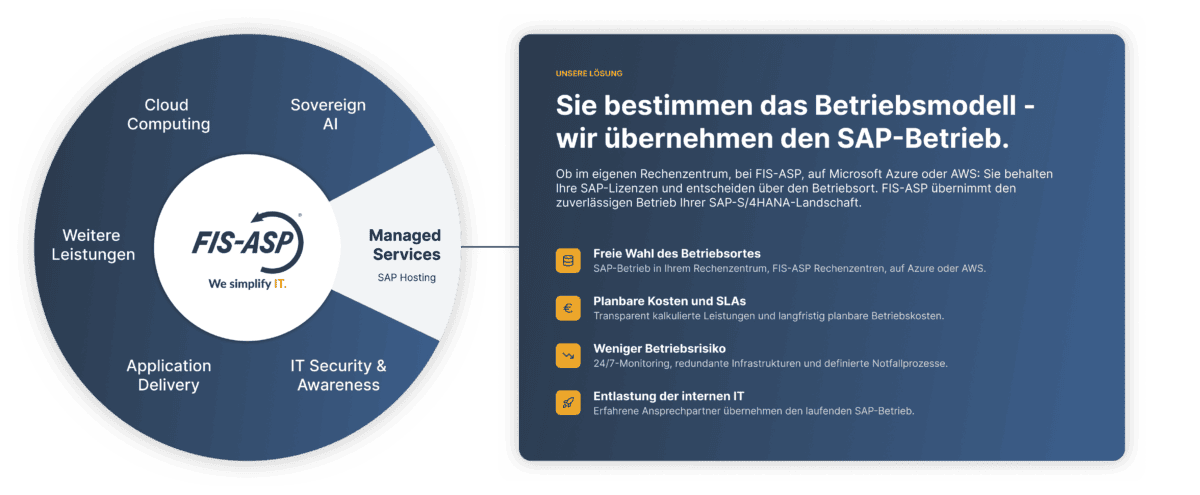
„SAP hosting must fit your company, your SAP landscape, and your IT strategy—not the other way around.“ By Christoph Kleinhenz, Managing Director, FIS-ASP.
FIS-ASP operates SAP environments in its own data centers and provides infrastructure and technical managed services for SAP S/4HANA. More than 1,000 SAP systems under management and approximately 60,000 hosted users form the operational foundation. Operations and support are available around the clock. ISO 27001, ISO 27017, ISO 9001, and ISAE 3402 provide a transparent framework for information security, cloud security, quality management, and controlled operational processes.
Economic efficiency requires planning certainty
An SAP operating model must function technically and remain economically viable in the long term. With SAP hosting in FIS-ASP’s data centers, price stability can be agreed upon for five years. This creates a solid foundation for budget planning. At the same time, it eliminates the need for investments in your own data center infrastructure and the establishment of a complete operational organization.
Whether there is a cost advantage must be assessed on a case-by-case basis. The number and type of systems, data volume, performance, availability, and scope of managed services determine the effort involved. An SAP hosting cost analysis can use these parameters to provide an initial cost range and establish a factual basis for decision-making.
Companies should therefore not begin their SAP strategy by asking the general question of whether the cloud or on-premises is better. A more productive question is which operating model meets the requirements for cost-effectiveness, security, availability, and control.
Sovereignty does not come from running everything yourself. It comes from the ability to realistically assess dependencies and maintain your own scope for action. This is precisely what a future-proof SAP operating model should be measured against.
To the partner entry:

 Deutsch
  English
  Español
  Français