
Recommendation for a Hybrid Platform Strategy

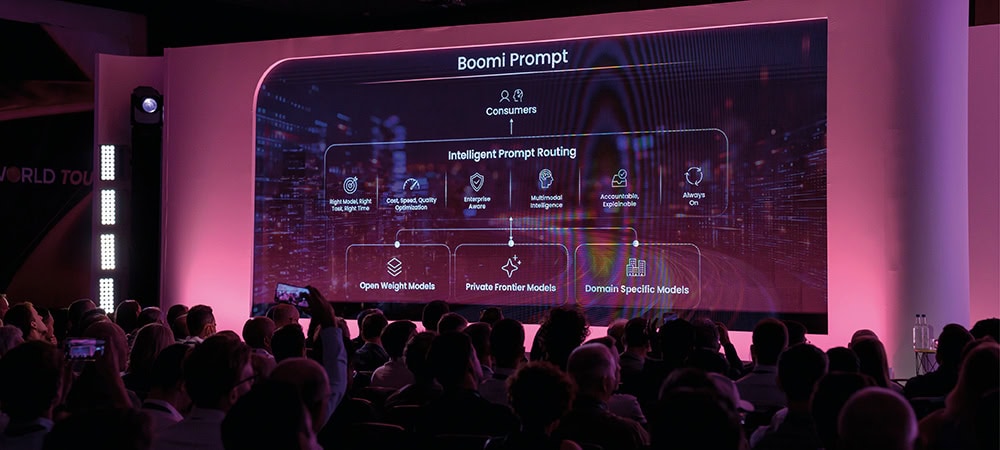


The push for standardization that SAP is championing under the banner of “Clean Core” presents existing SAP customers with an existential dilemma: How can urgently needed innovations be implemented when the digital core becomes untouchable and the company’s own system is blocked by Z-code that has accumulated over decades? Amid this tension, the Boomi integration and automation platform positions itself as an alternative to—and a complement of—SAP’s in-house tools.
Boomi’s Integration Platform-as-a-Service (iPaaS), ranked as a market leader by Gartner analysts, is a fully managed cloud service designed to orchestrate data silos and divergent data streams across system boundaries. To this end, the Boomi Enterprise Platform combines essential integration and automation tools into a single, unified architecture that includes not only traditional system integration (Boomi Integration) but also dedicated API management, EDI management for complex supply chains, the Boomi Master Data Hub, and workflow automation via Boomi Flow.
A strategic milestone in overcoming technical hurdles was the acquisition of data integration specialist Rivery, which enabled Boomi to integrate Change Data Capture (CDC) and Extract-Transform-Load (ELT) capabilities into its platform. As a result, Boomi is now able to retrieve real-time data from complex systems, semantically process it without the need for complex physical replication, and feed it in a controlled manner into modern cloud data lakes such as Snowflake or Databricks. As Donna Matthews, AI and SAP Alliance Manager at Boomi, personally explained in an analysis for E3 Magazine, companies should consider switching to an independent provider like Boomi primarily because the platform offers deep unification, combining integration, automation, data management, and API management into a single system. From the perspective of an existing SAP customer, this cloud-native system resolves the problem of digital fragmentation that ERP users face when they attempt to painstakingly piece together offerings from various IT providers.
Cloud-Native ERP Architecture
Boomi defines the term “platform” very precisely as a cloud-native, independent system built on distributed IT architectures that ensures the seamless connection of processes, databases, and workflows in both on-premises and complex multi-cloud environments. It is this technical agility that allows Boomi to respond extremely quickly to market changes and deliver tangible solutions, rather than putting customers off with theoretical future concepts or vague release promises, as Matthews critically points out. A natural next step in this platform philosophy was, consequently, the expansion into the area of master data management to holistically ensure the quality and consistency of enterprise data.
From an ERP analyst’s perspective, Boomi’s greatest value for existing SAP customers lies in reducing complexity, dependency, and the associated costs. While existing SAP customers have traditionally had to hire expensive ABAP developers or BTP consultants for every minor customization, Boomi breaks this monopoly through a consistent low-code and no-code philosophy.
Case studies from the global SAP community show that, after just three days of training, IT teams are able to tackle complex integration and automation tasks on their own, without relying on legions of external consultants. Furthermore, economic reality shows that Boomi reduces integration time from several weeks to just a few days and cuts implementation costs by an average of 41 percent. For existing SAP customers, this means a significant reduction in the total cost of ownership (TCO), as older, fragmented middleware solutions are consolidated and expensive, high-maintenance in-house developments within the core ERP system become obsolete. Instead of tying up valuable IT resources in the constant repair of error-prone interfaces, companies regain the much-needed agility to automate business-critical processes—such as order-to-cash or logistics planning—across system boundaries in real time.

„Change happens only this quickly,
how trust is built. When there are countless
If there are employees, who keeps track of everything?
”Who leads them? How do you build trust?"
Steve Lucas,
Chairman and CEO,
Boomi
In a direct comparison to the Business Technology Platform (SAP BTP), Boomi positions its offering not as a competitive threat, but as a strategic complement. In an E3 interview, Donna Matthews emphatically stresses that Boomi extends the functionality of SAP BTP by providing vendor-neutral integration capabilities that drastically accelerate and simplify the flow of data between SAP and non-SAP applications. This coexistence is of vital importance to existing customers, especially given that SAP plans to phase out its central on-premises solutions by 2027.
The certified Boomi for SAP Connector forms the technical core of this alliance. It enables direct access to core functionalities via OpenAPIs, queries SAP tables, processes IDocs, and manages BW data. The invaluable operational benefit for SAP users is that this abstraction layer allows even non-ABAP developers and IT generalists to design and implement complex integrations on their own, without needing in-depth knowledge of the notorious and highly complex SAP data model.
No „Rip and Replace“
In this context, Matthews strongly warns against the widespread—but often disastrous—tendency toward reckless „rip and replace.“ Companies that operate established and stable integrations should let them continue to run uninterrupted and instead migrate inadequate or messy processes—as well as all future new developments—to modern Boomi technology.
With the rapid adoption of artificial intelligence in business processes, the Model Context Protocol (MCP) is establishing itself as the new industry standard for secure and high-performance communication between large language models and ERP systems. MCP, which was originally developed by Anthropic and transferred to the Linux Foundation at the end of 2025, standardizes the way AI applications and autonomous agents access external tools and data sources. The protocol functions as a kind of universal „USB-C for AI applications,“ creating a clear separation between the logical reasoning layer of language models and the technical tool and data integration layer. Traditionally, companies face the problem of having to program a separate, highly specialized point-to-point connection for each individual AI agent and every upstream system to be integrated. With multiple agents and a multitude of applications, this inevitably leads to unmanageable and expensive interface complexity, following the mathematical principle of multiplication. MCP breaks through this integration bottleneck by enabling systems to present their capabilities as standardized MCP servers, allowing AI models to dynamically interpret and control them—which radically minimizes development effort.
In this new era of agent orchestration, Boomi is taking a leading role by seamlessly integrating MCP management with its proven expertise in integration and governance. The Boomi Enterprise Platform consolidates API and MCP management, integration, and workflow automation into a single, unified infrastructure. Under the name Boomi Connect, the provider offers a dedicated MCP engine that acts as a vendor-neutral control and governance layer.
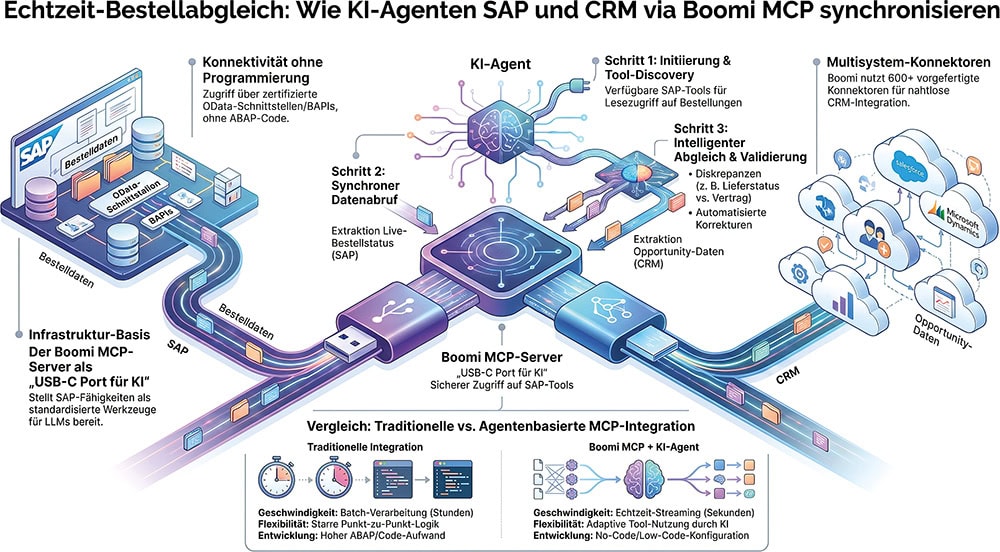
The uncontrolled proliferation of unmanaged MCP servers in public registries poses immense security risks, leads to a lack of transparency, and threatens to establish shadow AI structures that raise data protection concerns without anyone noticing. Boomi addresses this acute threat by giving administrators full control over the entire lifecycle of MCP servers. Through strict policy settings, access controls, and cost monitoring, Boomi protects companies from uncontrolled token consumption or the dreaded AI infinite loops.
For existing SAP customers, implementing a Boomi-based MCP scenario offers a breakthrough in architecture on the path to achieving the required “Clean Core.” By encapsulating core SAP functions—such as customer orders, invoices, master data, and inventory queries—behind a secure, Boomi-controlled MCP server, AI agents can autonomously discover and process this business-critical data without having to write a single line of invasive ABAP code in the ERP system. This ensures a system landscape that is completely upgrade-proof, as the ERP core—whether S/4 or even older ECC 6.0 systems—remains unaffected.
Furthermore, this standardized approach opens the door to technical autonomy: Since the Model Context Protocol is vendor-neutral, customers are no longer forced to rely exclusively on SAP’s internal copilot, Joule, or the restrictive BTP ecosystem. They can run powerful external language models—such as Claude from Anthropic—or AI solutions on AWS Bedrock and in the Snowflake cloud directly on their SAP data to drive complex, cross-system analytics and decision-making processes in real time. Boomi thus serves as the critical, neutral data hub that democratizes SAP data and delivers it securely and under controlled conditions to where the most advanced AI value creation takes place.
Boomi Platform vs. SAP BTP
The question of whether Boomi is a fully-fledged alternative to the Business Technology Platform cannot be answered with a simple yes or no, as the two platforms follow fundamentally different philosophies. SAP BTP is a highly specialized—but also highly restrictive—ecosystem that is closely aligned with the SAP ERP ecosystem, the ABAP Cloud, and the Clean Core concept. BTP forces customers into a commercial and technical straitjacket, where every extension and every API call can turn into yet another licensing and cost trap.
Boomi, on the other hand, operates as a vendor-neutral, open integration platform. It sees itself as a neutral data network that enables seamless communication between SAP and countless non-SAP applications such as Salesforce, Workday, or ServiceNow, without tying the customer to the release cycle or pricing policy of a single vendor. While BTP remains the undisputed home for highly ERP-centric, on-stack, or process-critical extensions, Boomi is the more agile, cost-effective, and open platform for enterprise-wide orchestration of heterogeneous IT landscapes. The technical implementation of the Boomi platform into existing SAP architectures—whether the aging ECC 6.0 with AnyDB or the modern S/4 HANA—is carried out via the certified Boomi for SAP Connector. This tool integrates directly into the SAP landscape and enables standardized, secure communication via open web services and OpenAPIs, without requiring users to have in-depth knowledge of the notoriously complex SAP data model.
This native connection allows even non-ABAP developers to query SAP tables, manage BW data, process IDocs, and interact with RFC interfaces. This implementation offers ECC customers—especially those who have yet to migrate to S/4—the ability to set up side-by-side scenarios and extract data in real time, while keeping the legacy system intact and stable.
Boomi and Red Hat
The strategic partnership between Boomi and Red Hat, announced in May 2026, addresses one of the biggest challenges in operationalizing artificial intelligence within enterprises: the uncontrolled piecing together of fragmented, standalone solutions, which in practice often leads to catastrophic data breaches and incalculable infrastructure costs. By integrating Boomi’s AgentStudio with the enterprise-wide capabilities of Red Hat AI, the two partners have created a unified, production-ready agent-based software stack.
For existing SAP customers, this alliance offers significant architectural and economic benefits. This combination makes it possible to feed autonomous AI agents directly with valuable, trustworthy SAP real-time data, while Red Hat OpenShift’s Kubernetes-native runtime environment guarantees strict data sovereignty and control. Since the entire architecture can be operated in hybrid cloud environments or even in the company’s own, sovereign data center, sensitive business data never leaves the company’s controlled environment.
A look at the AI offerings reveals a fundamental systemic conflict between SAP’s closed approach and Boomi’s open philosophy. With its Business AI, the in-house copilot Joule, and the SAP Knowledge Graph, SAP focuses heavily on optimizing business processes within its own cloud suite. However, this approach only works seamlessly if the customer commits to Rise or Grow cloud contracts and consolidates their data in the Business Data Cloud (SAP BDC). As soon as data from non-SAP systems comes into play or sensitive on-premises scenarios need to be addressed, the SAP AI universe runs up against strict functional and licensing limitations.
Boomi, on the other hand, positions itself as a vendor-neutral company specializing in data activation for AI. With Agent Studio, Agent Control Tower, and Boomi Gateway, the Boomi Enterprise Platform provides a comprehensive infrastructure for the design, orchestration, and governance of AI agents across all systems within an organization.
What Boomi does—and what SAP cannot do with Joule and the Knowledge Graph—is enable vendor-neutral data access in heterogeneous, complex multi-cloud environments. Boomi empowers customers by democratizing the flow of data to external AI platforms and models.
Hybrid ERP Strategy
While SAP seeks to retain semantic control over the data within a proprietary structure, Boomi ensures open, agile, real-time data delivery within that same structure. For a forward-thinking existing SAP customer, the decision between SAP BTP and Boomi is not an either/or choice, but rather a case for coexistence. It is strongly recommended to adopt a hybrid platform strategy. SAP BTP should be used sparingly for tasks closely related to ERP, for adhering to the “clean core” principle in the core system, and for specific Steampunk scenarios. However, for comprehensive, enterprise-wide integration of all non-SAP systems, the orchestration of hybrid data flows, and the flexible deployment of AI agents, customers should rely on the Boomi platform. This combination protects existing SAP investments, prevents the looming cost explosion caused by uncontrolled BTP license growth, and ensures the company’s technical sovereignty in an AI-driven economy. (pmf)


 Deutsch
  English
  Español
  Français