
Migration with method - from APO to IBP




The clock is ticking: SAP APO will be discontinued in 2027. What was long regarded as a tried-and-tested planning tool for manufacturing companies is losing its backing with the end of support - no updates, no further development, no safety net. But with IBP, the successor is already waiting in the wings. However, IBP is not just a replacement; the planning tool goes far beyond traditional planning approaches: cloud-based, collaborative, AI-supported. The changeover is not just an IT project, but a transformation of planning processes and decision-making logic.
More than just a system change
It therefore not only means a system change, but also offers the opportunity to plan in a more modern way, make more intelligent decisions and lift the entire supply chain - from demand forecasting to customer order confirmation - onto a future-proof platform.
There are not only technical, but above all economic arguments in favor of a prompt switch. Companies that migrate to IBP today can reduce their operating costs in the medium term and make more targeted use of IT resources: The elimination of in-house infrastructure, lower IT maintenance costs and automatic cloud updates relieve pressure on budgets and internal resources in equal measure. Those who wait too long, on the other hand, risk increasing operating and transformation costs.
Transparency instead of silos
In addition, IBP opens up measurable potential along the entire value chain: more precise demand forecasts using machine learning algorithms reduce excess stock and shortages, improved what-if scenario simulation options increase responsiveness in volatile markets, and the seamless integration of financial planning and supply chain management creates transparency where silos still reign today.
From a technical perspective, the integration of IBP into the existing system landscape is easily manageable with a clear integration strategy, as IBP is decoupled from the on-premise world due to its cloud architecture.
Cloud architecture as a trump card
This not only eliminates the need to import large software packages, but also the need to observe special release statuses. What's more, SAP automatically updates the SaaS solution and also provides permanent function updates. This makes maintaining the solution very convenient.
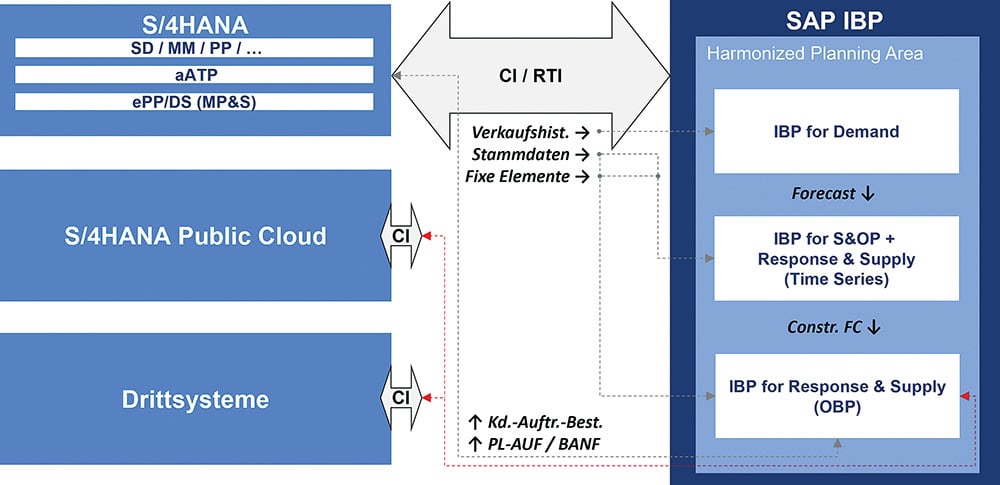
Data exchange with external systems is ensured by the SAP Cloud Integration (CI) and Real-Time Integration (RTI) interfaces. In this way, important data for planning - such as sales history and production orders - can be merged in IBP.
To do this, the interfaces access the ERP system, APO, a business warehouse (BW), SAP Analytics Cloud (SAC), the Business Data Cloud (BDC) or external tools. The data is then transferred to IBP. The extent to which the user uses the internal functions of IBP for further processing is an individual decision - for example, whether to create the forecast models in IBP or to incorporate the forecasts from externally connected AI algorithms that run on the Business Technology Platform (BTP), for example, into further planning.
Solid database as a foundation
A successful migration stands and falls with the quality of the master data. This is often underestimated in practice: IBP has clear requirements here - especially for fully maintained production versions for all materials and products manufactured in-house. Companies that address this aspect at an early stage avoid costly delays in the course of the project.
The crucial question is therefore not just: „When do we migrate?“, but also: „Is our master data ready?“ An honest inventory at the start of the project creates clarity and lays the foundation for a smooth transformation.
| Strategy | Advantage | Disadvantage |
| Big Bang | Fast, no interim solutions | High load for IT and specialist departments |
| Sequential | Reduced risk through gradual Procedure; the order of the modules can be prioritized according to business benefit. | Temporary interfaces required, slower |
Structured IBP changeover
A transformation from SAP APO to IBP rarely takes place in a single step. Rather, it is a structured process that typically takes place in several project phases - driven by technical realities and business priorities that vary from company to company.
In practice, this means that APO and IBP coexist for a defined period of time. These intermediate architectures are not a flaw, but a deliberate means of safeguarding ongoing operations while the transformation progresses step by step. The order in which modules are replaced does not follow a rigid pattern - it is determined by the specific requirements of the respective project.
Parallel IT projects - especially S/4HANA transformations - increase the complexity of the project, which is why dependencies need to be identified and actively managed at an early stage in order to avoid friction losses. This requires experienced partners who always take a holistic view of the desired target architecture and the interrelationships.
The big picture: IBP is responsible for overarching supply chain planning and is closely interlinked with detailed production planning in ePP/DS (MP&S) and customer order confirmation via aATP - both anchored in S/4HANA. The result is a continuous, integrated planning process from the requirements forecast to order confirmation.
Conclusion
Even complex transformation scenarios, including S/4HANA Public Cloud and third-party systems, can be successfully implemented with the right methodology and governance. An early start is crucial in order to avoid risks and time pressure and to quickly realize the added value of IBP. Although parallel projects such as an S/4HANA migration increase complexity, they can be implemented in parallel with coordinated planning, as transition architectures can be established.
Strategic arguments for IBP
The migration from APO to IBP is not just a compulsory exercise, but a real opportunity to take planning to a new level:
- Cloud advantages: Lower operating costs, reduced IT workload, automatic updates
- Ease of use: Away from the expert tool APO towards intuitive Fiori/Excel interfaces - broader user base possible
- Planning quality: Machine learning, demand sensing, automatic forecast model selection (best fit) - planning is becoming more intelligent
- Collaboration: Simplified collaboration with suppliers and customers via the web-based Planner Workspace or SAP Ariba
- Flexibility: What-if scenarios, improved dashboards, supply chain control tower
- Financial integration: Fully integrated financial planning - no more silos
To the partner entry:


 Deutsch
  English
  Español
  Français