
Exit, Exit, Exit




At this year’s Sapphire customer conferences in Orlando and Madrid, SAP CEO Christian Klein announced a strategic shift. Driven by the financial markets’ fear that traditional ERP business models would become obsolete due to AI, Klein abandoned the Business Suite’s North Star architecture and announced the vision of the Autonomous Enterprise.
At the heart of the ERP vision is the Joule Work user interface. In the future, users will simply describe their intentions in natural language, while more than 200 AI agents from the SAP Autonomous Suite will autonomously orchestrate complex business processes. To help these agents understand the often cryptic and historically evolved SAP data model, SAP is introducing the Knowledge Graph.
For existing SAP customers, this promise of autonomy turns out to be a dangerous pact that massively undermines the digital sovereignty of their own ERP systems, since SAP relies on far-reaching partnerships with U.S. tech giants such as Nvidia and Anthropic for implementation. While Nvidia provides the essential hardware and software frameworks—such as NeMo and Llama-Nemotron—for training and orchestrating the AI agents, SAP has chosen, of all things, the Claude language model from AI pioneer Anthropic as the primary cognitive core (Reasoning Model) for its digital assistant Joule. The incalculable risks posed by this dependence are illustrated by the U.S. government’s recent order to block access to Anthropic’s state-of-the-art Fable 5 and Mythos 5 models for all non-U.S. citizens as part of export controls.
This geopolitical shock exposes the utter vulnerability of European companies, whose supposedly autonomous SAP systems can suddenly become defenseless hostages to foreign sanctions policies. If the cognitive brain of an Autonomous Enterprise is blocked overnight by political restrictions, users face an immediate loss of functionality and an uncontrollable shutdown of the entire value-adding supply chain.
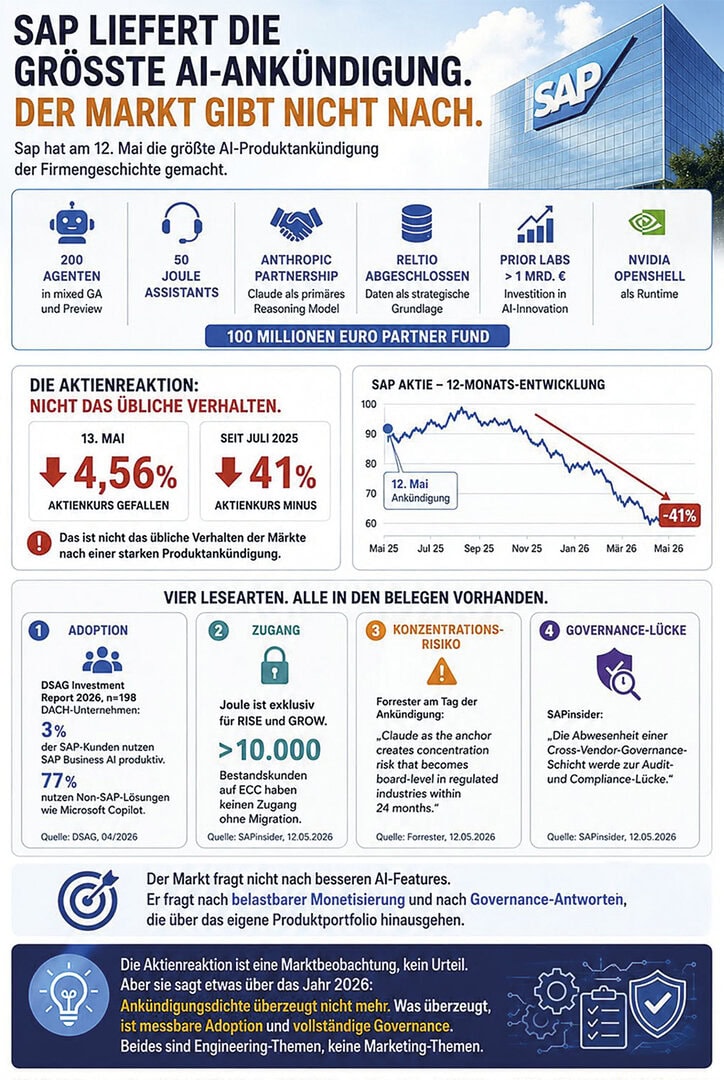
The dramatic nature of this development is greatly exacerbated by SAP’s failure to provide viable exit strategies. Just as the SAP community has long called in vain for a legally and technically sound cloud exit strategy to escape the ruinous vendor lock-in of contracts like Rise, the fatal lack of an essential AI exit strategy is now becoming apparent.
For users, the SAP Cloud is turning out to be a strategic one-way street, forcing customers to give up their valuable on-premises licenses, only to be left without the necessary algorithms and with nothing but useless raw data if they decide to leave. This looming loss of control is accompanied by a new, highly restrictive API policy, through which SAP artificially restricts direct data access by third-party AI providers in order to force customers into its own, cost-intensive ecosystem of the Business Technology Platform (BTP) and the Business Data Cloud (BDC).
Without legally sound, independent cloud and AI exit strategies, the much-touted autonomous enterprise turns into a risky black box for existing customers, in which control over business-critical financialand logistics decisions is irreversibly ceded to U.S. AI algorithms, and the company’s own digital independence is sacrificed on the altar of SAP’s profit-maximization agenda in Walldorf.



 Deutsch
  English
  Español
  Français