
The Future of SAP Business Warehouse: Should You Migrate to BW/4 HANA or Business Data Cloud?




Companies that use SAP Business Warehouse (BW) are under pressure for a variety of reasons, particularly since SAP will be discontinuing mainstream support for classic BW systems by the end of 2027.
If existing BW customers decide to migrate to BW/4 HANA in light of this, they will face significantly higher licensing costs than those of the previous BW NetWeaver licenses, particularly in relation to the added value provided. In addition, separate licenses are required to use reporting tools such as Analysis for Office (Excel integration), SAP Analytics Cloud (SAC), and BusinessObjects (Web Intelligence).
Furthermore, operating BW requires specialized expertise, which leads to higher costs for internal staff and external consultants. In addition, BW is primarily IT-driven and offers only limited opportunities for business units to conduct analyses on their own. Furthermore, new technologies—particularly in the areas of AI and machine learning—are not supported by traditional BW.
SAP is increasingly focusing its innovations on cloud products. Existing BW customers are therefore facing a critical decision regarding the transition to a future-proof system. However, you should not view the upcoming transformation as a mere formality, but rather as an opportunity to lay the foundation for a modern, high-performance data platform. Two possible scenarios are explained in more detail below.
Scenario 1: Migration to the BDC
The migration to the Business Data Cloud (BDC) offers companies a significant advantage: Mainstream maintenance is extended from the end of 2027 to the end of 2033, which makes planning easier for many companies. The migration can be carried out in a well-thought-out manner without time pressure.
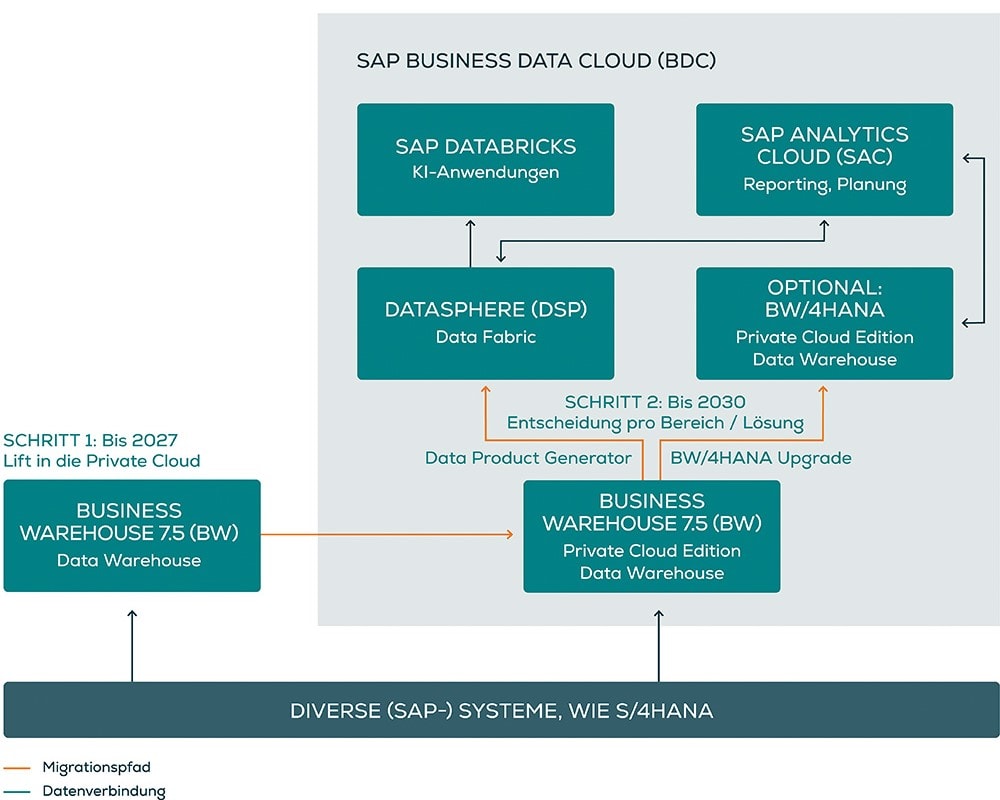
Migration Path to the BDC
In the first step, companies „migrate“ their BW 7.5 to the private cloud. This is a system migration supported by SAP. Particular attention must be paid here to interfaces with other systems.
In the second step, companies can use the Data Product Generator to generate data products from BW objects and load them on a regular basis. In the future, the Data Product Generator is expected to enable the migration of BW solutions to SAP Datasphere. If not all existing solutions can be fully migrated, a „reduced“ upgrade to SAP BW/4 HANA will be required for those solutions. The Data Product Generator can also be used from within an existing BW/4 HANA system. An S/4 HANA system, for example, serves as a data source. The data it contains is prepared via SAP Datasphere and then further processed—for AI applications in Databricks or for reporting, dashboarding, and planning in the SAP Analytics Cloud (SAC). The integration between Datasphere and SAC is significantly tighter and more seamless than the previous connection between BW and SAC.
Overview of the Benefits of the BDC
The BDC was developed to break down existing barriers between business units and enable a consolidated view of all relevant business processes. It creates a unified semantic layer for data from SAP and non-SAP systems. In the future, it will unite SAP BW, SAP Datasphere, Databricks, and SAP Analytics Cloud into a flexible, centralized cloud platform—offering new possibilities for data integration, AI, and analytics. The BDC does not replace existing products but rather integrates them under the umbrella of the SAP Business Suite. The BDC offers many advantages in terms of data management, reporting, and planning. Instead of isolated data sources, companies gain a unified, reliable data foundation that enables well-informed decisions.
Benefits for Users
Processed data is described as data products to enable a standardized exchange of data between business units. Intelligent apps also offer ready-to-use, AI-powered, industry-specific standard solutions from SAP. BDC enables a centralized, unified data foundation for planning, reporting, and dashboards—in real time and across system boundaries. This results in consistent analyses and planning based on up-to-date, harmonized data, without redundant data storage or complex data processing in the SAC. Thanks to Joule, users are increasingly benefiting from AI-powered features such as automatic report summaries and intelligent forecasts.
Benefits for IT
Data Integration – Unified Access Without Technical Barriers: All SAP and non-SAP data can be integrated into a central, consistent data layer. The BDC reduces complexity and lays the foundation for an integrated data strategy. High scalability and flexibility: BDC pricing is based on Capacity Units. Capacity Units can be freely allocated among components such as SAC, Datasphere, BW, and Databricks.
Benefits for Both Areas
Investment Protection: The existing SAP BW is seamlessly integrated into the BDC and can then be modernized incrementally as needed. This allows companies to safeguard existing solutions while creating room for future innovations. Future-Proof Data Architecture: The Business Data Cloud supports concepts such as data lakes and artificial intelligence. This is made possible by powerful SAP technologies as well as strategic partnerships—for example, with Databricks or Snowflake—which serve as a bridge to AI applications.
Scenario 2: BW/4 On-prem
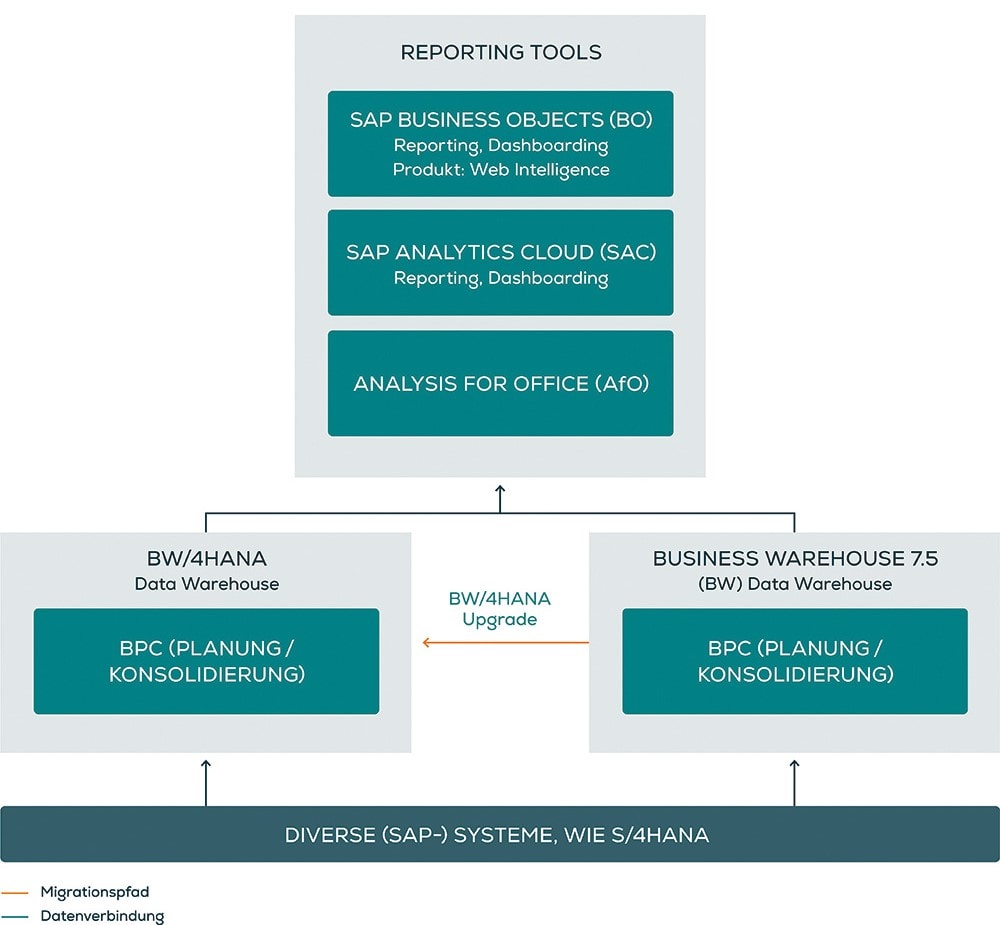
Using the BDC is not the right choice for all companies. This is due to reasons such as the following: Storing data in the cloud conflicts with corporate policies. Additionally, BW/4 has higher upfront costs but lower operating costs. The costs depend on storage requirements. BW/4 Hana is already in use or has been procured, or comprehensive BO solutions, BPC, or SEM-BCS are in use and are to continue to be operated. In these cases, a classic BW/4 upgrade is recommended, which should be completed by 2027 and must now be initiated.
Conclusion: Two Possible Solutions
The future of BW is not merely a technical issue, but a strategic decision that will shape the entire data architecture. By 2027 at the latest, companies will be under pressure to clearly define their path forward. There is no single “right” solution, but rather two valid roadmaps. With BW/4, companies opt for continuity, control, and the stable further development of existing structures—especially when regulatory requirements, existing investments, or organizational constraints argue against the cloud. The BDC opens up new possibilities: an integrated, flexible, and innovation-ready data platform that breaks down silos, promotes self-service, and simplifies access to modern technologies such as AI and data lakes. This makes it particularly attractive for companies that want to realign their data strategy with an eye toward the future. However, it is not just the technology that matters, but the individual context: corporate strategy, cost structure, innovation goals, existing system landscapes, and, last but not least, organizational maturity determine which path is the right one. (Source: Convista)

 Deutsch
  English
  Español
  Français