Nvidia and SAP: The Controlled AI Agent




Thomas Pfiester, Head of Customer Engagement and Adoption and a member of SAP’s Extended Board, took the stage at the 2026 DSAG Annual Congress in Cologne. On Tuesday, October 6, he outlined SAP’s vision of the Autonomous Enterprise in his keynote address and presented a pragmatic path to achieving it: the cloud as the foundation and AI as the engine for measurable business results. Afterward, E3 Magazine asked: How does an existing SAP customer keep AI agents under control? Thomas Pfiester referred to a partnership with Nvidia, without going into further detail. A statement from Andre Lamego, Senior Vice President and Chief Product Officer for the SAP Business AI Platform Fabric, sheds light on the technical background. E3 Magazine has summarized and supplemented Andre Lamego’s comments.
In addition to the announcement of the NVIDIA Open Agent Safety Platform and the widespread availability of NVIDIA OpenShell, the two technology companies, SAP and NVIDIA, are deepening their collaboration to make autonomous AI agents in enterprises safer, more controllable, and fully auditable from the ground up. As previously announced at the SAP Sapphire customer conference, the open-source, secure runtime environment OpenShell is to be deeply embedded in the newly consolidated SAP Business AI Platform (BAIP).
Enterprise-Grade
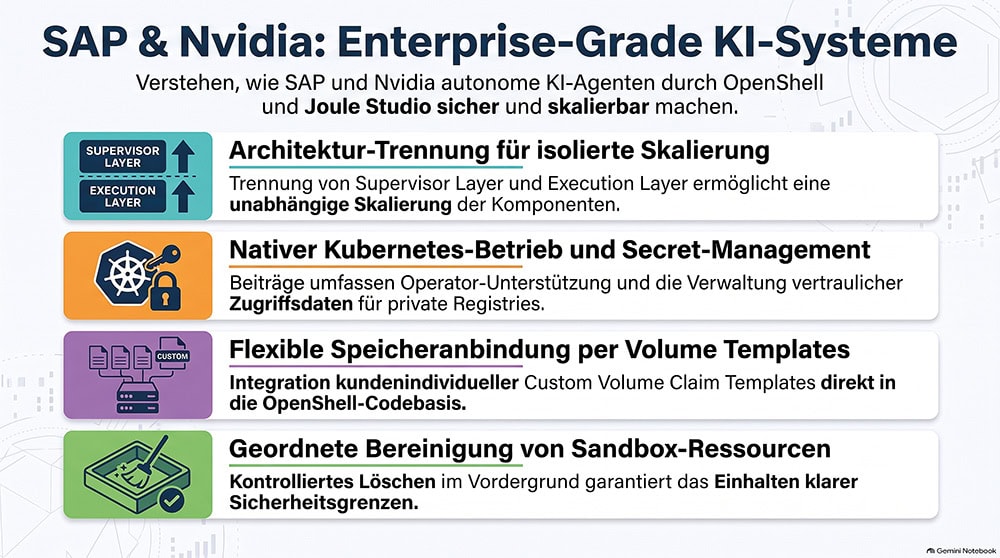
The alliance between SAP and Nvidia is far more than just a product integration; it reflects a shared commitment to establishing a definitive definition of „enterprise-grade“ for autonomous AI systems. As part of the co-development effort, SAP engineers are contributing directly to the Nvidia OpenShell codebase. While the AI-centric development environment Joule Studio provides a complete execution and governance stack for enterprise agents, Nvidia’s OpenShell handles secure deployment and execution within clear security boundaries.

„We are expanding our collaboration with Nvidia so that
”AI agents are more secure, easier to control, and easier to audit."
Andre Lamego,
Senior Vice President,
Chief Product Officer for the SAP Business AI Platform Fabric,
SAP
SAP's development work focuses on four specific core areas of the NVIDIA OpenShell project. At the platform architecture level, SAP has driven the decomposition of the runtime environment into independently deployable components by separating the supervisor layer from the actual agent execution layer to enable isolated scaling. For native Kubernetes operation, the contributions include operator support, the management of confidential access data (image pull secrets) for private container registries, customer-specific storage requirements (Custom Volume Claim Templates), and the orderly deletion of sandbox resources.
In addition, SAP is working to minimize the environmental and technical footprint of the gateway container image, expand driver support for heterogeneous computing infrastructures, and embed monitoring of the supervisor’s operational readiness and structured logging in accordance with established observability standards. At the governance level, the Joule Studio runtime environment serves as the highest authority.
Before a request reaches the actual execution layer, Joule Studio checks business authorizations, role-based policies, and the relevant process context. Nvidia OpenShell complements this with an isolated runtime sandbox that precisely controls what an agent is allowed to see and do, and where inference data flows. This collaboration is supported by the goal of achieving FedRAMP and FIPS certifications for regulated industries, as well as by participation in the newly founded Open Secure AI Alliance. Furthermore, SAP is making Joule Studio’s runtime environment available to its customers and partners free of charge through the end of October 2026.
Upon closer inspection, SAP’s decision to provide the Joule Studio Runtime free of charge through the end of October 2026 turns out to be a classic “bait-and-switch” tactic common in the software industry. Existing customers are falling for a costly illusion if they believe that the use of autonomous agents will remain free of charge indefinitely. Once this grace period expires, the usage-based billing system—which relies on consumption-dependent AI Units, BTP Capacity Units, and AI token prices—will relentlessly kick in behind the scenes. As in-depth analyses by the SAP community demonstrate, this model of prepayment with an expiration date results in unused BTP credits expiring without replacement at the end of the year, while uncontrolled peak loads during production operations are immediately billed at full list prices. The apparent gift of a free trial period through the end of October 2026 thus merely laid the groundwork for future, recurring toll charges in the BTP Cockpit.
The openness touted by SAP appears particularly questionable in light of Version 4 of the SAP API Policy, issued in April 2026. While SAP and Nvidia tout the open-source OpenShell project as a milestone for AI security, SAP erects a strict digital barrier in Section 2.2.2 of the API Policy. The direct, unlicensed extraction of bulk data by AI agents from third-party platforms is drastically restricted under the pretext of stability and security concerns. As a result, existing SAP customers are forced to route their data streams exclusively through the cost-intensive channels of the Business Technology Cloud (SAP BTP) and the Business Data Cloud (SAP BDC). Representatives of the European cloud association CISPE and the user association DSAG view this practice as an attempt—which raises antitrust concerns—to force a closed market and increase the cost of AI units by about 15 percent.
Sandboxing and the EU AI Act
Even from a technical standpoint, the best sandboxing solution in no way protects existing SAP customers from their own legal liability. Under the strict requirements of the European EU AI Act, the operator itself bears full liability in the final instance—without exception—for hallucinatory or erroneous transactions in the production ERP general ledger.
Since stochastic language models remain inherently unpredictable, purely technical security measures at the container level are not sufficient. For responsible existing SAP customers, the conclusion from this analysis is that testing sustainable security concepts is essential, as is a thorough evaluation of Nvidia OpenShell and SAP Joule Studio. For the SAP community, open interface standards such as the Model Context Protocol (MCP) are therefore essential to preserve digital sovereignty and effectively prevent the creeping lock-in into proprietary BTP fee models. (pmf)


 Deutsch
 English
 Español
 Français