
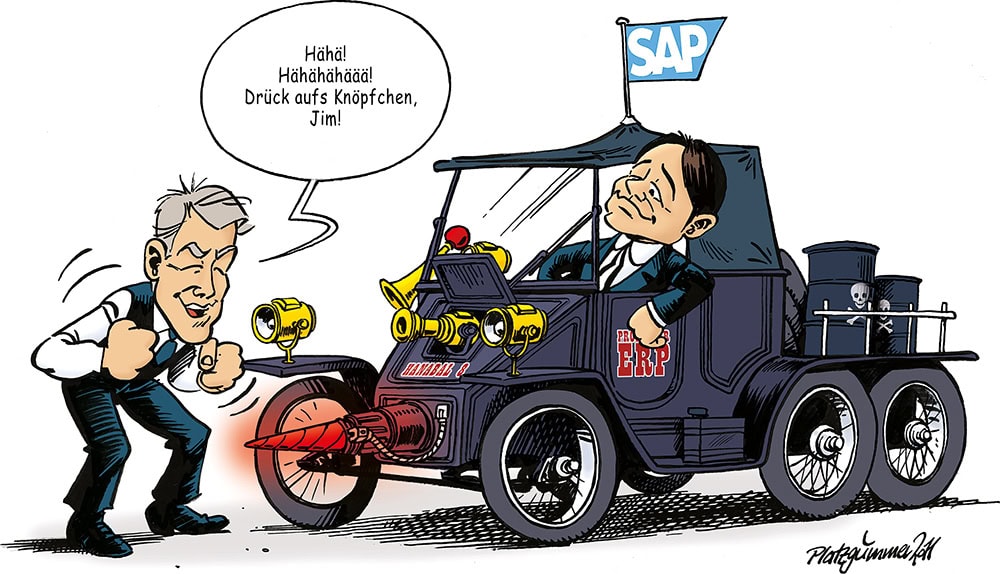
Press the button



Those who blindly rely on the American AI gold rush may find themselves waking up to a geopolitical hangover of epic proportions. The U.S. government’s sudden order to block access to Anthropic’s modern AI models, Fable 5 and Mythos 5, for all foreign nationals has hit the European SAP community like a wet washcloth.
Out of concern for national security, Washington treats the algorithms as critical weapons technology and, without further ado, bars non-U.S. customers—and even its own employees—from accessing them. For SAP CEO Christian Klein, this intervention is turning out to be a strategic nightmare, as he had only recently selected Anthropic’s language models as the primary cognitive core for his digital assistant, Joule, at the Sapphire 2026 customer conference in Orlando.
The much-touted “Autonomous Enterprise”—in which AI agents are supposed to manage quarterly financial statements or the supply chain as if by magic—is thus suffering an embarrassing setback. For concerned existing SAP customers, this U.S. ban reveals glaring risks to the autonomy and sovereignty of their own ERP systems. The deep partnership with Anthropic shows that the Walldorf-based global market leader lacks sufficient in-house core expertise in the field of generative foundation models and is being reduced to a mere data supplier for the superior AI engines of U.S. hyperscalers.
If a foreign government can now shut down the core of the European ERP system overnight by decree, users face an incalculable loss of functionality and the immediate shutdown of business-critical processes. To make matters worse, while there are now extensive discussions in the SAP world about the new EU Data Act and cloud exit strategies, a lifesaving AI exit strategy is simply lacking. If the external language model suddenly becomes unavailable or prices are dictated, companies face the collapse of their automation efforts, because raw data is effectively worthless without the corresponding interpretive algorithms and licenses.
The much-touted digital sovereignty of existing SAP customers thus becomes a myth if they allow themselves to be forced, unprepared, into the highly regulated AI architectures of the global ERP market leader. In light of this disaster, the critical recommendation to all IT decision-makers is this: do not blindly sacrifice your own independence on the altar of SAP marketing.
Users should break free from technical lock-in and adopt hybrid, composable architectures—what is known as “composable ERP.” By using independent integration platforms and running open language models locally on their own servers, organizations can maintain control over sensitive data and avoid painful vendor lock-in.
But is SAP now completely at a loss and forced to rely on Anthropic? Apparently, the Business Technology Platform (SAP BTP), with its GenAI Hub, offers an architectural intermediary layer that allows users to switch between different AI providers such as Microsoft, Google, or open-source models like Llama.
In addition, SAP has apparently taken the hint and is hastily attempting to build its own models for tabular ERP data through acquisitions such as the startup Prior Labs. Nevertheless, switching to an integrated AI model remains a complex undertaking, which is why existing SAP customers are strongly advised to design AI applications from the outset to be modular and completely vendor-independent, so as not to become pawns of foreign governments. (pmf)


 Deutsch
  English
  Español
  Français