Der Stern on Walldorf: SAP's AI-Native Architecture




AI-Native North Star Architecture
The strategy paper titled „AI-Native North Star Architecture,“ presented in October 2026 by SAP Group Management in Walldorf, Germany, under the leadership of Chief Technology Officer Philipp Herzig and the head of the Office of the CTO, Anirban Majumdar, marks the theoretical culmination of an ambitious realignment. After SAP Executive Board Spokesperson Christian Klein had only recently begun to quietly phase out the North Star Architecture of the classic Business Suite 7 (ERP/ECC 6.0)—which had long been hailed as the indisputable ERP „bible“—is now to be gradually phased out, a purely AI-centric reference model is set to pave the way toward the “Autonomous Enterprise.”.
From the perspective of the SAP community, however, this document calls for a careful deconstruction: Behind the glamorous terms of self-learning systems and adaptive user interfaces lies an architectural, business management, and commercial ordeal for existing SAP customers who must base their day-to-day operations on stable, deterministic processes.
Right in the introductory remarks of the SAP paper, the company’s top management drops a legal and strategic bombshell that every IT decision-maker must carefully weigh: SAP makes it unmistakably clear that this North Star document is neither a technical specification nor a binding product roadmap, nor even a contractual commitment to deliver specific functionalities or meet specific timelines. Rather, it is a non-binding statement of intent and a strategic vision.
For long-standing SAP customers who are facing major investment decisions as part of the S/4 transformation and the impending end of support for ECC 6.0, this creates significant uncertainty in planning!
Four New ERP Platforms from SAP Autonomous Enterprise
SAP demands that existing customers place their unconditional faith in a new paradigm without offering any firm guarantees: Technically, the document divides the future enterprise architecture into four overlapping layers: the User Experience Layer, the Process Layer, the Foundation Layer, and the Platform Layer; see the diagram.
In the User Experience Layer, SAP is effectively moving away from traditional transaction menus and static Fiori tiles. Replacing them is the digital assistant Joule, in the form of Joule Work, which serves as the central interaction layer where users control their tasks using natural language, intents, and generative interfaces.
In the process layer, traditional business applications are reduced to mere providers of functions and data for autonomous AI agents, which orchestrate processes across systems using multi-agent protocols and interfaces such as the Model Context Protocol (MCP server).
The Foundation Layer transforms the existing „system of record“ into a „system of context,“ in which the Business Data Cloud (SAP BDC) and the Knowledge Graph from SAP HANA provide the semantic foundation for basic cognitive models such as the innovative SAP-RPT model family.
The Platform Layer rounds out the architecture, providing a secure runtime environment, identity verification, and governance mechanisms for enterprise-wide agent fleets.
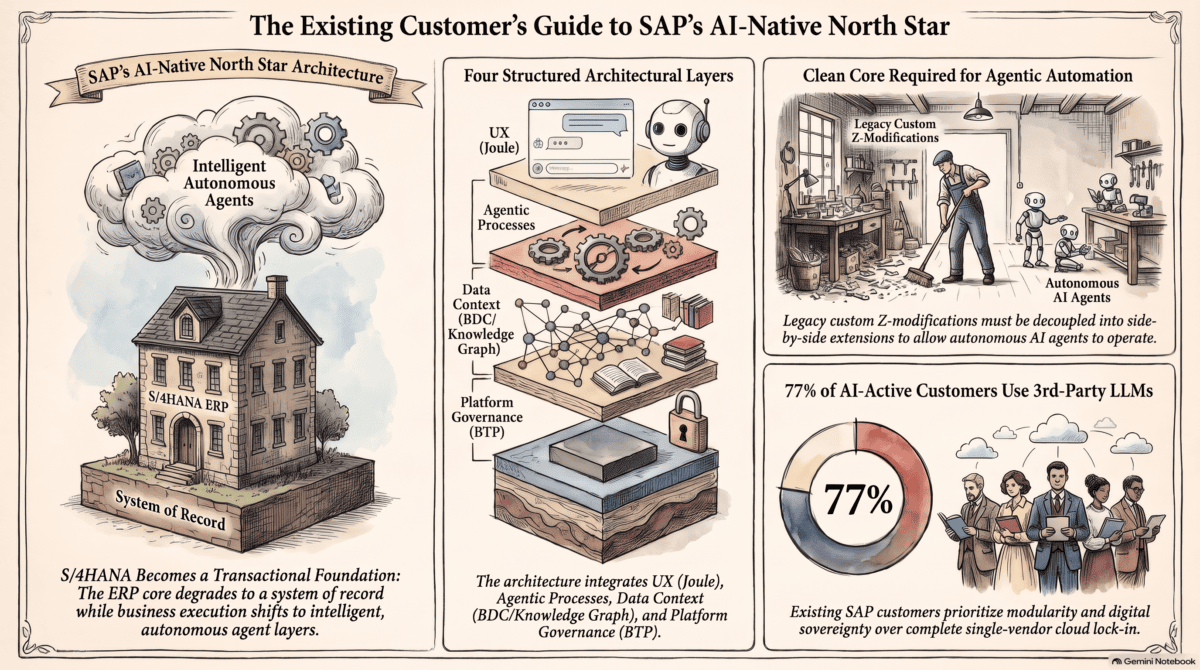
For experienced IT veterans in the SAP ecosystem, however, this four-tiered architecture evokes a sense of historical déjà vu: The paper shows striking parallels to the year 2004, when SAP enthusiastically introduced the NetWeaver integration and application platform (as former SAP Chief Technology Officer Shai Agassi recalls). Then, as now, companies faced the problem that the ERP vendor was dumping a massive, highly complex infrastructure stack (dual stack: ABAP and Java) that devoured years of upfront investments and required far-reaching reorganizations before the business promises built upon it could even be fulfilled.
For current customers, the AI-Native North Star Architecture means they must radically modernize their existing system and data landscape at great financial cost and commit to the Clean Core principle, while the actual components of the Autonomous Suite are, for the most part, still a long way off and merely announcements.
DSAG Ruling on SAP's AI-Native North Star Architecture
Particularly noteworthy and insightful is the official assessment by the German-Speaking SAP User Group (DSAG), which closely monitored the paper’s development and provided commentary directly within the document through two influential members of its executive board. While DSAG Chief Technology Officer Stefan Nogly generally welcomes the fact that SAP is providing strategic guidance in this AI-driven period of upheaval through this paper, he immediately urges a measured approach. Nogly emphasizes that the vision must by no means remain static and warns of the massive implications for corporate organization and enterprise IT. If the AI copilot Joule takes the lead as a voice-based interface and replaces Fiori applications, UX design must fundamentally shift from interface considerations to focus on controllability, verifiability, and governance. Nogly bluntly states that key questions regarding the operation, control, and responsibilities of agent-based systems in the North Star architecture remain entirely unresolved, and the paper deliberately provides no definitive answers on these points.
Thomas Henzler, the new CEO of DSAG, echoes this sentiment. Henzler reassures the user base that the strategic shift toward the Autonomous Enterprise by no means means that ongoing S/4 migrations will be abandoned, as transactional applications remain the irreplaceable core. At the same time, however, DSAG issues an unambiguous directive: The fundamental functions that make an ERP system successful for small and medium-sized businesses in the first place—such as end-to-end document management, effective user administration, interface stability, and reliable core functions—must under no circumstances be neglected in favor of glamorous AI investments.

“AI is increasingly changing the way we interact with our systems and how we design our business processes. As business processes become more automated, the demands placed on technology also increase accordingly. It is not uncommon for complexity to rise simultaneously in many areas. Clear guidance on the use of AI and related technologies is therefore essential to ensure that we do not ultimately fail because of this complexity.”.
The ‚AI-Native North Star Architecture‘ provides a strategic overview of how SAP is approaching AI transformations and integrating them as a fundamental component of SAP technologies. It also gives companies insight into what they can expect from SAP in the coming years.
”We at DSAG welcome this. The North Star architecture can thus also provide a framework for the AI transformation at the various levels being implemented within companies.”
The DSAG’s discussion papers and conference reports, published in parallel, also sharply criticize SAP’s attempt to tie these future scenarios exclusively to the cloud models of “Rise with SAP,” even though, according to the latest DSAG Investment Report, 56 percent of existing customers still rely on on-premise architectures, and 77 percent of users actively employing AI are deliberately opting for non-SAP solutions.
More Than Just an ERP Architecture
To assess the scope of the AI-Native North Star Architecture, existing SAP customers must draw on a range of additional, independent sources. In addition to the official SAP Architecture Center, where the paper is now available for community discussion on GitHub, research by the IT trade press in particular provides the necessary perspective. National business media outlets such as the Handelsblatt and WirtschaftsWoche also document the massive acquisitions and minority stakes through which SAP is hastily amassing the necessary AI expertise —such as the 640-million deal for the table-model startup Prior Labs or the 60-million-euro investment in the open-source workflow platform n8n, which is now set to be deeply integrated into Joule Studio.
This picture is complemented by international market analyses from firms such as Pierre Audoin Consultants (PAC) and Gartner, whose symposium report from Barcelona strongly warns that by 2027, forty percent of all agentic AI projects will have to be discontinued due to a lack of governance and skyrocketing costs. Last but not least, independent architectural analyses by pioneers such as Professor Alexander Zeier (Nova Intelligence) provide evidence that Clean Core innovations and agentic AI can succeed even without the proprietary constraints of the Walldorf-based cloud platform.
Autonomous Enterprise and SAP Knowledge Graph
The integration of the North Star architecture with the SAP Autonomous Enterprise, the Business AI Platform (formerly SAP BAIP, now SAP BTP), and the SAP HANA database’s knowledge graph ultimately reveals the real dilemma for business practice.
The Business AI Platform (BAIP) serves as a new umbrella solution that brings together the existing individual components, such as SAP AI Core, the AI Launchpad, the Generative AI Hub, and the Integration Suite. The paper’s bold assertion is clear: Data was the moat of the past decade; context is the moat of the next decade. This is precisely the context that the SAP Knowledge Graph is designed to provide by translating the over seven million relational data fields of the core ERP system into semantic ontologies and serving as an error-preventing compass for AI agents. But this is exactly where the theoretical construct collides with the reality of existing customers: By its very nature, a standard knowledge graph is familiar only with the untouched SAP standard data model. For a customer who has built up custom Z-tables, customer-modified posting rules, and complex interfaces over decades, this graph is simply blind.
In addition, through the SAP API Policy—which will be tightened in April 2026—SAP is establishing a digital tollgate that prohibits third-party agents from directly accessing the ERP system and forces customers to route their AI workflows through the fee-based BTP and BDC. What SAP touts as an open, AI-native platform turns out, in the worst-case scenario for existing customers, to be a dangerous trap of costs and dependency, in which unused BTP Capacity Units expire and stochastic AI agents jeopardize the audit compliance of the general ledger.
The bottom line for the Customer Center of Expertise (CCoE) is therefore this: The „AI-Native North Star Architecture“ document is a fascinating showcase of technical prowess that must be studied closely to understand the vendor’s mindset. But instead of blindly following them into the golden cage of proprietary cloud subscriptions, existing customers must maintain independent digital sovereignty based on a streamlined system core, open interface standards such as MCP Server, and uncompromising human oversight of the general ledger.

 Deutsch
 English
 Español
 Français