

Sovereign Hypercloud: Hyperscaler Power or European Control?




How should modern cloud services be structured to meet new market demands? 212 decision-makers from companies with more than 1,000 employees answered these and other questions.
Geopolitics, an unpredictable U.S. trade policy, and concerns about extraterritorial data access have transformed digital sovereignty from a compliance issue into a strategic board-level topic. Four out of five respondents (80 percent) say they are expanding their IT infrastructure in Europe more aggressively in light of these challenges. At the same time, 72 percent acknowledge a structural dependence on hyperscalers—particularly with regard to performance, stability, and cost-effectiveness. It is clear that hyperscalers are not being fundamentally questioned, but the framework conditions for their use are changing.
When it comes to making cloud decisions, there are clear priorities: The most important criteria are performance and stability during peak loads. Close behind are data sovereignty and EU sovereignty, which are also clearly prioritized over considerations of scalability and cost. Sovereignty is therefore not a „nice-to-have“ but a central decision-making criterion, at least as important as technical performance.

„The idea of a sovereign hypercloud is not a
an ideological counter-movement to the existing ones
Offered by the major hyperscalers—it is their logical
”Further development in the context of European integration."
Robert Klimke,
Director of Advanced Cloud Solutions,
Valantic
Hybrid Cloud Challenges
Many companies are currently caught between a rock and a hard place: While 73 percent are generally willing to use U.S. public clouds even for critical data, if sovereign hypercloud offerings from European providers were to offer a comparable level of security, 64 percent would prefer those.
At the same time, there is a significant lack of clarity: 73 percent of survey respondents view the U.S. Cloud Act as a major risk, and 69 percent cite a lack of insight into sovereign cloud offerings.
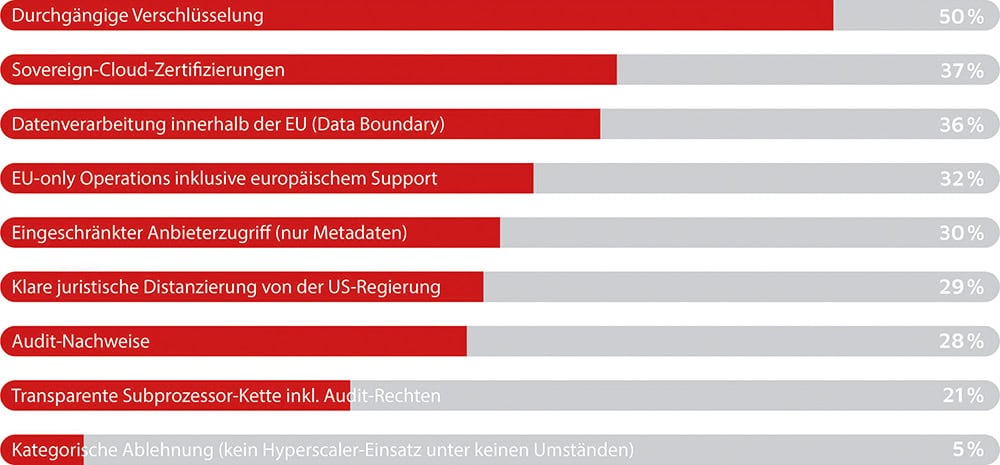
According to survey participants, for sovereign hyperscaler offerings to gain traction, they must meet a clearly defined set of criteria. At the top of the list is end-to-end encryption, followed by sovereign cloud certifications, a clear EU data boundary, and EU-only operations with European support.
In this context, sovereignty is not viewed as a single measure, but rather as a multi-layered architecture of trust comprising technical, organizational, and legal safeguards. A large majority also expects that a sovereign single hypercloud will significantly reduce the effort required by today’s hybrid and multi-cloud landscapes.
To the partner entry:



 Deutsch
  English
  Español
  Français