
Self-determination Instead of External Control in the SAP World



The landscape is becoming more complex, vendor roadmaps are becoming more dynamic, and business units are growing more impatient. For SAP customer companies, the question therefore remains: How can you ensure stability and the ability to act when the operating environment is constantly changing?
The theme of the 2026 DSAG Annual Conference—„Claim Your Ground. Lead Your Business.“—sums it up perfectly. Today, it’s no longer about chasing the next technological buzzword or blindly rushing into cloud migration. It’s about making well-informed decisions, about perspective rather than euphoria, and about consciously defining your own scope for action.
Anyone who wants to stay ahead in a state of constant transformation needs flexibility. Companies must not allow rigid infrastructure constraints or vendor lock-ins with hyperscalers to dictate their future direction. This also means being able to opt out at any time. Without a viable cloud and AI exit strategy, SAP customers quickly become prisoners of third-party pricing models.
This is exactly where SUSE, as a long-standing technology partner of SAP, comes in. As a company founded in Germany, deeply rooted in Europe, and at the same time boasting tremendous global influence, SUSE provides the open platform for a self-determined SAP future. At its core, it’s all about one thing: giving companies back control over their own infrastructure—whether on-premises, in a private cloud, with a hyperscaler, or in a hybrid environment. Only those who master their foundation can go from being driven by circumstances to shaping the future.
Digital Sovereignty „Made in Europe“
In an increasingly fragmented and geopolitically uncertain world, European values such as data sovereignty, strict compliance requirements, and technological openness are becoming an ever-greater focus for SAP customers operating globally. IT security requirements in SAP environments have risen dramatically in recent years, driven not least by the GDPR, the NIS2 Directive, the European Union’s Cyber Resilience Act, and industry-specific regulations. The integration of cloud services expands the potential attack surface, and hybrid architectures defy traditional perimeter security. Against this backdrop, digital sovereignty means maintaining unrestricted control over one’s own data, encryption methods, and software supply chains at all times.
The technological solution to the need for greater resilience and autonomy is SUSE Linux Enterprise Server (SLES) for SAP Applications (for SAP Linux environments such as SAP HANA) and SUSE Rancher for SAP Applications (for the cloud-native SAP ecosystem). SLES for SAP serves as the reliable foundation for the SAP landscapes of tens of thousands of companies worldwide. About 80 percent of all SAP HANA installations currently run on this platform. SAP itself also operates the SAP S/4HANA Cloud on SUSE’s operating system platform. But market leadership alone is not enough in times of escalating threats. The entire platform is therefore designed with security „by design.“.
The Common Criteria EAL4+ certification from the Federal Office for Information Security (BSI) confirms that SLES meets the highest security requirements—not only for the platform itself, but for the entire software supply chain. This certification saves companies the trouble of conducting their own time-consuming evaluations of their supply chain security and makes it easier to demonstrate NIS 2 compliance to auditors.
SUSE Live Patching provides additional protection for business-critical processes against unplanned downtime and cyberattacks. It allows security vulnerabilities in the Linux kernel to be patched while the system is running, without maintenance windows or system reboots. Logistics processes, financial closings, and production systems continue to run while SUSE Live Patching updates the system to the latest version. The SUSE Multi-Linux Manager handles automated patch rollout and centralized management of security policies. This makes compliance a transparent, standard process.
SUSE’s Sovereign Premium Support goes one step further. SUSE stores and encrypts all support data within the EU—and technical support is provided exclusively by support engineers based in the European Union. For companies in regulated industries, this means that not only their own data but also their support access remains under European control.
The New Freedom of Virtualization
Escape the licensing trap with SUSE’s virtualization strategy. While the operating system ensures stability, a massive transformation is currently taking place at the infrastructure deployment level. The global virtualization market has undergone a fundamental shift in recent months.
Acquisitions, discontinued products, the pressure to purchase bundled mega-licenses, and drastic price increases have caught many companies off guard. The shift from socket-based to core-based licensing, for example, results in additional costs that can amount to several hundred thousand or even millions of euros per year, depending on the size of the company. SAP customers who have relied on proprietary hypervisor infrastructures for years are facing massive cost increases and a noticeable loss of control. The demand for a technologically open and financially predictable alternative is correspondingly high.
The SUSE Hypervisor, based on the proven Kernel-based Virtual Machine (KVM) technology, offers SAP customers a way out of the licensing trap. SUSE has fully integrated the hypervisor into its ecosystem and validated it for SAP workloads (see SAP Note 1522993). Unlike proprietary black-box solutions, the KVM-based approach enables high-performance, scalable, and—above all—transparent virtualization—with an overhead of typically only five to ten percent compared to running on bare-metal hardware. With SUSE Virtualization, non-SAP workloads and containerized Kubernetes environments can be deployed cost-effectively, with high availability, and without vendor lock-in. Consultants such as Thomas Herrmann, an SAP consultant at SoftwareOne, also confirm these benefits: „The migration to S/4 is the ideal time to rethink your virtualization strategy as well. KVM offers a powerful, open, and cost-effective alternative to traditional hypervisors.“
Achieving Confident SAP Operations
FIS-ASP, a full-service IT provider with approximately 140 employees and three redundant data centers in Bavaria, currently operates about 1,000 SAP systems for more than 50,000 users at medium-sized companies. Then came Broadcom’s acquisition of VMware. Costs rose dramatically, and FIS-ASP faced a fundamental question: How can an open, digitally sovereign infrastructure be built for business-critical SAP systems? The strategic decision was made to undertake a comprehensive migration to SUSE’s open-source solutions.
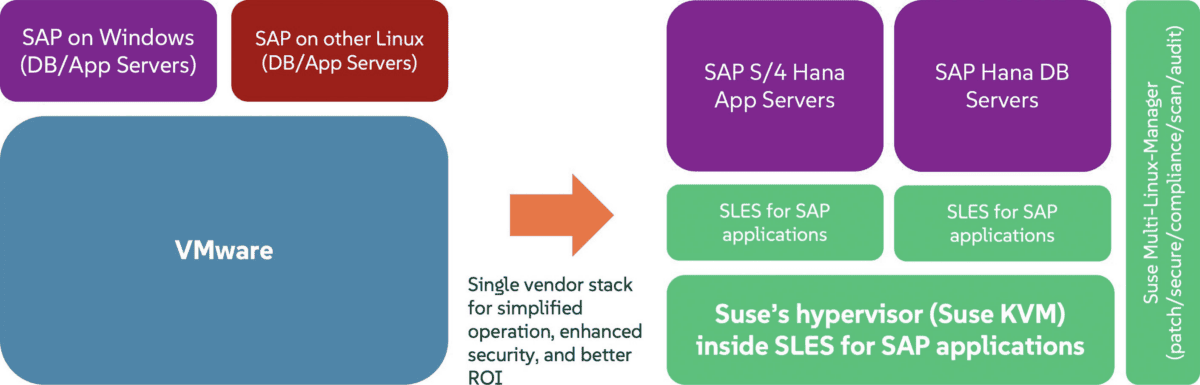
By switching its virtualization platform to SUSE’s hypervisor, FIS-ASP was able to prevent impending cost increases of more than 100 percent, which would have been unavoidable with the previous proprietary solution. The new environment also enhances financial planning reliability through transparent support models. With a solution stack comprising SUSE Linux Enterprise Server for SAP Applications, SUSE Virtualization, SUSE Rancher for SAP Applications, and SUSE Multi-Linux Support, FIS-ASP has established a central platform for seamless SAP operations. This platform enables the seamless deployment of both traditional ERP workloads and modern, cloud-native container applications. Full control over infrastructure components and software supply chains also makes it easier for the service provider to comply with regulatory requirements such as ISO 27001 or NIS2. Automated operational processes and „Infrastructure as Code“ take operational efficiency to a new level. FIS-ASP Managing Director Manuel Sammeth emphasizes: „Our goal was to build a truly sovereign infrastructure for operating SAP applications, and SUSE provides all the components we need to do so.”
Sovereign AI with SUSE AI and SAP
The right to sovereignty and self-determination does not end at the infrastructure boundary, but extends into the AI strategy. Many companies are currently facing a dilemma in this area: Business units are vehemently calling for the rapid integration of generative AI and large language models (LLMs) to optimize business processes and tap into new value-creation potential. At the same time, IT leadership must safeguard the highly sensitive financial, HR, and production data stored in the SAP system. For most European companies, the unconsidered transfer of this core data to uncontrollable public cloud AI services is not an option for compliance and data protection reasons.
SUSE AI resolves this conflict without hindering innovation. The Kubernetes-based platform enables the development and highly secure operation of AI applications under the company’s own control. Companies gain the ability to run powerful large language models—such as Llama or Mistral—locally in their own data centers or in dedicated hybrid environments. The AI is thus seamlessly embedded into existing SAP processes, yet operates completely independently of external, non-transparent AI clouds.
Trustworthy AI in Your Own Data Center
SAP service providers such as the FIS Group are already using SUSE AI in their client projects. The SAP Gold Partner has been developing its own AI solutions for SAP users since 2018—ranging from the automatic assignment of incoming invoices to image recognition for the retail sector. To protect the sensitive SAP data of customers in regulated industries, the FIS Group consistently operates its AI applications in German data centers.
SUSE AI handles the orchestration, monitoring, and lifecycle management of AI workloads, making the infrastructure manageable. „A major advantage of SUSE AI is that it significantly reduces the complexity of operating AI workloads,“ says Manuel Sammeth, who leads the FIS Group’s AI expertise team. „We can manage different large language models through a central platform and, when needed, very quickly implement new models for our customers.“
Not every AI project succeeds right away, as Sammeth knows from experience: „There’s huge interest in AI-powered solutions—but we also repeatedly speak with companies whose AI projects initially failed. Often there’s a compelling idea, but those in charge don’t give enough thought to the necessary infrastructure.“ SUSE AI can bridge this gap.
Transparency is also key to cost-effective and secure operations: The FIS Group can view token usage, model performance, and GPU utilization at any time. Custom guardrails and container security protect business data and prevent tampering with the models. This ensures that data sovereignty remains entirely within the company.
Looking Ahead to 2027: Putting Things into Perspective Rather Than Giving In to Migration Panic
In addition to virtualization and AI, many SAP customers are focused on the year 2027. By then, not only should the migration to SAP S/4HANA be complete, but mainstream support for the proven integration solutions SAP Process Orchestration (PO) and SAP Process Integration (PI) will also end. Replacement by the modern SAP Integration Suite is inevitable.
But here, too, the „Claim Your Ground“ principle applies: Instead of panicking or rushing to move systems to the cloud, it’s important to approach the transition in a controlled manner. For companies that need to keep sensitive interfaces and API calls on-premises in their own data center, SAP has developed the Edge Integration Cell. It allows you to design integration flows in the cloud but execute them locally and securely within your own network.
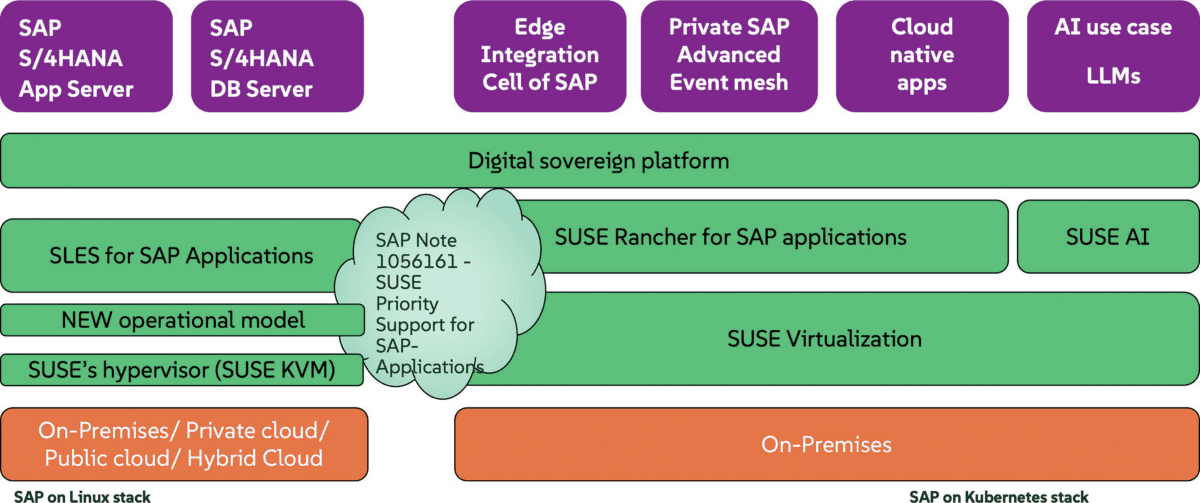
From a technological standpoint, the SAP Edge Integration Cell marks a paradigm shift, as it is a containerized application that requires a robust Kubernetes environment. SUSE Rancher for SAP Applications provides the validated, highly available, and automated Kubernetes foundation needed to securely operate components such as the Edge Integration Cell. For those who are currently organizing their on-premises and virtualization environments with KVM and SLES for SAP Applications while simultaneously building a bridge to the container world with SUSE Rancher, the 2027 deadline loses its fear factor.
Conclusion: If you master the basics, you'll lead the business
Transformation in the SAP world cannot be put off—it remains the constant pulse of enterprise IT. What matters most is the position from which companies shape this transformation: Are they sitting in the passenger seat, letting themselves be driven by license metrics, cloud constraints, and proprietary dead ends? Or are they taking the wheel and setting the pace of innovation themselves? The DSAG motto „Claim Your Ground. Lead Your Business.“ is a call to IT decision-makers to reclaim technological sovereignty. With SUSE, SAP users have a partner at their side that makes this sovereignty a reality through an open, certified code base. The European reliability of SLES for SAP Applications, the cost savings enabled by SUSE’s KVM-based hypervisor, and secure data processing with SUSE AI combine to form a future-proof foundation. Building on this foundation, SAP customers can implement their ambitious hybrid cloud and AI strategies with precisely the right balance to suit their individual business realities. Those who confidently master their technological landscape will successfully lead their businesses even in times of constant change.
To the partner entry:


 Deutsch
  English
  Español
  Français