
SAP Concur in the Age of AI Agents




Long before artificial intelligence became a topic of discussion in boardrooms, Concur was already committed to reducing manual work, simplifying processes for employees, and integrating compliance directly into the travel booking and expense reimbursement processes.
Today, this vision is more within reach than ever. With generative and agent-based artificial intelligence, automation is evolving toward rule-based and reliable autonomy. AI agents can already understand context, recommend actions, execute them within defined rules, and act proactively. But no matter how much the technology has advanced, enterprise-ready autonomy arises primarily not from artificial intelligence alone, but from processes, business context, and the data that reliably guides their actions.
From Automation to Autonomy
The first phase of the digital transformation of business travel focused on automation through rule-based workflows. Reduced manual work and standardized processes had already yielded the first noticeable efficiency gains. However, employees still had to manage exceptions, decisions, and approvals themselves. Agent-based AI is bringing about a paradigm shift. Intelligent agents can capture data and signals from connected systems, interpret intentions, and act in a coordinated manner across system boundaries. For travel expense reporting, this means a shift from digital systems that capture receipts and apply rules to systems that orchestrate an end-to-end process.
Expenses are reviewed, compliance is ensured, and approvals are initiated, while the technology continuously learns from the results within clearly defined parameters. As a result, travel expense reporting isn’t just faster—it begins to handle itself.
Why AI alone isn't enough
For AI agents to operate autonomously within a company, more than just technology is needed—reliability is essential. This is because business travel processes are closely tied to regulatory requirements, tax law, internal controls, and audit obligations. At the same time, they span different jurisdictions, currencies, approval hierarchies, and corporate policies.
Without a solid foundation, an AI-driven approach quickly reaches its limits: without clear processes, unpredictability arises. Without governance, risk arises. When AI acts autonomously, it must comply equally with requirements such as tax regulations, documentation obligations, data protection, and company-specific guidelines.
Many narratives about AI fall short precisely here. They emphasize intelligence but underestimate institutional knowledge, process maturity, and data quality. Agent-based AI only realizes its full potential when it operates within a proven, compliant framework.
Benefits of SAP Concur
Over the years, SAP Concur has established best practices for travel booking and expense reporting processes across various industries and markets. Compliance, auditability, and control have been at the core of the platform from the very beginning.
This creates something that is crucial for agent-based AI: a comprehensive dataset of global spending patterns, policies, and compliance data derived from standardized processes. These data streams enable AI systems not only to recognize patterns, but also to understand the business context and act accordingly.
SAP Concur doesn’t simply add artificial intelligence to travel booking and expense reporting workflows. The platform embeds SAP Business AI into an already mature process layer. This foundation makes all the difference, because autonomy doesn’t start with algorithms, but with process design. The result is a controlled progression from assistance through delegation to fully autonomous execution.
Evolution Instead of the Big Bang
The transformation of business travel processes does not happen overnight, but rather in stages. With each step, SAP Concur increases the use of artificial intelligence, thereby enhancing process autonomy.
AI features and agents based on Joule, which are directly embedded in the platform, are already helping to interpret documents, provide context-sensitive advice, and proactively support decision-making. As a result, they are already reducing the workload today and laying the groundwork for the comprehensive, reliable performance of tomorrow’s AI agents.
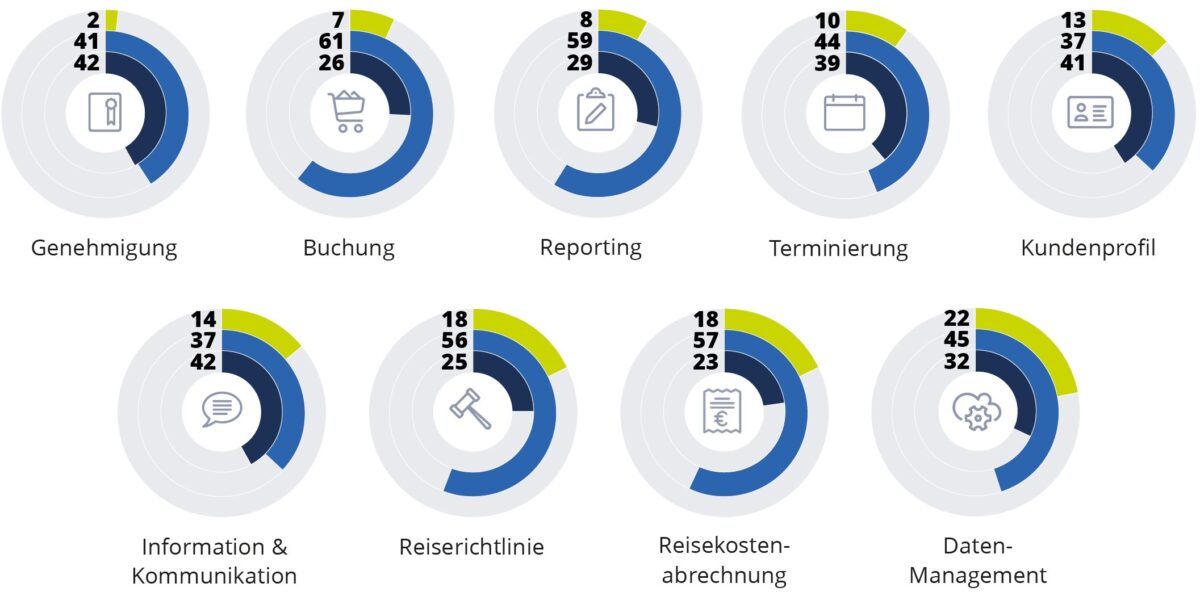
Automated business travel process
And what does the end goal look like? Travel expense reporting serves as a prime example of where we’re headed: In an AI-powered, autonomous process, the employee simply enters an expense. From there, the system takes over. It reads and interprets the receipt, understands the business context, checks tax logic and policies, initiates approvals, flags and explains exceptions, and transparently documents every step for final review and audit.
People switch roles and take the lead instead of simply carrying out tasks. Employees focus on value-adding work, managers step in when human judgment is required, and the finance department maintains full transparency and accountability.
No substitute for people
The goal is not to replace people with AI. Rather, it is to relieve them of repetitive, manual tasks while maintaining reliability, compliance, and accountability. People remain the ultimate authority. „The travel expense report that practically takes care of itself“ has always been more than just a slogan. It is a long-term vision rooted in process excellence, not in technological hype.
Over time, this vision has evolved into a system where travel bookings and expense reports are handled almost automatically—as a seamless end-to-end process in business travel management. Agent-based artificial intelligence does not change this vision; it makes it possible.
Self-directed business trip
SAP-Concur solutions combine deep industry expertise, established processes, and structured data. This gives them a unique advantage in implementing autonomy in a way that companies can trust.
The future of business travel isn’t just smart. It’s autonomous, compliant, and built for businesses. And, step by step, it’s becoming a reality. (Source: SAP Concur)


 Deutsch
  English
  Español
  Français