

SAP Autonomous Enterprise with TFM




Large Language Model vs. Tabular Foundation Model
SAP’s acquisition of the Freiburg-based AI startup Prior Labs, announced in May 2026, has brought an AI concept into the spotlight that could be of fundamental importance to existing SAP customers: Tabular Foundation Models (TFMs) and, in particular, the operationally available TabPFN (Tabular Prior-data Fitted Network) model series.
While the global AI community has been focused on large language models (LLMs) such as ChatGPT and Claude for months, a sobering truth is emerging for day-to-day ERP operations based on SAP: Traditional language models fail miserably when tasked with making precise predictions based on highly structured business data, as they tokenize numbers incorrectly, fail to understand mathematical relationships, and are prone to massive hallucinations in relational table structures.
In a system landscape where all business knowledge is stored in rigid tables—such as the MARA material master table—or complex sales databases, SAP users therefore do not need linguistically skilled jack-of-all-trades, but rather a specialized tool that natively understands tables—and this is precisely where TabPFN promises a technical AI disruption.
SAP Autonomous Enterprise Needs Alternative AI
From an architectural IT perspective, the TabPFN model breaks with the traditional AI paradigms of machine learning. For over twenty years, the analysis of structured tabular data has been dominated by gradient-boosted decision trees (such as XGBoost, LightGBM, or CatBoost). However, these methods have a serious business-related weakness: they are maintenance-intensive, as they must be time-consuming to train, manually prepared, and painstakingly optimized through parameter tuning over countless hours for each new dataset.
TabPFN, on the other hand, operates as a completely training-free model that generates predictions solely through in-context learning (ICL) in a single forward pass. The model was trained by Prior Labs on over 100 million artificially generated synthetic datasets and, in the process, learned to map the underlying mathematical and statistical algorithms directly into its neural weights.
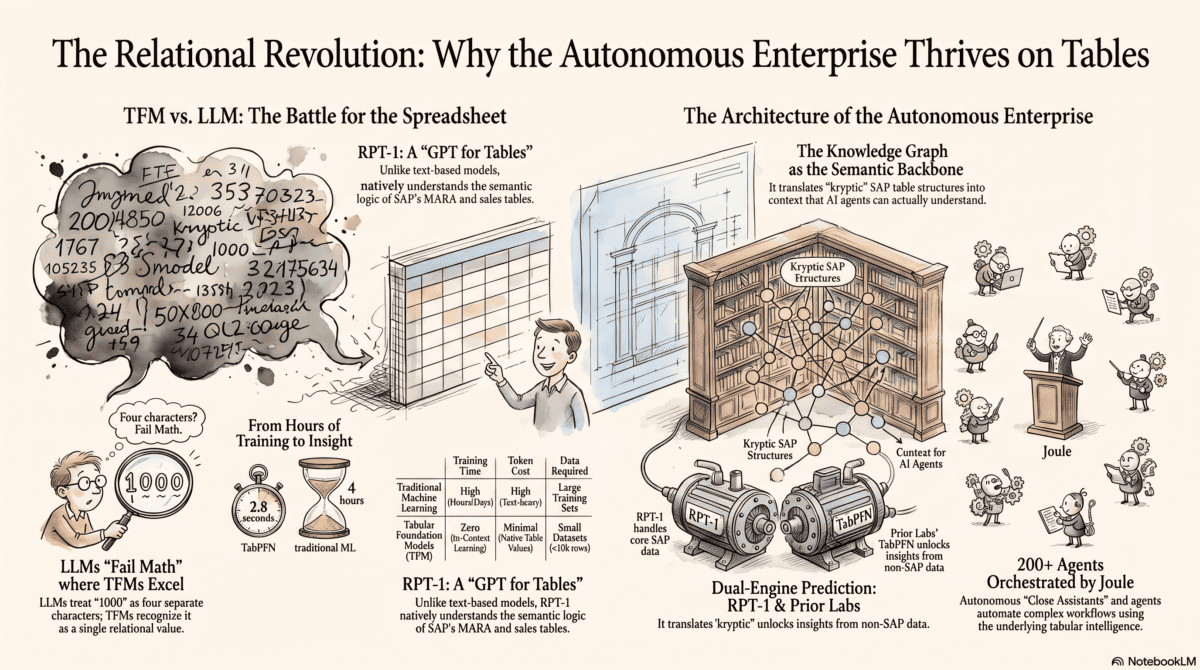
For SAP users, ICL could mean a dramatic reduction in time-to-value: A Tabular Foundation Model (TFM) can adapt instantly—and without any additional training phase—to any business use case, whether it’s forecasting payment delays, identifying supplier risks, or analyzing customer churn.
The Superiority of Prior Labs' TabPFN Model
The resulting increase in efficiency borders on an IT sensation and can be precisely quantified. Independent benchmarks based on scientific publications show that, for datasets with up to 10,000 rows, the standard TabPFN model outperforms the most powerful classical algorithms—which had previously been intensively optimized for four hours—in just 2.8 seconds. This corresponds to a speedup by a factor of 5,140 for classification tasks and by a factor of 3,000 for regression tasks. Compared to conventional AI systems, which consume enormous computational resources and astronomical amounts of tokens during operation, the TabPFN model is resource-efficient while still delivering far more accurate and predictable results.
With the latest model generation, TabPFN-2.5, the developers at Prior Labs have also further optimized the previous scaling limits of TFM technology: While the previous version could only process small amounts of data, TabPFN-2.5 has been validated for datasets with up to 50,000 data points and 2,000 features—which represents a twentyfold increase in the number of data cells it can process. On the TabArena IT benchmark, the model achieves a perfect 100 percent win rate in pure default mode against standard XGBoost on small to medium-sized classification datasets and matches the accuracy of AutoGluon, a highly complex model ensemble optimized over several hours. The additional introduction of the Real-TabPFN-2.5 variant, which was fine-tuned on real, curated datasets, further significantly increases this predictive accuracy.
TabPFN, designed for SAP S/4 and SAP ABAP
Another invaluable advantage, given the often incomplete and error-prone nature of data in SAP systems, is the model’s extreme robustness in the face of poor ERP data quality. Typically, neural networks require meticulous and error-prone data cleaning. TabPFN, on the other hand, handles unstructured, categorical values, missing values, uninformative data fields, and extreme outliers completely autonomously and without the time-consuming detour through complex, manual ETL pipelines.
In addition, the model has the inherent ability to quantify statistical uncertainties without incurring additional computational costs. Instead of a simple, deterministic number, it returns a complete probability distribution (target distribution). In sensitive business processes—such as credit checks or risk management in the finance department (SAP Simple Finance)—this transparency is an invaluable security feature, as users can always see how reliable the AI’s predicted decision actually is.
Supercomputing for the SAP Autonomous Enterprise
Despite this architectural brilliance in AI, critical existing SAP customers must not ignore the structural limitations of the In-Context Learning (ICL) infrastructure. Since the computational complexity of TFM (Tabular Foundation Model) transformers scales quadratically with the number of rows and columns, the pure inference time can increase noticeably with very large datasets.
To circumvent this IT bottleneck (in reference to the von Neumann bottleneck) in production ERP environments, Prior Labs is introducing a Distillation Engine. This tool is capable of fully automatically translating the complex TabPFN-2.5 model for a specific dataset into a compact, classic multi-layer perceptron (MLP) or a lean decision tree ensemble. The resulting code loses its in-context capability but delivers latency that is orders of magnitude lower and minimal memory requirements in live production environments. This allows the acquired model intelligence to be seamlessly integrated into existing, time-critical SAP production pipelines without any compliance conflicts.
Tabular Foundation Model with SAP RPT-1 and Prior Labs TabPFN
For existing SAP customers, TFM technology fits perfectly into the overarching ERP platform strategy of S/4 HANA and the Autonomous Enterprise. Together with the RPT-1 (Relational Pre-trained Transformer) model developed by SAP itself and its successor, RPT-1.5, the Walldorf-based ERP company is seeking to establish its own dominant position in tabular AI applications.
If these models are made available in the future through the Generative AI Hub of the Business Technology Platform (SAP BTP) or the Business Data Cloud (SAP BDC), business units will be able to use the AI assistant Joule to perform complex simulations and „what-if“ analyses in natural language without having to recruit expensive data science specialists.
However, S/4 users must remain vigilant: Since these highly efficient table models rely on a flawless, semantically rich data context, establishing a clean system (SAP Clean Core with Cleanfield) and a structured data model via the SAP Knowledge Graph (HANA) and Datasphere (BDC) is an essential economic prerequisite for being able to actively leverage the benefits of TabPFN within one’s own company.

 Deutsch
  English
  Español
  Français