
AI starts with ERP and engineering data




The use of artificial intelligence in manufacturing companies is increasing at a rapid pace. Experts predict that the increasing use of AI in manufacturing could trigger the biggest increase in productivity in a century.
Productivity drives AI investments
Companies will achieve some of this success with advanced standard software, which is increasingly being enhanced with task-specific AI functions and assistants. The trend towards AI integration can be seen in ERP systems from SAP as well as in design and simulation software. However, in order to achieve decisive advances in productivity, companies must extend the use of AI to the roots of their individual processes in production or assembly. According to analysts, company-specific AI projects for automation, data analysis, quality monitoring and process control are expected to leverage the greatest potential.

Hurdles of individual AI projects
Today's large language models of artificial intelligence, as we know them from everyday applications, are taught in extensive pre-training with huge, publicly available amounts of data on the Internet so that they deliver accurate results. This method cannot be transferred to individual, industrial use for two reasons:
Companies usually only have limited, domain-specific data available, which is not sufficient for complete pre-training.
However, the extensive training and optimization phases required for these data volumes would also seriously jeopardize the economic viability of most projects.
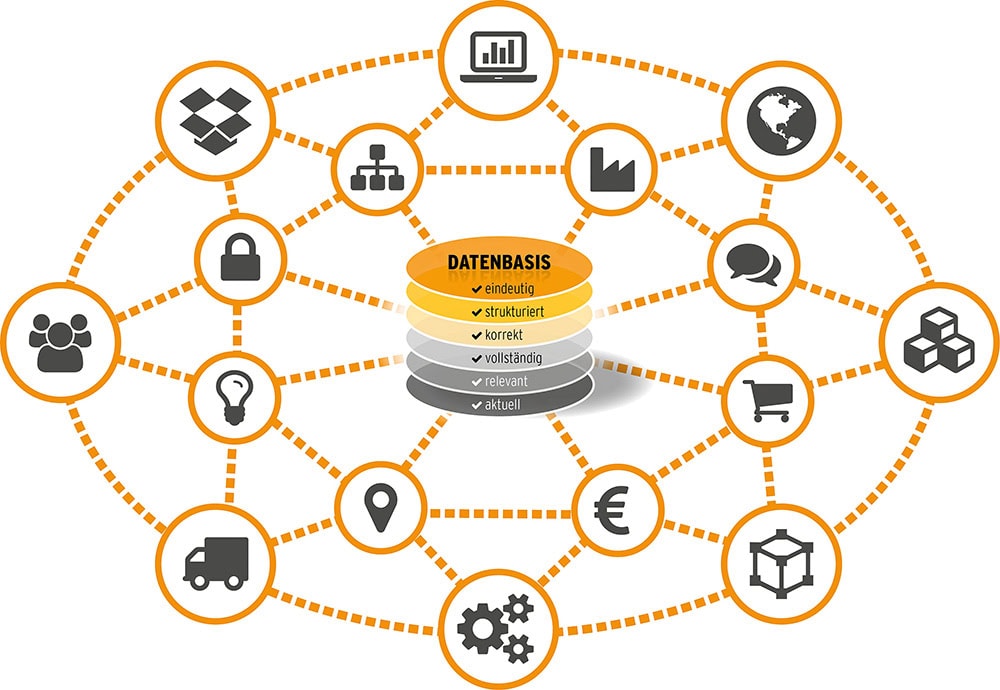
simus classmate extracts and collects data from various sources and prepares it on the basis of modifiable rules.
The first challenge for companies is therefore to identify suitable data sources and databases for each individual use case. They can then use the extracted data to train or further refine their AI models. Because the data volumes are smaller by dimensions and the effort required for training must be limited, the focus is shifting to the quality of the data: in most companies, data in ERP, PDM and CAD systems is incomplete, incomplete, stored in different terminologies, formats, categories and units and interspersed with duplicates and old data. If they originate from different sources, they need to be harmonized. Under these conditions, the effort required for AI projects increases to the point of impossibility. Companies must therefore prepare their data professionally for the use of AI in order to achieve the required quality. This is the second major challenge of individual AI projects.
Tapping into permanent data sources
The simus classmate software from simus systems, a specialist in the cleansing, structuring and efficient use of technical data, provides support in the search for suitable data sources and databases. It contains various tools that analyze data stocks of any size from the relevant internal company sources such as databases, tables or CAD, ERP and PDM systems and store them in a structured way in a results memory. This is important because many industrial AI projects use information from different data sources. For example, data from software solutions often needs to be linked with process data from OPC servers, machine controllers or PLCs of systems. simus classmate can process this data regularly and transfer the required data records to the AI.
Anyone who wants to access geometry or product manufacturing information (PMI) from CAD models will also find the right tool in simus classmate. The software searches, compares and finds geometry and other features, which has proven to be very helpful in quality projects, for example. You can even import drawings and add the drawing information to a CAD model using AI.
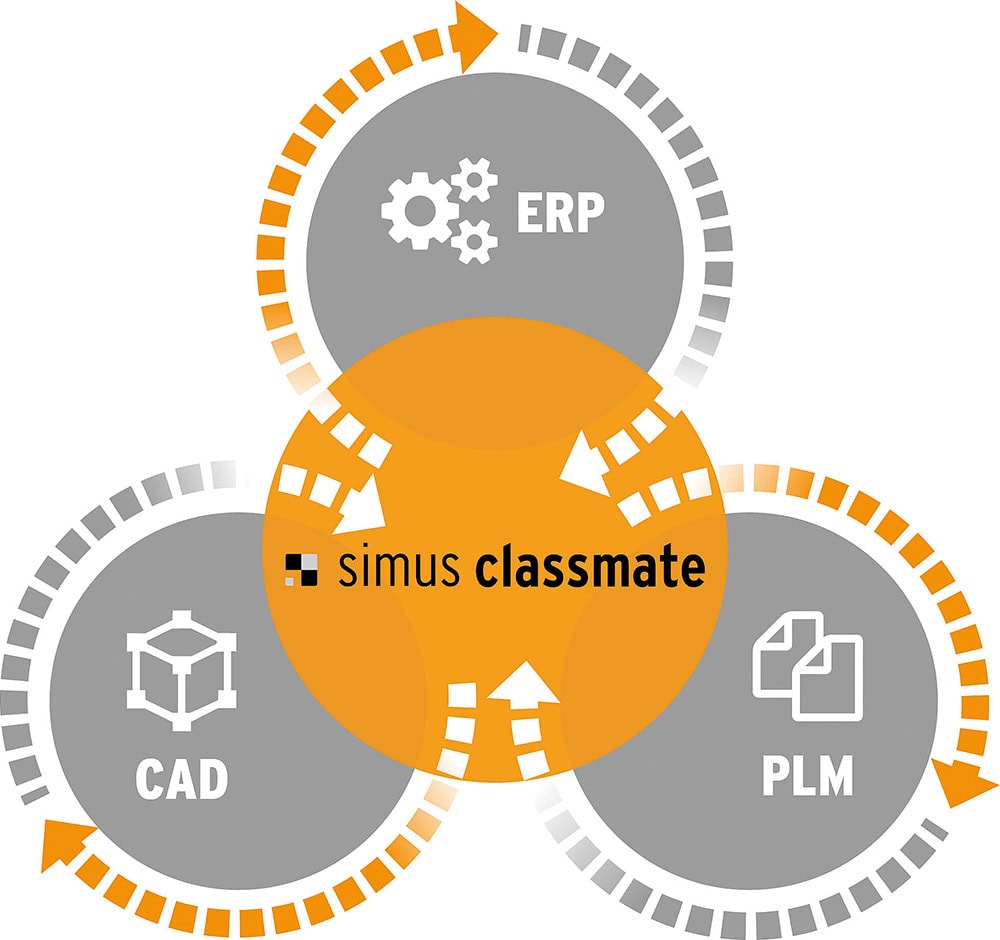
The software acts as a data hub between ERP, CAD and PDM and the peripherals.
Rule-based for AI data quality
With the tools of the -simus classmate software suite and proven project methodology, simus systems helps manufacturers to become „Fit for AI“. First, a sample of the data is analyzed in a preliminary project. This allows the goal and effort to be compared and the project to be clearly defined.
The project is now being extended to the entire relevant database. Large databases are automatically cleansed, supplemented, sorted, structured and stored using rule-based AI functions. The results are further refined in workshops with the project participants. Data can be filtered and viewed using a special search engine in order to identify any errors, duplicates or inaccuracies. Finally, the optimized dataset is released for further use. Finally, the data quality is secured for the future. The defined formats, rules and conventions are implemented for all newly created data using simus classmate software. As far as SAP's ERP systems are concerned, simus systems has powerful interfaces that ensure seamless integration of the maintained databases.
Opening up new possibilities
Furthermore, simus systems' software and services not only support the use of AI. They make many other projects easier for manufacturers, such as Manufacturing X, digital twin or data cleansing before ERP and PDM migrations. Use the smart solutions for data management to tap into the potential of digitalization and drive the future of your company forward!
About simus systems
Founded in 2002 and based in Karlsruhe, simus systems GmbH with its simus classmate product family is one of the market leaders in the field of automatic classification of CAD models, data cleansing of mass data, searching and finding existing data and automatic calculation. The independent company offers experience from over 400 successful projects in the mechanical and plant engineering, automotive and electrical engineering sectors. The simus classmate product family integrates with leading 3D CAD and PLM solutions as well as ERP systems such as SAP. (Source: Simus Systems)


 DE
DE  EN
EN  ES
ES  FR
FR