
Innovation and orientation




SAP has grown into a global corporation because Hasso Plattner and friends were able to cast complex business processes, the single point of truth and the company's organizational structure and processes into software better than anyone else.
At the moment, however, there is a growing suspicion that the global ERP market leader under the leadership of CEO Christian Klein is primarily chasing global IT megatrends instead of creating market-dominating visions on its own. Instead of presenting existing SAP customers with a clear, strategic roadmap for a future-proof enterprise operating system, the management is taking refuge in an almost inflationary buzzword bingo around cloud, AI, agentic AI and quantum computing.
SAP's current involvement in the field of artificial intelligence often resembles a hastily applied sugar coating that is poured over the entire portfolio in order to present a progressive tech company to financial analysts on the stock exchange. However, a ruthless examination reveals that SAP is not driving forward any dominant in-house development in core areas of generative AI, but is heavily reliant on collaborations. When it comes to revolutionary approaches such as Agentic AI or a Composable ERP, in which users flexibly combine the best AI agents from different manufacturers, the SAP Executive Board even warns its own community of a dangerous „Frankenstein architecture“ or an unmanageable „patchwork quilt“. This defensive rhetoric reveals a deep fear of losing control of its own ecosystem.
Even excursions into highly complex and still immature spheres such as quantum computing currently seem more like a naive waste of resources with no real ERP added value, as even the foundations for a real „Gutenberg moment“ of the AI revolution are still missing in the SAP core.
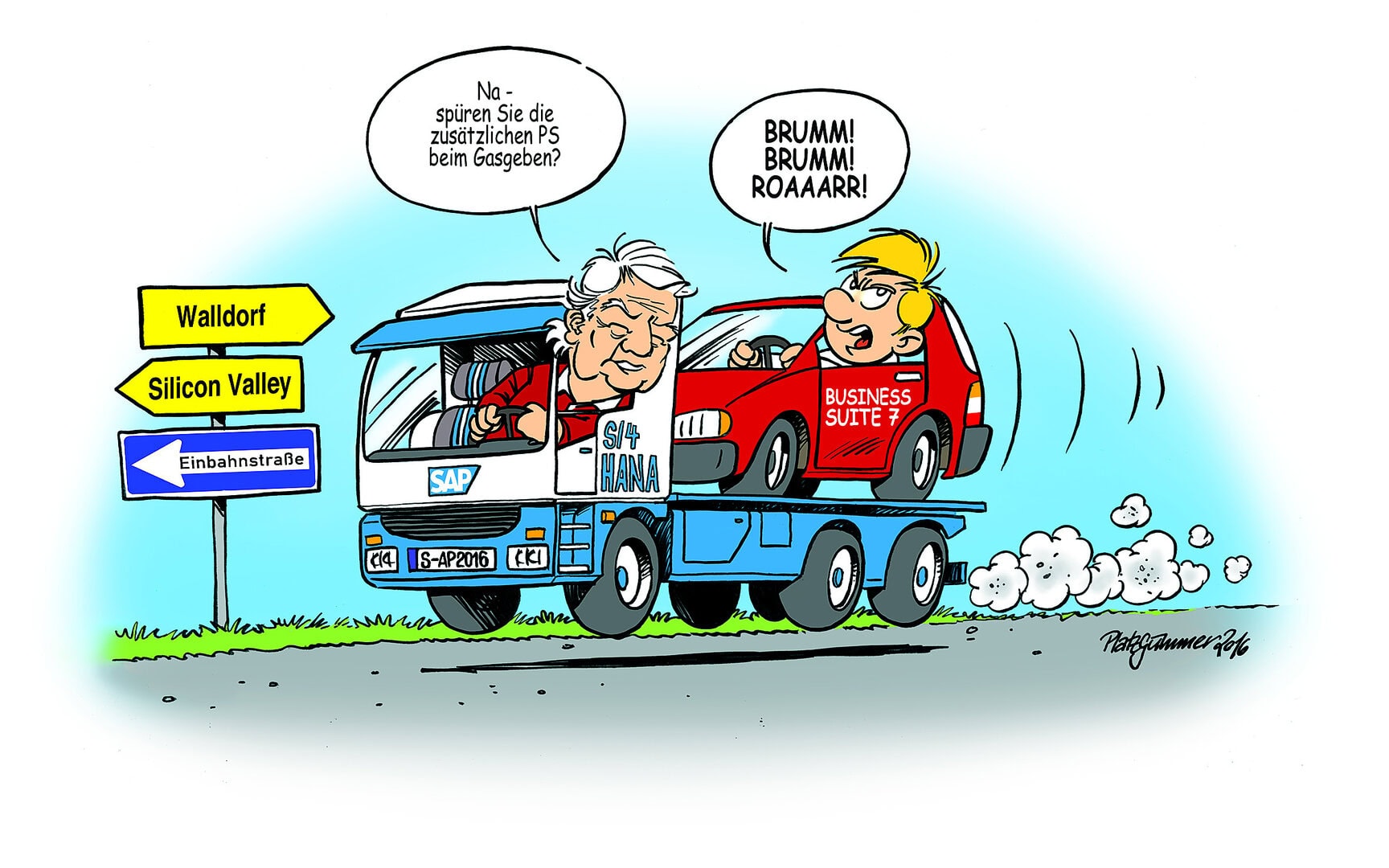
A look at the once much-praised SAP database Hana illustrates this dilemma of dwindling innovative strength particularly impressively. When Professor Hasso Plattner designed this in-memory computing database around 15 years ago at the Hasso Plattner Institute in Potsdam, it was a truly disruptive innovation that made the visionary goal of an agile „real-time enterprise“ tangible in the first place.
What has become of this innovation? Over a decade later, the initial speed advantage has almost been marginalized, as IT giants such as Oracle, IBM and Microsoft have long since caught up technically and established their own equivalent in-memory technologies on the market. For the critical existing SAP customer, the question inevitably arises as to whether in-memory computing can still be celebrated as an exclusive innovation in the context of ERP databases. The sobering answer is: no, it has long since become an indispensable industry standard that no longer justifies SAP's elitist claim to innovation.
In line with Clayton Christensen's theory of the „innovator's dilemma“, SAP has strategically failed to assert Hana as a universal, independent database leader in the free market against the established top dogs. Instead, the former technical spearhead mutated into a tough commercial instrument of vendor lock-in.
 Deutsch
  English
  Español
  Français