
First understand, then migrate: Moving alone does not create understanding




Most SAP BW cloud migrations fail because nobody knows what the data actually means. Companies invest budgets in the millions to move objects whose business logic has remained undocumented.
The result is predictable: the same questionable key figures, only on a faster infrastructure. What is planned as modernization ends up as a costly reproduction of old problems on new hardware. If you don't understand the importance of your data, you won't be able to migrate it - regardless of how powerful the target platform is. With SAP's consistent reorientation towards cloud-native platforms, such as SAP Business Data Cloud, SAP Datasphere and BW/4 Hana, it is clear that the classic BW landscape has an expiry date. Migrations are becoming a time-critical mandatory event.
Problem: Fragmented knowledge
A typical SAP BW environment in a corporate context is a product of ten to twenty years of organic growth. Thousands of InfoCubes, Data Store Objects, MultiProviders and transformations have accumulated - created by people who have long since left the organization, rarely documented, even more rarely consolidated. The decisive factor: a large proportion of the business-critical logic is not contained in transparent data models, but in individual abap code - non-transparent and personally bound.
SAP's modern target platforms are optimized for SQL. A migration therefore requires not just the relocation of data, but a complete re-engineering of the logic. It is necessary to understand what each Abap routine does, what business issue it serves, and then re-implement it in SQL or other languages. This is not a syntactic translation process, but a paradigm shift.
Bottom-up migration dead end
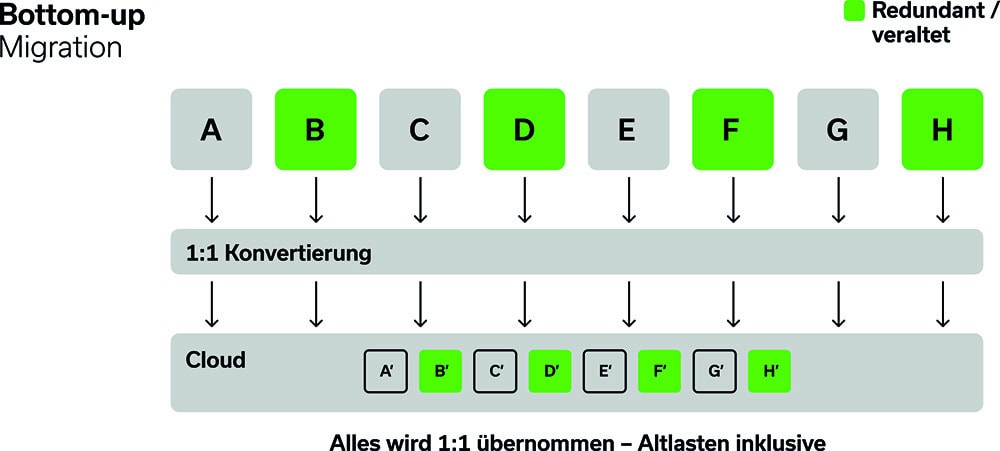
The prevailing migration approach treats this challenge as a code translation problem. Tools and consulting methodologies work from the bottom up: they inventory technical objects, assign them technical equivalents in the target platform and convert them individually. SAP itself offers powerful tools that address each migration step.
However, each of these tools looks at the individual objects in isolation. What none of them provide is an overarching understanding of the system: how do the objects interact and what business purpose do they fulfill together? Tools can migrate rules and transformation logic syntactically correctly. But they cannot assess whether these rules are still relevant to the business.
Inconsistencies in the cloud
The consequences are obvious: redundant objects are migrated together with essential ones. Teams invest months in backward analysis of logic that serves a report that has been irrelevant for years. Technical legacy is transferred unfiltered to the cloud. And where definitions were inconsistent in the source, the inconsistencies are transferred at the same time.
A semantic top-down approach reverses the conventional migration logic. Instead of moving every object from A to B, it puts the question first: What does this data mean and who needs it? The central driver of this approach is relevance and trust - and both are not created by moving, but by understanding.
The target architecture is not derived from the legacy structure, but is designed based on the added business value. In concrete terms, this means that instead of analyzing 4,000 technical objects individually, the migration begins with the question: Which 20 KPIs drive our business and what do they need?
Migration vehicle data products
In practice, this approach results in verified data products. A data product traces data back to its business purpose, records the underlying logic and makes quality, origin and responsibility transparent - this creates trust.
The resulting cost effect is considerable: instead of migrating all objects in a legacy environment to the cloud, only what actually serves the company is migrated - obsolete objects are decommissioned and redundant objects are consolidated. SAP itself is incorporating corresponding concepts into the Business Data Cloud (SAP BDC). However, the semantic approach starts one step earlier: Data products are created from metadata before the raw data is moved.
What this looks like in practice
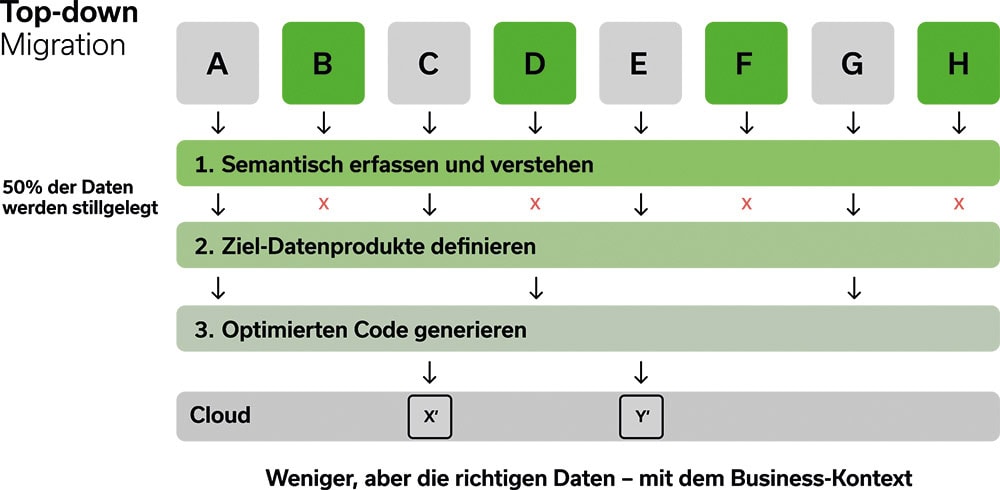
Specifically, the procedure is divided into three steps. First, the legacy environment is captured semantically: A platform reads all metadata from the SAP BW system - system objects, Abap source code, transformation logic, existing documentation. This results in a networked knowledge layer. It makes visible which objects exist, how they are connected and what purpose they serve.
In the second step, data architects and specialist departments jointly define the target data products. They do not start with a blank sheet of paper, but on the basis of this knowledge layer. Where can consolidation take place? What logic must be retained, what can be omitted? Each data product is given clear responsibility, defined quality standards and a documented context.
In the third step, the captured logic is automatically converted into executable code for the target platform. Since the intention is already understood, optimized code is created instead of a syntactic one-to-one transfer.
One example: during semantic capture, a manufacturing company identified that only around 40 percent of 3200 BW objects were actively used. The remaining 60 percent, such as historical test runs, temporary workarounds or orphaned reports, could be decommissioned before a single byte was transferred to the cloud.
An SAP BW cloud migration is often seen as a one-off infrastructure project. However, those who choose a semantic approach gain more than just a new platform: the resulting assets last beyond the migration. The semantic model becomes a living documentation of the data landscape. The data products - with their embedded quality rules, their data origin and their technical definitions - become reusable building blocks that every team can find, understand and use in new contexts. This is particularly relevant for organizations that rely on AI, because models and agents are only as reliable as the data they consume.
Creating a reliable foundation
The actual migration does not lead from one system to another. It transforms fragmented, undocumented data into a governance-capable, traceable and trustworthy database. Migrating meaning first not only creates a cloud landscape, but also a data foundation that the company can rely on. For correct KPIs, for reliable reports and for well-founded decisions.
To the partner entry:

 Deutsch
  English
  Español
  Français