
The Cost of AI for an Existing SAP Customer




Discontinued On-Prem Licenses and Engine Fees
When SAP CEO Christian Klein loudly proclaims that the traditional subscription model is foolish in the age of artificial intelligence, alarm bells should immediately go off for every existing SAP customer. Klein’s argument is based on the assumption that user-based billing will become obsolete in the age of the Autonomous Enterprise, as highly advanced AI agents will largely automate the manual work performed by humans in the ERP system and drastically reduce companies„ staffing needs. If, in the future, only a handful of AI operators control the system instead of a hundred clerks, the traditional licensing model based on Full Use Equivalents (FUE) will collapse for the Walldorf-based software manufacturer. To avert this looming cannibalization of its own revenue, SAP is pushing for a radical commercial paradigm shift toward “pay per AI usage” and results-oriented billing models.
Pay-Per-AI-Usage and Total Cost of Ownership (TCO)
What at first glance sounds like fair, value-based pricing turns out, upon closer analysis, to be a cleverly designed tool for maximizing revenue from data streams and processes—one that drives the total cost of ownership (TCO) for customers is intended to be driven to astronomical heights.
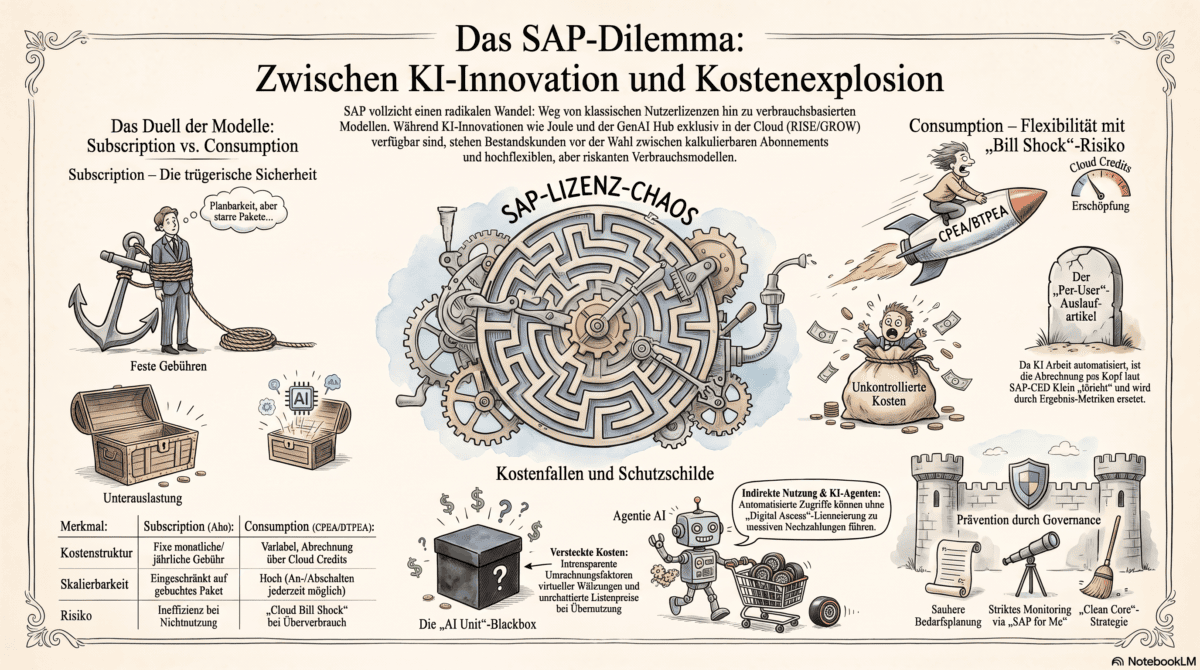
Within this new sales framework, two fundamental billing philosophies stand in contrast to one another: the traditional subscription model and the usage-based consumption model.
With a traditional subscription, existing SAP customers pay a fixed monthly or annual fee—which can be calculated in advance—for defined service packages. The advantage for cloud users lies in the absolute predictability of planning; the major disadvantage is the risk of „shelfware“—that is, paying for unused capacity.
In contrast, the consumption model—as implemented on the SAP Business Technology Platform (BTP) via the Cloud Platform Enterprise Agreement (CPEA) or the newer BTP Enterprise Agreement (BTPEA)—promises maximum agility and on-demand scaling, in which existing SAP customers have access to a prepaid-style credit account.
However, for established SAP customers, consumption is by no means inherently better than a subscription. While a subscription guarantees predictable IT budgets, the consumption-based model places constant pressure on business units to deliver a return on investment. Since virtually no company can accurately estimate in advance how many transactions an AI algorithm will actually need to answer a question, budgeting under a pure consumption strategy quickly becomes an unpredictable financial gamble during day-to-day operations.
Given the heavy AI investments by SAP, OpenAI, Oracle, Anthropic, and others, as well as the currently very low fees and token prices, this is a valid question: I exceeded my limit on Anthropic’s Claude and had to buy more expensive tokens. I asked Claude about this, and the AI replied that, based on a full-cost calculation, it was still a good deal for me, since my $200 Claude subscription is roughly equivalent to $75,000 in value. The difference is currently subsidized, and all AI providers are operating at a loss!
Subscription vs. Consumption
The cost pitfalls of this consumption model are numerous and threaten the financial stability of the IT infrastructure of unprepared SAP users. First, there is the tricky expiration policy for cloud credits purchased in advance. Existing customers must commit to annual minimum purchase volumes under contracts such as the BTPEA.
The insidious detail: Unused cloud credits expire without compensation at the end of each contract year, which creates enormous commercial pressure to frantically consume services so as not to waste money. Second, at the other end of the consumption spectrum, there’s the dreaded „cloud bill shock.“.
Cloud Bill Shock
As soon as the prepaid allocation of cloud credits is exhausted, SAP strikes without mercy and charges for any further overage at the extremely expensive list price, with no discounts. The seemingly flexible Pay-As-You-Go (PAYG) model turns out to be a commercial sham, since the service fees involved are not eligible for discounts from the outset and thus represent by far the most expensive of all operating models when used on a scalable basis in day-to-day production.
LLM Token and SAP BTP GenAI Hub
A third, often completely underestimated cost driver is the sheer token consumption of large language models within BTP’s Generative AI Hub. Unlike deterministic software, large language models operate probabilistically. When complex, iterative prompts are initiated or AI agents are called upon to search through massive context windows as part of RAG (Retrieval-Augmented Generation) architectures, API costs skyrocket in no time.
Due to the „Lost in the Middle“ phenomenon—where language models simply overlook and ignore information in the middle section of long texts—users often have to run search queries that have been refined multiple times, which drives up the token count unnoticed in the background. Every single query made to a copilot like Joule or a BTP agent costs real money. If, in the end, a human expert must still painstakingly review and approve every AI booking in accordance with the „human-in-the-loop“ principle, the economic viability of this statistical black-box approach—under the constant pressure of skyrocketing token fees—is more urgently in question than ever.
SAP API Policy and Digital Access
SAP has erected a digital customs barrier through its new, restrictive API policy. Under the guise of security concerns, the Walldorf-based SAP Group is rigorously restricting direct data access by external third-party AI agents to business-critical SAP systems. Anyone who wants to extract valuable ERP data to analyze it using the hyperscalers’ AI tools will be blocked and forced into the proprietary, expensive ecosystem of BTP and the SAP Business Data Cloud (BDC).
This isolation deeply undermines the time-tested principle of „digital access.“ Under this model, it is no longer the human user who is licensed, but rather the sheer number of documents created in non-SAP sources and imported into the SAP core system—which can lead to devastating additional charges if planning is incomplete. Since the list prices for this volume of documents are absurdly high, SAP is attempting to lure customers into the new model with limited-time discount programs such as the Digital Access Adoption Program (DAAP), in order to then contractually bind them to the document-counting model on a permanent basis.
Ultimately, the expensive but mandatory Hana database licenses on the BTP make simple, innovative low-code application development for small and medium-sized businesses uneconomical from the outset.
SAP Autonomous Enterprise
If an existing SAP customer wonders what the much-touted Autonomous Enterprise actually costs, they’ll encounter a convoluted web of opaque pricing and technical dependencies. There is no simple flat rate for autonomous intelligence. Instead, the cost structure is made up of numerous individual components: In addition to the base costs for cloud transformation (Rise with SAP), additional licenses for the BTP platform infrastructure must be purchased. While pre-built embedded AI scenarios and Joule notifications are technically included in certain cloud subscriptions in small quotas, as soon as these limits are exceeded, SAP requires the expensive purchase of so-called AI units.
SAP Discovery Center
How these virtual currencies are converted into real euros depends on individually negotiated contracts, which nips any transparency in the bud. A concrete calculation example from the SAP Discovery Center illustrates the pricing structure: The automated generation of an ESG report using generative AI based on the SAP Sustainability Control Tower costs 12 AI units for a 100-page report, which, at a hypothetical unit price of 7 euros, results in monthly costs of 84 euros—or 1,008 euros per year—for this single feature alone.
Furthermore, other hidden costs lurk on the fringes of this new architecture. The BDC—aptly derided by critics in the DSAG user group as „Business Data Complexity“ , forces companies to replicate their historical data in an expensive lakehouse architecture just to gain access to modern AI services—which effectively amounts to a ruinous “data duplication tax.”.
Pitfall: SAP Contract Conversion
Even with a traditional S/4 migration, there are significant cost risks: In addition to the drastically rising maintenance fees for older ECC systems, SAP charges a hefty two percent surcharge on existing maintenance fees for extended maintenance through 2030, which effectively amounts to a hidden price increase of about nine percent. Anyone who signs these contracts unprepared and converts the licenses via „Contract Conversion“ loses all legacy rights to their On-premise licenses, switch to a pure, permanent subscription model, and face price surcharges of 20 to 50 percent.
Governance with a Customer Center of Expertise (CCoE)
To protect themselves from an uncontrolled cost explosion in this highly complex commercial minefield, existing SAP customers must establish ironclad technical and organizational governance. As a fundamental control mechanism, the Customer Center of Expertise (CCoE) or IT Asset Management must be expanded into a strategic FinOps hub that monitors the consumption of cloud credits, AI units, and tokens—not just as a one-time assessment at the time the contract is signed, but as an ongoing management task monitored throughout the entire contract period.
Existing SAP customers should never start negotiations with SAP by requesting overly large Cloud Credit packages (BTPEA) in an effort to effectively prevent credits from expiring without replacement at the end of the year; instead, they should begin with smaller volumes. Furthermore, a thorough cleansing of master and transaction data, as well as the legally compliant decommissioning of legacy systems, is essential to minimize unnecessarily expensive data traffic and main memory requirements. Likewise, system authorizations must be consistently restructured according to the principle of least privilege, since SAP system assessment tools such as STAR sometimes incorrectly classify users based on assigned role permissions rather than actual usage, leading to massive, avoidable over-licensing. Finally, a meticulous analysis of all interfaces to non-SAP systems is absolutely essential prior to any audit in order to block unplanned digital access payments and to contractually stipulate cost-free data transfers such as the „Indirect Static Read.“.
AI developers working on the SAP Basis should use grounding techniques—such as optimized RAG chunk sizes, prompt caching, and data protection-compliant preprocessing on the SAP AI Core to systematically curb the token consumption of language models, so that artificial intelligence does not ultimately eat away at the company’s economic viability.


 Deutsch
  English
  Español
  Français