Always be truthful, not neutral




Jens Hungershausen, former CEO of DSAG, successfully led the user association for six years. In his dealings with SAP, he sought to maintain an agile yet neutral stance. Only once did the association’s criticism of SAP become clear and forceful, after which Hungershausen was summoned to Walldorf by SAP CEO Christian Klein to explain himself. SAP reacts very strongly to any perceived insult to its authority—something E3 Magazine has experienced repeatedly and with increasing frequency for over 25 years. Thus, Christiane Amanpour’s statement, „Always be truthful, not neutral,“ applies to the SAP community as well, and not just to CNN journalists.
The tense three-way relationship between SAP’s top management, the German-Speaking SAP User Group (DSAG)—which represents the interests of over 4,200 member companies—and the company’s existing customers worldwide reveals one of the deepest rifts in the history of enterprise software.
While the stock-market-oriented leadership under SAP CEO Christian Klein is driven by the expectations of international capital markets—and achieving recurring cloud subscription revenue is the top priority— IT managers at SAP’s existing customers are grappling with the physical complexity of system landscapes that have evolved over time, tight budgets, and an acute shortage of skilled workers.
Within this framework, DSAG no longer functions merely as a traditional exchange association, but increasingly as a protective bulwark for its members’ digital sovereignty—a role into which the new DSAG CEO, Thomas Henzler, will have to quickly grow into! Outgoing DSAG CEO Jens Hungershausen summed up the dynamics of this relationship by noting that SAP is advancing at a tremendous pace of innovation and, in doing so, is trying to drag existing customers and DSAG members along behind it.
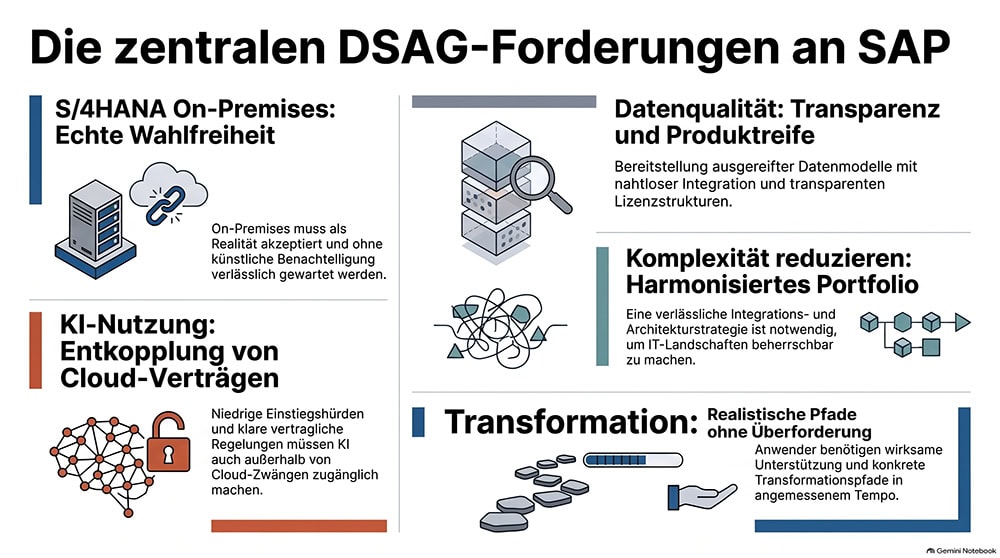
Two paradigms are clashing: SAP is promoting the vision of the Autonomous Enterprise, in which the AI copilot Joule, autonomous agents, and the Knowledge Graph take control of business processes, relegating the traditional ERP system to a mere posting server operating in the background. In contrast, existing customers and the user association view the ERP system primarily as a deterministic, absolutely reliable general ledger and digital backbone (system of record), in which audit compliance, legal compliance, and functional stability take precedence over stochastic AI experiments.
At SAP, there is a fear that, in the age of artificial intelligence, the customer interface will be lost to powerful hyperscalers such as Microsoft, Amazon Web Services, or specialized AI pioneers like Anthropic and OpenAI—which is why SAP is trying to retain customers through cloud contracts and the mandatory “Clean Core” policy.
The 2026 DSAG Annual Conference in Cologne, held under the motto „Claim Your Ground,“ marked a historic assessment of the user community’s current position and a confident change of course. With approximately 5,500 attendees at the Confex venue in Cologne, the conference made it clear that user companies must transition from being passive followers of vendor roadmaps to active architects of their own IT architecture.
The key findings and conclusions of the Cologne conference rejected blind hype cycles and emphasized the principles of „context rather than euphoria, benefit assessment rather than buzzwords, and cost-effectiveness rather than knee-jerk reactions.“.
With the transition to a new leadership team headed by Thomas Henzler, DSAG made it clear that the gap between the announced visions of the “Autonomous Enterprise” and the actual benefits for customers in day-to-day operations must be closed quickly.
For existing SAP customers, the bottom line is this: Instead of letting vendor-imposed deadlines dictate their course, IT decision-makers must chart their own path to transformation based on a clean system core, cost-benefit analyses for AI use cases, and a reliable cloud and AI exit strategy—in order to keep control of their company’s ERP system.

 Deutsch
 English
 Español
 Français