
ERP Maintenance Has to Be Expensive: A Discussion of SAP's Licensing Policy




The ongoing and successful transformation of the Walldorf-based software company SAP into a cloud-based platform provider can be characterized as an asymmetrical power struggle at the expense of SAP’s existing global customers, who face a licensing and cost jungle that threatens their very existence. The systematic transition from the customer-friendly On-premise model—featuring perpetual purchase licenses with annual maintenance (CapEx)—to a non-cancellable cloud subscription (OpEx) under the “Rise with SAP” program is gradually stripping companies of all IT autonomy and creating a permanent vendor lock-in. Anyone who stops paying their cloud subscription fee immediately loses the right to use their ERP system upon expiration of the contract term and is left with a silo of worthless, uninterpretable raw data.
This drive toward monopolization ultimately prompted the European competition regulator to step in. Following an intensive preliminary investigation, the European Commission, led by Executive Vice President Teresa Ribera Rodríguez, initiated formal antitrust proceedings under case number AT.40823 to investigate SAP’s blatant abuse of dominance in the on-premises ERP support market. The Commission preliminarily determined that SAP abused its dominant market position by forcing customers to bundle vendor support for their entire software landscape as a single, indivisible package, did not allow customers to cancel unused licenses, and charged exorbitant reactivation fees following maintenance breaks.
EU antitrust proceedings
Although SAP was required to make far-reaching commitments in July 2026—such as allowing partial landscape terminations (landscape splits) and eliminating reinstatement fees— existing SAP customers must recognize that this antitrust victory is merely a small consolation in an on-premise battle that has already been lost. Since support in the new cloud subscriptions is inextricably linked to the licenses, the cloud future remains effectively locked for independent third-party maintenance providers such as Rimini Street.
SAP is particularly aggressive when it comes to monetizing automated data flows at the system boundaries. What once unsettled users as an unresolved issue of “indirect use” was transferred in 2018 to the transaction-based Digital Access licensing model, which, however, primarily serves as a commercial stranglehold. Instead of counting human users, the sheer volume of documents generated by third-party systems, the IoT, or AI—is priced astronomically high within the SAP core, which nips innovative business models—such as low-cost spare-parts web shops—in the bud and is used as an artificial lever to push customers toward the Rise subscription model.
FUE and the Star Rules
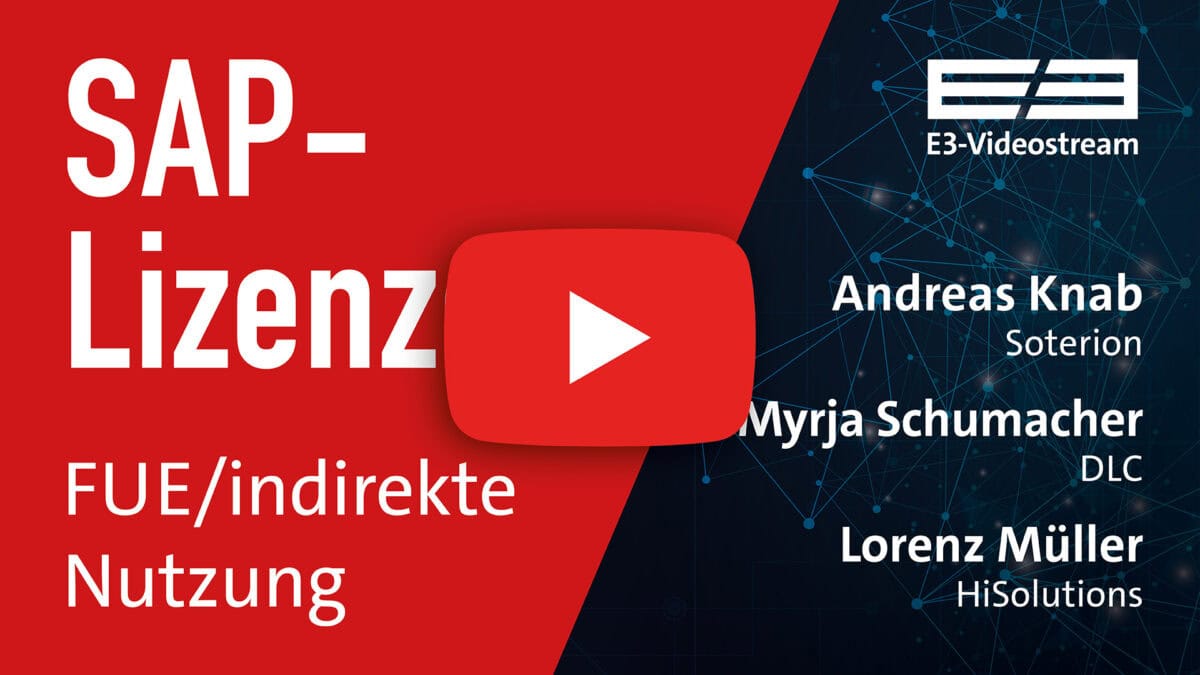
The true pitfalls of this cloud regime were revealed during the E3 roundtable (YouTube video stream from August 5, 2026) on the topic of SAP licenses: Andreas Knab, Vice President of Sales and Authorized Signatory at Soterion in Stuttgart, painted a concerning picture of the new level of control in the cloud world and emphasized: „Those who opt into this FUE model—such as with Rise—are now measured on a monthly basis. What used to be done annually now has to be kept up to date on a daily basis; otherwise, you run the risk of incurring significant costs.“
This shift in licensing metrics to Full Use Equivalents (FUE) forces companies to move from periodic reconciliation to continuous, daily entitlement monitoring, SAP licensing tools such as Star classify existing customers based on their theoretically assigned entitlements rather than on actual usage. Although Andreas Knab pointed out that SAP’s offer to freeze the Star ruleset is intended to provide customers with a certain degree of relative security, the fundamental compliance risk remains unmanageable without dedicated governance software.
Myrja Schumacher, Senior SAP Product Manager at Dynamic License Control (DLC), shed light on the business aspects behind unused license packages with hard numbers: „We have use cases where, in fact, only one percent of what was purchased is actually used—just imagine that: by the end of the year, that money is gone.“
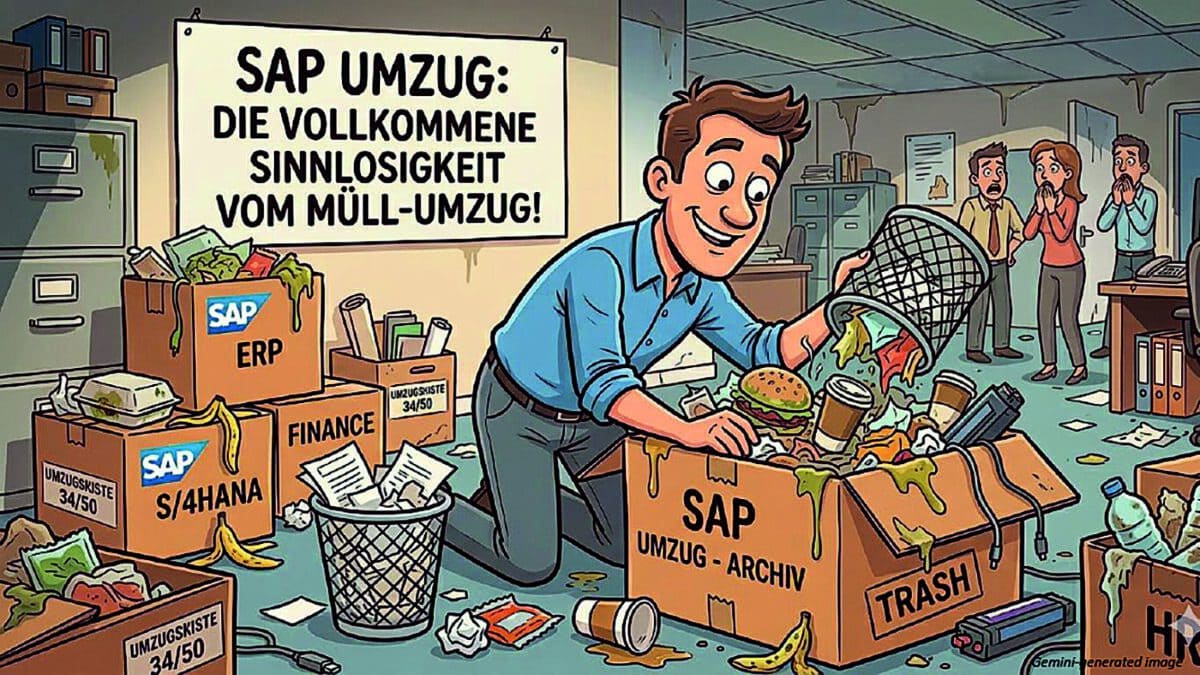
To prevent this „burning of capital“ when switching to a near-standard system (Clean Core), Myrja Schumacher drew a vivid comparison to ERP cleanup (see illustration on the right) and warned against simply dragging along historical baggage: “You don’t move into a new apartment and take your trash with you.”
Furthermore, Myrja Schumacher exposed SAP’s latest platform monetization strategies as a form of covert extortion: „Anyone who wants to extract mass data or connect AI agents via LLMs has to use the Business Data Cloud. That’s now only possible via BTP. That means high usage fees—this shouldn’t be underestimated, and it’s completely opaque.“

Lorenz Müller, Principal IT Management Consulting and SAP expert at HiSolutions, analyzed with forensic precision just how critical these hidden cost traps can become for the survival of entire companies, stating: „And SAP is extracting more and more money from companies, and in some cases this is becoming a matter of survival for them, because the complexity is increasing beyond measure.“
Lorenz Müller touched on the sore spot of the lack of transparency surrounding BTP and BDC usage and revealed the extent of the commercial inefficiency, according to which an estimated billions of euros go to waste because „with Business Data Cloud, several million to billions of euros vanish into thin air every month through credit points and tokens.“.
Lorenz Müller also criticized the blatant two-tier system and discrimination against small and medium-sized businesses in the Rise model: „We have a situation where a large customer pays a list price of 39 euros with Rise, while a small-to-medium-sized business pays somewhere between 56 and 70 euros—and then the large customer receives very high discounts, while the smaller customer gets significantly less.“
This commercial arrangement is complemented by SAP’s restrictive API policy, enacted in April 2026, which acts as a digital trade barrier. Under the guise of security and performance concerns, SAP prohibits the direct extraction of bulk data to external data warehouses such as Microsoft Fabric or the use of current third-party AI agents, unless they are routed through the expensive, in-house SAP BTP or the BDC.
Abuse and Blockage
While SAP’s own tools, such as Integrated Business Planning (IBP), are permitted to actively use the high-performance ODP interface, access to it is blocked for all competitors—a move that the German-speaking user association DSAG views as a clear abuse of a dominant market position. Consequently, anyone who wants to enhance their ERP data with LLMs in the AI era must pay a hefty toll at SAP’s “customs barrier” in the form of usage-based credit points and unpredictable AI token prices.
For existing customers, the only recommendation can therefore be to consistently secure their own licensing landscape through FinOps, permission optimization based on the principle of least privilege, and composable architectures (Composable ERP) to ensure they are not left defenseless against the insatiable profit-seeking of the Walldorf-based monopolist.
Click here to watch the recording:
Don't miss our roundtable on September 16 at 11:00 a.m.:


 DE
DE  EN
EN  ES
ES  FR
FR