
Strategic Data Sovereignty




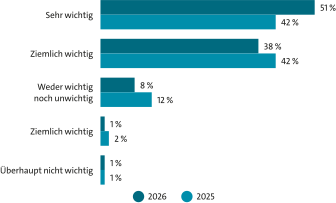
For example, 51 percent of respondents consider the topic to be very important (2025: 42 percent), and 76 percent expect its importance to continue to grow. At the same time, 40 percent have not yet invested in related initiatives, and only 10 percent have a dedicated budget.
Drivers: From Regulation to Risk
Regulatory requirements remain the most important external driver at 61 percent, but are losing ground (2025: 69 percent). Risk-driven factors are on the rise: political developments in the U.S. (54 percent, up 8 points), cybersecurity incidents (49 percent, up 7 points), and concerns about dependence on public cloud providers (46 percent, up 6 points). Internally, the main drivers are the use of data and AI in core processes (62 percent), increasing data sensitivity (52 percent), and growing vendor dependencies (49 percent).
Only 38 percent of companies have implemented sovereignty governance, while 46 percent have an established technical architecture. In terms of measures, cybersecurity (43 percent) and hybrid cloud and on-premises strategies (35 percent) dominate. The proportion of companies with repatriation initiatives has doubled within a year, from 8 to 16 percent. Regionally, North America stands out: 73 percent of companies there are funding sovereignty measures, compared to 56 percent in Europe.

„By 2026, sovereignty had become a prerequisite for,
”Scaling data and AI securely in core production processes."
Carsten Bange,
Founder and CEO,
Barc
More Than Just a Compliance Add-on
Carsten Bange, founder and CEO of Barc, comments: „By 2026, sovereignty has become a prerequisite for securely scaling data and AI in core production processes, and thus goes far beyond being merely a compliance add-on. Many programs start with a strategy and funding but then fail due to a lack of resources and technical hurdles. Anyone looking to scale needs reproducible architectural patterns and clear governance guidelines.“
Sovereignty as a Driver of Innovation
46 percent see sovereignty initiatives as having a positive effect on innovation capacity, while 9 percent see them as having a negative effect. Among companies with a dedicated budget, the proportion of positive assessments rises to 71 percent. At the same time, technical hurdles have risen sharply in 2026 (43 percent; 2025: 26 percent), and 44 percent cite a lack of human resources as a key obstacle. (Source: Barc)


 DE
DE  EN
EN  ES
ES  FR
FR