
Autonomous Enterprise versus Composable ERP




Platforms, engines and hubs
SAP had everything an ERP user needed for a modern business application: Many things were too expensive, too complex and often redundant, so that an ERP problem could be solved with different SAP tools. But the existing SAP customer was hesitant because nobody knew which products had a verified roadmap and which products would be replaced by acquisitions. The SAP offering was unmanageable and has grown even more and become even more complex with the latest announcements surrounding Sapphire in Orlando. What now? Who will provide the answers to the SAP Integration Suite, the Hana Knowledge Graph Engine and the n8n cooperation? And who will prevail in the end: SAP-RPT or Prior Labs?
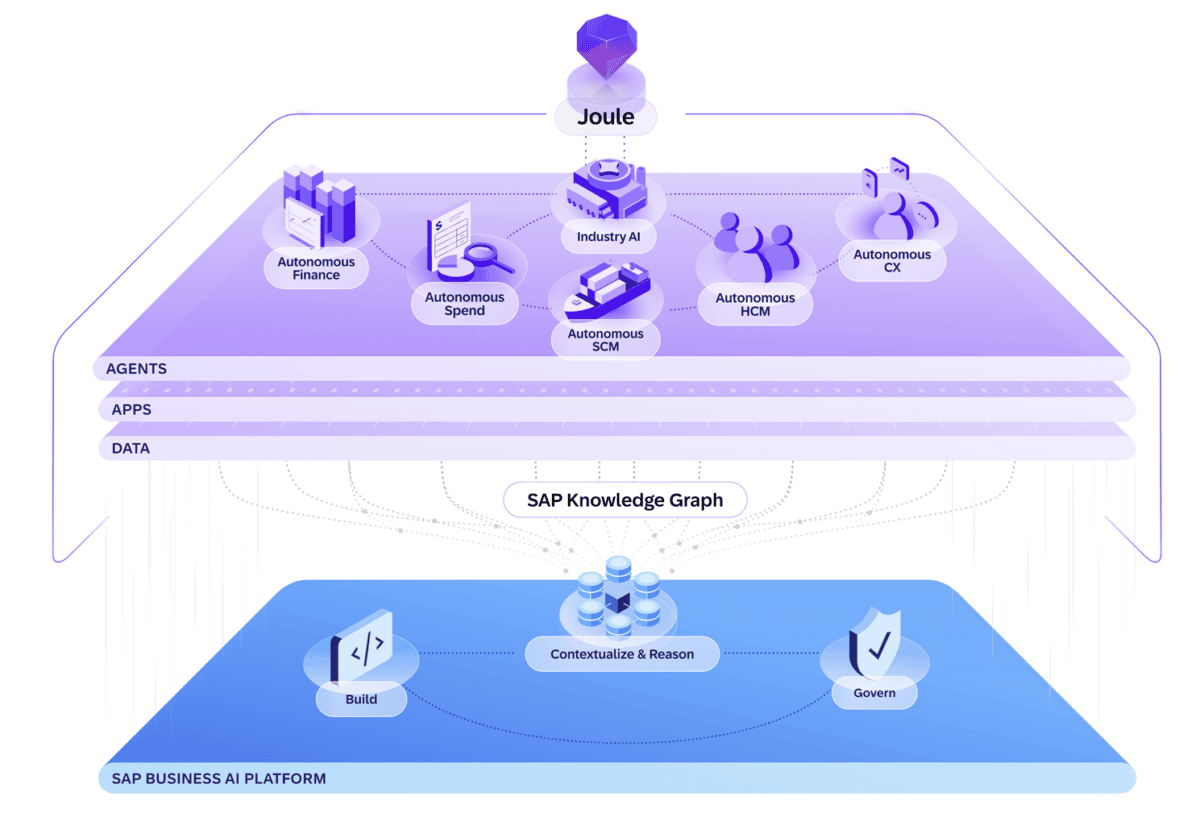
At Sapphire, SAP CEO Christian Klein reshuffled the ERP cards: architecturally, SAP is building the autonomous target image in several layers, the foundation of which is the so-called Business AI Platform, in which the technical pillars of the Business Technology Platform (SAP BTP), the Business Data Cloud (SAP BDC or, as the user association DSAG puts it: Business Data Complexity) as well as tools such as Signavio and LeanIX are brought together to develop and provide AI solutions. The essential link between this new platform and the actual applications is to be an „SAP Knowledge Graph“ (the old graph engine from the Hana database platform), which is intended to make the historically grown and often highly complex SAP data readable and retrievable for AI agents in a structured manner in the first place.
From ECC 6.0 to self-driving ERP
According to Christian Klein, the new and operational centerpiece is the „SAP Autonomous Suite“, in which SAP promises more than 50 domain-specific Joule assistants for traditional business areas such as finance, supply chain or procurement. In future, these assistants will act as digital coordinators and control a subgroup of over 200 specialized AI agents in order to carry out entire end-to-end processes - such as quarterly closing in the finance department - largely autonomously and reduce the time required from weeks to a few days.
Ideally, the ERP user only interacts via the higher-level user interface „Joule Work“, where they express their intentions using natural language input, while the AI proactively reveals insights and performs routine tasks automatically in the background.
However, if you look behind the scenes of this autonomous vision with journalistic detachment, a much more sober picture emerges for existing SAP customers, which the user association DSAG has already analyzed. SAP's established core applications and familiar Software-as-a-Service solutions remain virtually untouched in the new architecture; they are merely being strategically reorganized, given the prefix „Autonomous“ - such as „Autonomous Finance“ or „Autonomous Procurement“ - and supplemented by various AI agents.
So whether procurement is advertised as autonomous in the future does not change the fact that the familiar cloud solutions such as SAP Ariba or the SAP Business Network will continue to operate in the machine room. According to DSAG's assessment, this strategic change will therefore have no direct impact on the current system landscape of existing customers or on S/4 conversions that are already underway, which is why existing transformation projects do not need to be stopped or reconsidered. SAP is therefore not fundamentally reinventing the ERP wheel in this move, but is primarily putting a new AI layer over the previous, independent solutions and combining them into a new narrative.
Like Tesla, with Autonomous Enterprise to the crash
The operational maturity and commercial design of this promise of salvation of a self-driving and independent ERP are particularly open to criticism. At the time of the grandiose announcements at the Sapphire customer trade fair, there was a lack of fundamental details on the technical implementation, exact release dates and, above all, the decisive pricing and billing models, which massively jeopardizes the financial planning security of companies.
In addition, many existing customers and IT experts have had the painful experience in the past that SAP marketing is often miles ahead of the actual technical reality and that previous AI functions are still immature in the tough day-to-day business environment. DSAG therefore strongly warns that fundamental core functions that are essential for ERP success - such as end-to-end document management, reliable central user administration or the continuous improvement of user interfaces - must not be allowed to take a back seat in favor of costly AI investments.
Existing SAP customers will also have to wait and see whether the translation of complex SAP databases (Hana) by the new Knowledge Graph (Hana Engine) actually works without errors in practice, as it is precisely this lack of contextual knowledge that has often presented the AI assistant Joule with unsolvable problems to date. Knowledge Graph - old wine in new bottles: A graph engine has existed on the Hana platform for many years. In order to be able to present something concrete at Sapphire in Orlando, graph theory from computer science was once again used. Ultimately, the Autonomous ERP Suite is currently proving to be primarily a visionary construct where customers need to remain vigilant as to whether the promised autonomy actually justifies the high price before they blindly allow themselves to be dazzled by the cloudy AI promises of Walldorf.
Digital sovereignty: autonomous versus composable
When the future direction of enterprise software (ERP) is viewed through a critical analytical lens, a fundamental conflict of direction emerges between the „Autonomous Enterprise“ freshly proclaimed by SAP and the market-driven paradigm of „Composable ERP“.
The SAP concept of the „Autonomous Enterprise“ is the latest, heavily stock market-driven marketing narrative from Walldorf, which is already ruthlessly replacing the North Star architecture presented just a year ago in order to hastily meet the enormous pressure to innovate in the financial markets around artificial intelligence. Critically scrutinized, this highly polished target image often turns out to be pure fraudulent labeling for existing SAP customers, as the new AI sugar coating still conceals exactly the same established cloud solutions such as Ariba or the Business Network. In contrast, the revolutionary and liberating alternative is composable ERP, an approach coined by analysts such as Gartner and thought leaders such as Professor August-Wilhelm Scheer, which finally puts an end to the era of rigid, monolithic systems and instead places maximum business adaptability at the heart of IT. Composable ERP enables users to free themselves from the threat of being locked into a single vendor and flexibly assemble their IT landscape from the best modular building blocks on the market - for example, the financial core from SAP combined with innovative HR solutions from Workday and CRM systems from Salesforce - via integration platforms such as SAP BTP or independent alternatives such as Boomi.
Personal responsibility of existing SAP customers
The decisive difference for every existing SAP customer therefore lies in the distribution of power and digital sovereignty: While the „Autonomous Enterprise“ is SAP's transparent attempt to cement total control over customers' data and processes through a closed AI ecosystem and push them deeper into lucrative cloud dependencies, Composable ERP requires and encourages companies to take radical personal responsibility for designing their architecture beyond Walldorf's marketing illusions as an orchestrated, open and vendor-independent network in a self-determined and self-reliant (autonomous) manner.

 DE
DE  EN
EN  ES
ES  FR
FR