

- This event has passed.
E3 Roundtable: Mid-Sized Businesses Between Monolithic Suites and Composable ERP
October 14, 11:00 a.m. to 12:00
Free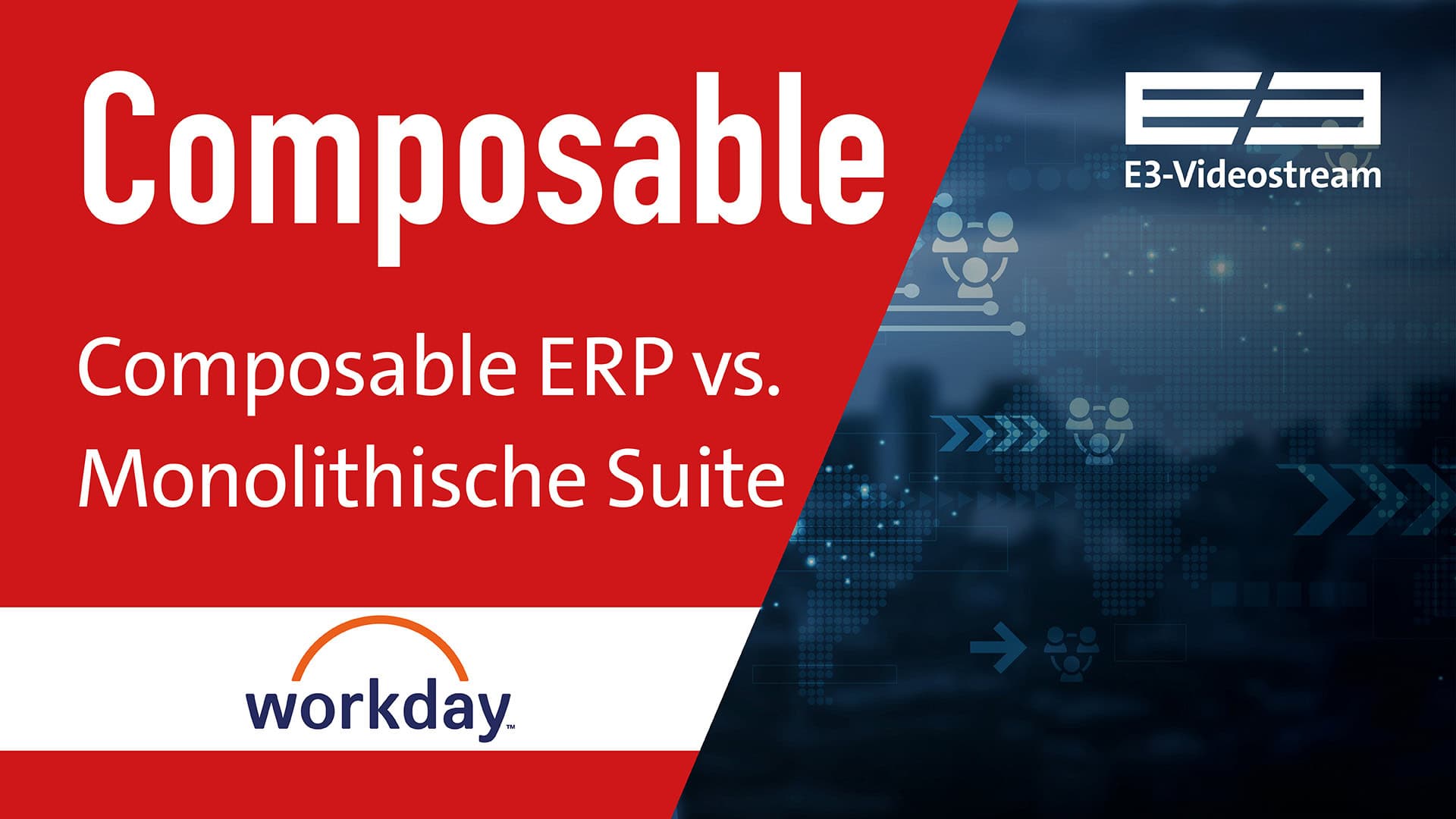
Monolithic Suite vs. Composable Enterprise
For traditional industrial customers, a hybrid coexistence approach is becoming increasingly common in practice. The key issue is the productivity of end-to-end processes. How can small and medium-sized businesses without large IT departments achieve ERP productivity for their business processes: What IT architecture, software selection, and organizational structure are necessary or desirable?
For existing SAP customers, the question of the optimal software infrastructure has long since become a fundamental strategic decision. While SAP has for decades preached the dogma of the integrated “best-of-suite” solution—in which everything from production to payroll runs on a single system—this monopoly is inexorably crumbling in the cloud era.
The market is clearly drifting toward a composable ERP architecture, in which specialized market leaders (best-of-breed) are linked via standardized interfaces. In this competitive landscape, the two software giants—SAP and the U.S. challenger Workday—face off against each other. Existing customers facing the mandatory S/4 migration are increasingly using this technological turning point to critically evaluate their core areas—namely Human Capital Management (HCM) and Finance—and, if necessary, realign them.
The difference between Workday and SAP lies in the DNA of their software architecture. From the very beginning, Workday was consistently designed as a cloud-native system, free from the burdensome legacy issues of on-premises systems that are decades old. The entire platform’s value proposition is based on the principle of a single, unified source of truth, a consistent security model, a seamless user experience, and a single release version for all customers worldwide.
The decision in favor of one system or the other must be strictly based on the user’s business model: For service providers, media companies, or retail firms—where employees and their specific skills are the most important asset and the largest cost center—Workday offers a significantly more modern, flexible, and low-maintenance platform. The global SAP user community is perplexed by the often erratic cloud messaging coming out of Walldorf, which leaves customers caught between hybrid, private, and public scenarios without a clear roadmap. For midsize companies—which Workday pragmatically defines as having up to 3,500 employees—and for existing SAP customers, the U.S.-based challenger Workday offers a technical and organizational breakthrough. The key to this lies in its uncompromising “cloud-only” and “cloud-native” philosophy.
Designed specifically for small and medium-sized businesses—which, unlike global corporations, lack both unlimited IT budgets and vast development resources in a volatile market environment—the cloud provider has created Workday GO, a tailored, preconfigured package. This offering combines HR, global payroll, and finance on a single platform and enables a fast, low-risk go-live based on over 270 predefined best-practice processes. Implementation takes place as part of a transparent fixed-price package with a clearly defined scope of functionality (fixed scope). This ensures a rapid return on investment and reduces the burden on internal IT teams, as all support and maintenance for hardware and software are fully outsourced to the cloud.
In addition, through this unified platform, mid-sized businesses can directly benefit from technical innovations—such as immediate access to sophisticated AI agents—that would otherwise only be feasible for large corporations with substantial financial resources. From the perspective of users and business units, this shift leads to a noticeable increase in productivity and a modern employee experience that traditional, menu-heavy ERP systems cannot provide.
Workday consistently focuses on the needs of the workforce and, through an intuitive mobile-first approach, enables real-time, round-the-clock access to HR and financial processes worldwide. For traditional SAP customers, the transition to Workday by no means involves a reckless “rip-and-replace” approach that would destroy the carefully built ERP foundation. Rather, in practice, a highly agile, best-of-breed scenario is taking shape. While complex physical core processes in production, materials management, or logistics continue to be handled in the proven SAP system, companies are outsourcing strategic talent management, workforce planning, and forward-looking financial simulations to the Workday cloud.
 Deutsch
  English
  Español
  Français