
S/4 On-Prem and SAP FSM: Two Systems, One Goal




How can the SAP Business Technology Platform (BTP), as an integration layer, connect S/4 On-Prem and SAP FSM and enable an end-to-end service process?
S/4 Hana Service and SAP Field Service Management fulfill different roles in the service process. The former is designed to map business processes, while SAP Field Service Management is designed for operational execution in the field.
While this clear division of responsibilities offers advantages for each role in the service process, without integration, information between the systems must be manually reconciled or updated. This results, on the one hand, in organizational inefficiencies due to media breaks and, on the other hand, in increased administrative effort—even though the goal of both components is to eliminate such effort as much as possible.
Duplicate Data Maintenance
However, the challenge here very rarely lies in the functional capabilities of the individual systems, but rather in how well they work together across systems.
Although both SAP S/4 HANA and SAP Field Service Management are products from the same vendor, they are based on different data models. In the ERP system, many business objects are closely linked to one another. For example, a service order contains references to business partners, materials, technical objects, and organizational structures. These relationships reflect complex business contexts. SAP Field Service Management, on the other hand, uses a data model that is more focused on operational service processes. Objects such as service calls or activities have a more compact structure and are geared toward field service scheduling.
Without the necessary technical integration, information must therefore be transferred manually between the systems. Typical problems in this context include the need to maintain master data—such as customer information or addresses—in two places, a lack of transparency regarding the current status of a service call, and data inconsistencies that can occur between scheduling, field service, and billing.
BTP Integration Layer
In many organizations, these gaps are filled with manual workflows. Service technicians document information separately, while schedulers must consolidate data from multiple systems. This significantly increases the administrative burden and largely negates the intended benefit. To address these challenges, an integration layer between the systems is required. In the SAP landscape, the SAP Business Technology Platform (BTP) fulfills this role. The BTP provides a cloud platform that connects different systems. For integration scenarios, the Integration Suite is used within this platform. It acts as middleware between the connected applications.
Platform and Integration Layer
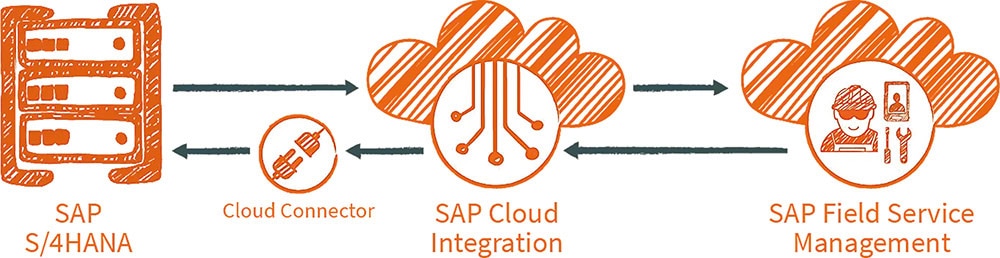
The purpose of this integration layer is to orchestrate data flows between the systems. Information from S/4 HANA is transformed into a suitable format and forwarded to SAP Field Service Management. Feedback from field service can then be transferred back to the ERP system in a structured manner.
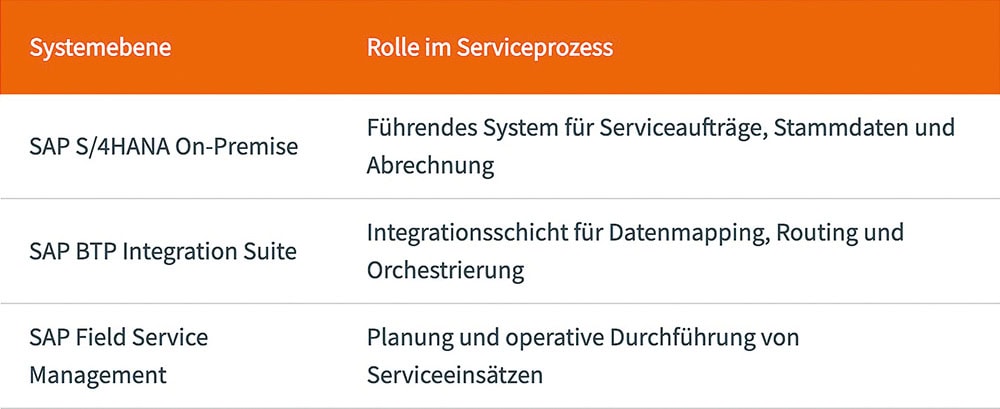
In simple terms, the architecture can be broken down into three layers: This structure creates a loose coupling between the systems. Changes can be made to one system without having to adjust the entire integration architecture.
Orchestration with Integration Suite
Within the SAP Business Technology Platform, the Integration Suite handles the operational implementation of system integration. The integration logic is modeled in what are known as integration flows (iFlows). These iFlows define how messages are received, transformed, and then forwarded to target systems.
A typical integration flow involves several steps. First, the platform receives a message from the ERP system. The data contained in the message is then analyzed and converted to match the structure of the target system. Finally, the data is transferred to the corresponding interface of the target system. The integration layer performs several technical tasks in this process: transforming different data formats, such as XML or JSON; mapping between the systems’ data models; and controlling the communication flows between the applications.
This creates a technical translation layer between the systems. It ensures that information that is substantively identical is transferred correctly despite differences in data structures.
Proper structure alone is not enough
The correct technical setup of the integration is only part of the solution. A clearly defined organizational structure in the SAP S/4HANA system is at least as critical. Only when the organizational units and responsibilities are consistently maintained can the filters for data transfer be configured correctly.These filters determine which objects from the ERP system are transferred to SAP Field Service Management. These include, for example, business partners, technical objects, or service orders. If organizational structures are modeled inconsistently, either too many or too few data records will be replicated.
Data Replication Framework
In SAP S/4 HANA, the data replication framework forms the basis for these automated data transfers. It controls which data is initially transferred and subsequently synchronized on an ongoing basis. A proper configuration of this framework contributes significantly to the stability of the integration.
If this foundation is not properly set up, automatic synchronizations often function only to a very limited extent. In such cases, replication runs must be triggered manually so that the data between the systems can be kept up to date. (Source: Inwerken)
Conclusion: The best of both worlds
An integrated system landscape enables service organizations to combine the respective strengths of SAP S/4 HANA and SAP Field Service Management in a targeted manner. S/4 HANA remains the leading system for business processes, master data, and billing, while SAP Field Service Management supports operational planning and execution in the field. The BTP integration platform orchestrates data flows between the systems. It ensures that relevant information is transferred in a structured manner and processed correctly in the respective target systems.
This provides planning and service management with a consistent view of the entire service process. The result is a service architecture that links business processes in the ERP system with the operational requirements of field service. Successful integration of S/4 HANA Service and FSM lays the foundation for end-to-end digital service processes. A structured integration approach based on the SAP Business Technology Platform also makes it possible to connect service processes across systems.


 Deutsch
  English
  Español
  Français