Pandora's Box



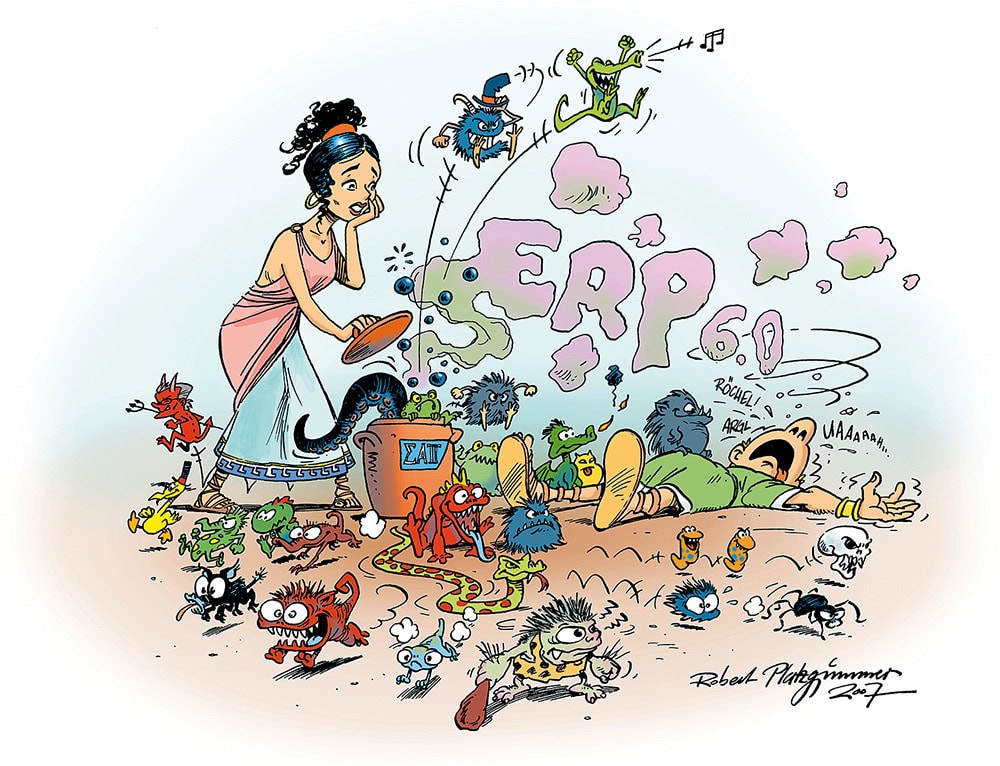
With Pandora’s box, countless plagues, diseases, and hardships came upon the world, while only a glimmer of hope remained at the dark bottom of the vessel. When SAP CEO Christian Klein proclaims the dawn of the self-sufficient enterprise and touts Business AI, Joule, and the SAP Knowledge Graph as revolutionary breakthroughs, a fascinating parallel comes to mind: has SAP, with this technical construct, opened a digital Pandora’s box? Is the SAP Knowledge Graph, in reality, the vessel from which unanticipated licensing costs, usage-based billing shocks, extreme computational demands, and unmanageable consulting projects—while in the end, the only vague hope that glimmers is the promise of hallucination-free artificial intelligence?
Even the most intelligent large language model fails miserably when faced with the historically evolved, notoriously cryptic table structures of an SAP system, since the machine lacks any understanding of business contexts. This is where the SAP Knowledge Graph comes into play—aptly described by the community as the semantic „Babelfish“ of the data world.
The Babel Fish is a fictional creature from Douglas Adams' novel *The Hitchhiker's Guide to the Galaxy* that has become a symbol for machine-based translation systems. Douglas Adams chose the name “Babelfish” in reference to the biblical story of the Tower of Babel and the ensuing confusion of languages described in the Book of Genesis.
The SAP Knowledge Graph serves as an AI data compass and maps the complex ERP landscape by automatically translating master data, documents, and process paths into a machine-readable ontology and a graph model consisting of nodes and edges. However, the flip side of the coin reveals why the Knowledge Graph can actually become a real headache for existing customers: The theoretical advantage of rule-based, explainable logic and the preservation of authorization structures is offset in reality by massive business and organizational drawbacks. Modeling and maintaining ontologies is a complex undertaking that requires expert knowledge and entails enormous initial effort.
The SAP Knowledge Graph seems like Pandora’s box. As soon as a company lifts the lid, it is confronted with a flood of technical dependencies, organizational overhead, and new licensing tolls. Nevertheless, the „hope“ at the bottom of the box should not be overlooked: With semantic graph modeling, users gain a tool to integrate their AI into the processes of an Autonomous Enterprise in a way that is free of hallucinations, transparent, and adds value.

 Deutsch
 English
 Español
 Français