
The Great Hypervisor Revolt




The era of „business as usual“ in virtualization is finally over. Recent upheavals in the virtualization market—particularly the massive price hikes and the forced shift to subscription models following Broadcom’s acquisition of VMware—have created a major pain point for the market. IT decision-makers are facing escalating costs, unpredictable renewal cycles, and a dangerous „TCO explosion.“.
VMware Load
Average licensing costs rise dramatically when contracts are renewed, and the shift from CPU-socket-based to core-based billing often leads to artificial over-licensing. For medium-sized to large enterprises, these costs for operating and managing ESX environments can range from several hundred thousand to several million euros annually.
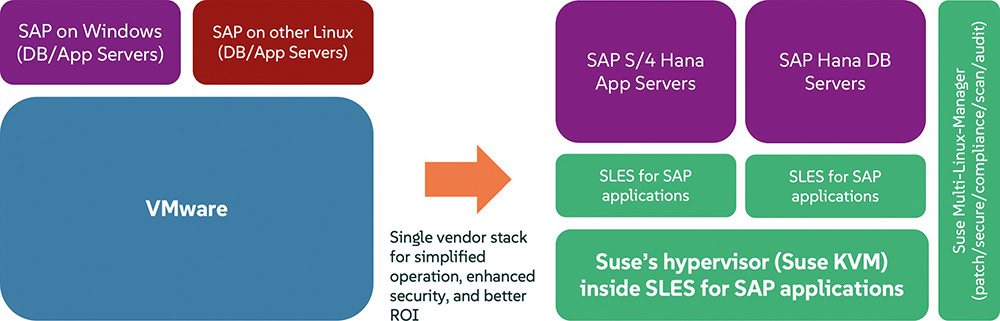
This uncertainty creates a need for IT consolidation. Companies urgently need to streamline their IT landscapes and free themselves from the proprietary „VMware burden“—the so-called hypervisor tax—in order to adopt a new, future-proof operating model and reduce costs. Financial pressure is turning the inefficiency of legacy hypervisors into a risk at the executive level. Especially in storage-intensive and business-critical SAP environments, it is no longer economically justifiable to pay a premium for a virtualization layer that essentially performs a purely commodity function. Proprietary models tie companies to a single vendor’s roadmap and pricing structure, limiting their bargaining power and flexibility.
This is precisely where the core message for modern data centers comes into play: With its SUSE Linux Enterprise Server (SLES) for SAP Applications Platform, SUSE offers the SAP-validated KVM (Kernel-based Virtual Machine) as well as a genuine, stable, and enterprise-ready open-source alternative through SUSE Virtualization.
Instead of spending their budgets on proprietary software subscriptions, companies are shifting their investments to a Linux operating system subscription that already includes a built-in virtualization layer. This protects companies’ investments, prevents hardware lock-ins, and provides a high-performance foundation for the world’s most demanding workloads. SUSE’s unique selling point in this highly competitive environment is that it offers the only SAP-validated KVM solution currently available on the market. Added to this is its positioning as a provider that offers the hypervisor for SAP directly and natively from within the Linux platform. SUSE Linux Enterprise Server for SAP Applications includes not only the operating system but also SUSE KVM, the hypervisor for SAP, as an integral component—which completely eliminates the need for separate hypervisor license fees. This deep integration guarantees superior performance, which is essential for business-critical S/4 environments and memory-intensive in-memory databases such as HANA. KVM operates with minimal overhead—typically only 5 to 10 percent—and thus delivers near-bare-metal speed. This not only meets SAP’s stringent performance KPIs but also ensures high availability (HA) and business continuity during maintenance work.
From a technological standpoint, the platform stands out for its scalability: For example, based on the Intel Sapphire Rapids architecture, it supports HANA instances with up to 8 TB of RAM. SUSE manages the hypervisor and the operating system for the SAP applications via a central interface, the SUSE Multi-Linux Manager.
SAP HANA on KVM
The biggest challenge is to optimally align existing HANA systems with the target platform in terms of data volume, storage requirements, and workload distribution. Without a thorough analysis, resources are often oversized, or performance potential goes untapped. To harness the full potential of this architecture, customers rely on a strong partner ecosystem. XLC (Crossload Consulting), led by Jens Gleichmann, provides comprehensive architectural expertise in the HANA environment and lays the technical foundation for running HANA on KVM.
The focus is on a systematic health check of the existing environment. Storage consumption and workloads are analyzed, and opportunities for optimization are identified. Techniques such as SAP HANA Native Storage Extension (NSE), optimized indexes, or the conversion of suitable data types (Varbinary to Large Objects) significantly reduce storage requirements without noticeably impacting the performance of business-critical applications. The topics of sizing and workload management are so important today that Matthias Sander and Jens Gleichmann have dedicated separate chapters to them in their reference book *SAP HANA Deep Dive*. Practical experience shows that structured analysis and optimization can save 30 to 40 percent of system resources in many projects. Given the high investment costs for RAM and current generations of Intel servers—such as Emerald Rapids—this results in sustainable economic benefits. In a Discovery Workshop, XLC works with the customer to analyze the existing landscape. Building on this, the target architecture and operating model for KVM are developed. An initial health check provides the necessary transparency and lays the foundation for a migration that is both economically and technically successful.
NetApp: Performance Booster
NetApp delivers business value for SAP environments running on SUSE KVM by providing the highly available, high-performance data foundation required for HANA operations at near-bare-metal speeds. While SUSE KVM already minimizes virtualization overhead and delivers SAP-validated performance, its full potential is only realized when combined with NetApp’s enterprise storage and data management capabilities.
In SUSE virtualization environments, NetApp provides persistent, high-availability storage—either as FC LUNs or NFS volumes—ensuring uninterrupted operation. Storage provisioning in OnTap can be fully automated using open standards and APIs. Whether for in-guest mounts using NFS or via Fibre Channel (FC)—provided the HBA is assigned directly to the VM in accordance with SUSE recommendations—seamless backup and recovery processes via SnapCenter integration are standard. Backup and recovery processes via SnapCenter integration are standard features. NetApp’s first-party cloud storage solutions on Microsoft Azure (ANF) and AWS (FSx for NetApp OnTap) are HANA-certified. They enable customers to replicate data to the cloud using native NetApp technologies such as SnapMirror. In this way, on-premises resource bottlenecks can be offset in the short term through the flexible use of cloud resources without requiring adjustments to the existing operating model. This makes a hybrid multi-cloud architecture a reality for customers who rely on the combination of SUSE, NetApp, and SAP.
SAP Orchestration with Fsas
For cross-system orchestration, automation, and hardware integration, Fsas Technologies offers Primeflex for SAP Landscapes and the FlexFrame Orchestrator (FFO)—a well-established SAP platform on the market that natively supports KVM. While SUSE provides the technological foundation for the operating system and virtualization, FFO ensures a standardized and highly automated operating model across the entire SAP landscape. SAP systems can be automatically provisioned, moved, scaled, and maintained, thereby reducing administrative overhead and simplifying operational processes. FFO’s orchestration capabilities support stable and efficient operations, particularly during updates, maintenance windows, and high-availability and disaster-recovery scenarios. This frees up time for IT departments to focus on strategic tasks and move away from the frequent “firefighting” mode of day-to-day operations.
Freedom with Hypervisor
Evidence of this added value comes from a statement by Andreas Spiegler, SAP Basis Administrator at the Kuka Group: „With Primeflex for SAP Landscapes, we were able to significantly reduce our virtualization costs while maintaining the familiar standardized processes and automations for our SAP systems.“
Spiegler emphasizes that the world's leading provider of intelligent robotics, plant engineering, and systems technology has strengthened its digital sovereignty and regained freedom in its hypervisor strategy through the use of the open-source-based platform.
More Than Just "Lift-and-Shift"
Migrating Hana workloads to SUSE KVM is far more than a simple “lift-and-shift” project. Since proprietary vSphere features have no direct equivalents in the KVM world, the migration requires entirely new architectural approaches and a fundamental shift in operational procedures. Specialized expertise is essential for this complex technological transition.
This is where SoftwareOne and SUSE come in: SUSE’s technological leadership in the open-source market is combined with SoftwareOne’s in-depth implementation and consulting expertise. A holistic, all-in-one approach covers the entire lifecycle of the SAP landscape. Following a secure KVM migration performed by a Professional Service team, SoftwareOne—as part of this managed service—takes over proactive system management upon request, manages additional S/4 transformation projects, and provides consulting and development support for the SAP Business Technology Platform. Through targeted FinOps, the use of proprietary tools, and precise license optimization for SAP Rise projects, SoftwareOne ensures continuous cost reductions. Every successful and secure modernization begins with the right first step.
That is why SoftwareOne always begins joint projects with a thorough assessment. During a detailed scoping call, the experts analyze the customer’s current VMware environment, identify technical legacy issues, and design a customized, risk-free target KVM architecture.
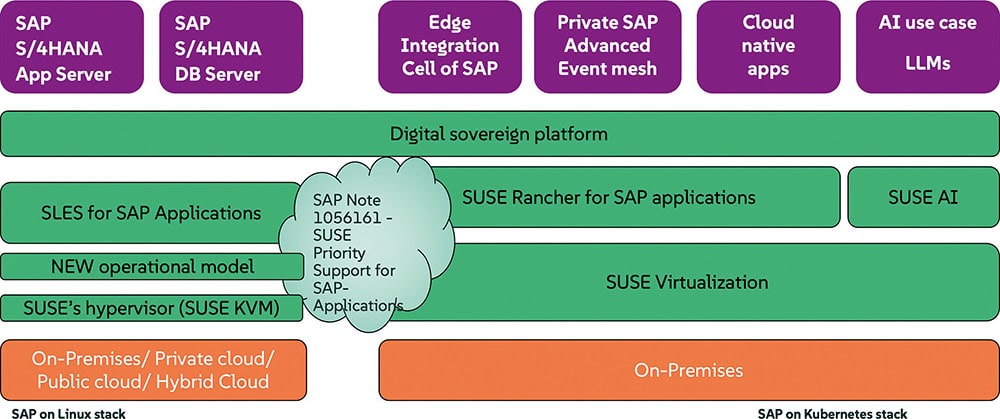
However, the modernization of the IT infrastructure must not stop at SAP core applications. To realize their full economic and technological potential, companies must take the strategic step of looking beyond the core. This means that the replacement of VMware with SUSE Virtualization based on Kubernetes should also be extended to SAP and non-SAP cloud-native workloads, as well as traditional non-SAP workloads.
Kubernetes for Edge Integration Cell
SUSE Virtualization offers a hyperconverged infrastructure (HCI) based entirely on open-source technologies, combining a Kubernetes-based virtualization layer (KubeVirt) with integrated storage and networking capabilities. This enables enterprises to securely and efficiently manage both traditional virtual machines and modern containerized applications on a single, consistent platform.
Modern SAP architectures benefit from this expansion into cloud-native technologies. The platform is ideally suited for deploying groundbreaking SAP extensions such as the Edge Integration Cell (EIC) and SAP Digital Manufacturing for Edge—all on a unified, cost-efficient foundation.
The SAP Edge Integration Cell is a next-generation hybrid integration runtime offered as an extension of the SAP Integration Suite. It enables companies to manage APIs and execute integration scenarios directly within their customer-managed private environments (on-premises or private cloud). By running the SAP EIC on SUSE Rancher for SAP Applications, sensitive data remains within the company’s own network, which meets the strictest regulatory compliance requirements and ensures absolute data sovereignty. Another outstanding advantage of the Edge Integration Cell is its offline capability: it can continue to operate reliably even during temporary disconnections from the SAP Business Technology Platform (BTP).
SAP Digital Manufacturing for Edge also benefits from this open, containerized infrastructure. The solution brings data processing extremely close to the machines on the shop floor, which drastically minimizes latency issues and enables faster decisions directly on the production line.
By synchronizing master data between the cloud and the edge system, the solution acts as a critical buffer. Transactions and production-related data (such as orders and recipes) are continuously synchronized, ensuring that manufacturing continues seamlessly even during planned or unplanned cloud outages and is later replicated back to the cloud.
Conclusion
In addition to offering a way out of the VMware dilemma, SUSE KVM and SUSE Virtualization create a future-proof, robust, and fully integrated platform that brings everything together—from high-performance SAP databases to decentralized AI and edge scenarios on the modern shop floor.
FlexFrame and SUSE KVM
SAP on KVM and the FlexFrame Orchestrator reduce virtualization costs while maintaining a high degree of flexibility. They address the growing cost pressures associated with virtualized SAP workloads through seamless integration and freedom of choice in hypervisor strategy.
- Cost-effective: SAP on KVM is designed to address rising licensing costs and uncertainties.
- Confident: Open-source technologies such as KVM reduce dependence on proprietary software.
- Validated for SAP: The SUSE KVM validation for SAP and HANA is officially referenced in SAP Note 1522993.
- Result: Lower operating costs, reduced dependence on vendors and U.S. technology, and a future-proof virtualization solution.
To the partner entry:



 Deutsch
  English
  Español
  Français