SAP Partners: Qualtrics and Databricks 2.0




The End of a Monolithic Solo Endeavor
SAP and Databricks are in a strategic partnership, and Databricks can hardly believe its luck: Through this partnership, Databricks is not only gaining global visibility but also exclusive access to SAP’s existing customer base. Databricks’ sales have gotten a major boost.
The situation was similar with Qualtrics many years ago. Qualtrics is a U.S.-based software company specializing in enterprise feedback management. From 2018 to 2023, it was part of the German software conglomerate SAP. Due to the increase in value during this period, SAP was able to exit the planned acquisition with a financial profit. Technically and organizationally, the collaboration never worked out, but Qualtrics was savvy enough to use its partnership with SAP as a door opener with many existing customers. Now Databricks finds itself in this advantageous position. The technical pioneer in data management is gaining global attention thanks to SAP. Nearly 3,000 visitors attended a Databricks conference in Munich in early November.
The announcement of the expanded partnership between SAP and the data intelligence specialist Databricks marked one of the most significant shifts in the recent history of SAP’s ERP data architecture. For years, the software company attempted to address complex data integration and big data scenarios through ambitious in-house developments such as the SAP Data Hub —an effort that often failed in the day-to-day operations of user companies due to technical complexity, enormous resource consumption, and a lack of cost-effectiveness.
Via the intermediate step of the SAP Data Warehouse Cloud, SAP eventually arrived at SAP Datasphere and the overarching solution bundle known as the Business Data Cloud (SAP BDC). From an analytical perspective, the partnership with Databricks is an official admission by SAP’s top management that the company has neglected the areas of big data, data engineering, and master data management for years and can no longer provide the highly innovative computing power of modern data lakehouse platforms on its own.
For existing SAP customers, however, this alliance means a noticeable relief from rigid, predefined ERP monoliths. Instead of locking business-critical data away in proprietary silos, SAP is opening up to Databricks’ market-leading data intelligence platform. While SAP continues to claim semantic sovereignty over the business context from S/4 Hana, SuccessFactors, or Concur, Databricks contributes the scalable analytics engine, data engineering based on Apache Spark, and advanced environments for machine learning (ML) and artificial intelligence. SAP and Databricks are thus fundamentally redefining the interaction between transactional business software and future-oriented AI data processing.
Openness and the Evolution Toward the Enterprise Lakehouse
At global developer conferences, particularly SAP TechEd in Berlin, SAP emphasized the strategic significance of its partnership with Databricks. The BDC was not presented to developers as an isolated standalone product, but rather as an open, cross-cloud data ecosystem (Business Data Fabric) designed to seamlessly integrate heterogeneous data landscapes. At TechEd, SAP made it clear that the direct integration of Databricks via the so-called zero-copy principle and the open-source Delta Sharing protocol puts an end to the historical necessity of time-consuming data copying and replication.
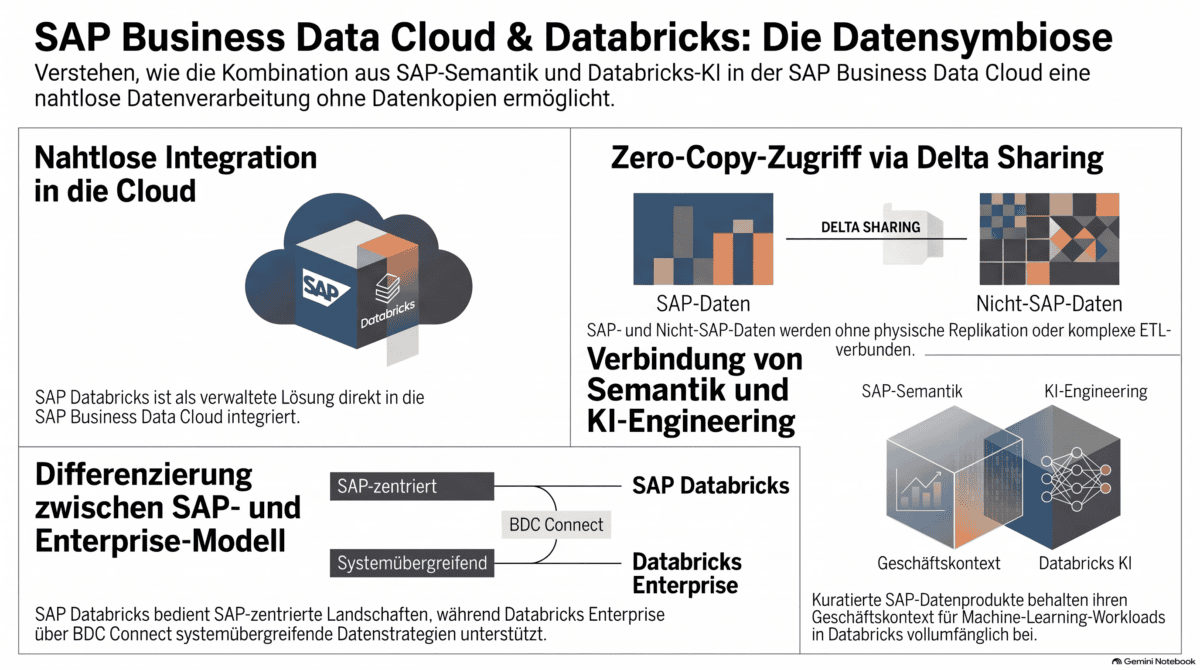
In addition, SAP reaffirmed its commitment at the Berlin conference to further develop the BDC into an enterprise lakehouse. Through strategic moves such as the acquisition of data specialist Dremio, SAP is expanding its existing Delta Lake support to include native interfaces for Apache Iceberg and the open catalog standard Apache Polaris. At TechEd in Berlin, existing customers were promised that data from SAP and non-SAP sources could remain in open formats such as Apache Parquet in the future, while distributed SQL query engines and AI models would access it directly without time-consuming ETL cascades.
SAP BDC, Knowledge Graph, and Databricks
SAP Business Data Cloud is SAP's overarching solution and licensing concept. It bundles SAP Datasphere (for semantic modeling and data cataloging), SAP Analytics Cloud (for reporting and integrated planning), and SAP BW in the Private Cloud Edition.
There are currently two operational variants: SAP Databricks is a fully managed SaaS component from SAP that is directly embedded in the BDC and billed through SAP contracts. In contrast, Enterprise Databricks (also known as Native Databricks) is operated independently by companies directly on the infrastructures of hyperscalers such as Microsoft Azure, Amazon Web Services (AWS), or Google Cloud Platform (GCP). According to a statement by Daniel Holz, former SAP Managing Director in Germany and now Databricks Vice President for Central Europe, Native Databricks and the Databricks component of the SAP BDC are expected to have equivalent functionality starting in the first quarter of 2027. No details regarding licensing adjustments or sales were available at this time. Daniel Holz made this announcement at Databricks’ own event, the Databricks Data plus AI World Tour, held in Munich in early November.
The technical interface between BDC and Databricks is based on the Delta Sharing protocol. Data products derived from operational SAP systems are made available in the BDC Catalog and made visible to the Databricks Unity Catalog via Delta Sharing without creating physical copies of the data. Data specialists can train complex AI models in Databricks notebooks using Python, SQL, or R, and seamlessly feed the enriched model results back to the BDC and SAP Datasphere via Delta Share.
The SAP Knowledge Graph serves as the platform’s semantic brain. It translates the tens of thousands of relational tables and millions of data fields from S/4HANA into a machine-readable network model consisting of nodes and edges. While Databricks handles unstructured big data processing and model training, the Knowledge Graph provides the business context. This provides generative AI models, autonomous agents, and the Joule copilot with precise contextual information to prevent stochastic hallucinations in the general ledger.
The End of the Traditional Data Warehouse in Favor of a Data Lakehouse
The partnership between SAP and Databricks is accelerating the decline of traditional data warehouse architectures. Traditional enterprise data warehouses (such as the legacy SAP BW or purely relational SQL data warehouses) are increasingly reaching insurmountable performance limits when it comes to processing unstructured data, real-time streaming, and machine learning on a single platform.
The Data Lakehouse, as advocated by Databricks, combines the unlimited, cost-effective storage capacity of flexible data lakes with the ACID transaction guarantees, data quality, and query speed of traditional data warehouses. In the future SAP data architecture, the distribution of tasks will shift dramatically.
SAP Datasphere should abandon the idea of being a monolithic, all-purpose data store for big data. Instead, Datasphere functions as a logical, virtual layer (Business Data Fabric) that maintains semantic control over business processes and authorization rules.
The Value Databricks Brings to SAP Developers
Databricks thus takes over the compute-intensive execution layer (Compute Layer). Thanks to the strict separation of storage and computing power in the Lakehouse, data engineering workloads and AI training processes can be scaled to an extreme degree without placing a burden on operational ERP systems or the Datasphere instance. For existing SAP customers, this means a definitive shift away from the traditional ETL (Extract, Transform, Load) paradigm toward the federation and virtualization of enterprise data.
Zero-copy sharing eliminates time-consuming, error-prone ETL processes. This saves development time, reduces the likelihood of errors during replication, and lowers storage costs. Developers no longer have to settle for the limited analytical capabilities of legacy SAP tools; instead, they can use modern pro-code environments, Apache Spark, MLflow, and standard Jupyter notebooks with native multi-user support. Operational data from S/4 can be directly merged in the lakehouse with unstructured IoT sensor data, CRM information, or external market analyses.
The Critical Downsides and Business Pitfalls
The Risk of BDC as „Business Data Complexity“: The German-Speaking SAP User Group (DSAG) and critical voices in the community sometimes derisively label BDC as „Business Data Complexity.“ This is due to opaque contract clauses, complicated authorization models, and restrictive limits on data transfer. Those who purchase SAP Databricks directly through SAP pay for the BDC environment and the cloud capacities it contains. Billing is based on usage-based BTP Capacity Units or special credit models, under which unused credits expire without replacement at the end of the contract year.
Companies such as Mercedes and BASF, which already operate an established Enterprise Databricks instance on platforms like Azure, AWS, or GCP, do not need to purchase duplicate licenses for SAP Databricks. Using the BDC Connect interface, an existing Enterprise Databricks instance can be connected directly to SAP BDC via Delta Sharing. This avoids unnecessary duplicate purchases of BDC storage and preserves the company’s independence from vendor-imposed surcharges. The alliance between SAP and Databricks is a pragmatic and technically long-overdue step that breaks down the barriers between the transactional SAP world and modern AI lakehouse architectures. For existing SAP customers, this creates a highly flexible data ecosystem. Nevertheless, IT decision-makers should not blindly purchase the BDC as a ready-made panacea, but rather design the architecture in such a way that their own data sovereignty is preserved and financial surprises due to duplicate licensing are avoided.
 Deutsch
 English
 Español
 Français