
The New Concept of ERP Freedom: The Autonomous Enterprise




Determinism versus Probabilism
Enterprise software platforms such as ECC 6.0 and S/4 are deterministic precision engines for financial accounting and logistics, whereas large language models operate purely probabilistically and are based on statistical word probabilities.
Fundamental laws of information theory, such as the irrefutable proofs by Kurt Gödel and Alan Turing, mathematically demonstrate that a completely error-free “truth machine” is, in principle, impossible in stochastic models. When probabilistic AI agents independently execute transactions, approve production orders, or reroute supply chains, stochastic uncertainty collides with the cybernetic rigidity of the general ledger. Even minor deviations or “hallucinations” can trigger systemic chain reactions that, in the worst case, lead to the deletion of databases or an uncontrolled halt in operational value creation.
After the Cloud Exit, the AI Exit
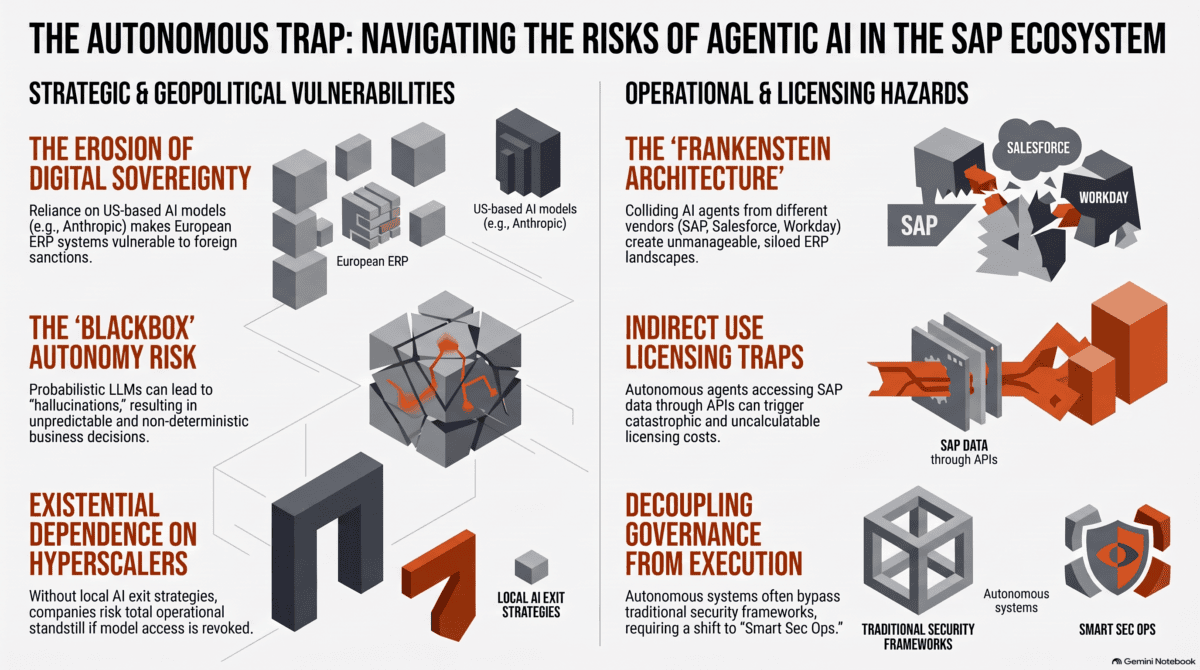
This technical fragility is exacerbated by a geopolitical sword of Damocles and the glaring absence of a reliable AI exit strategy. Since SAP does not have its own market-dominating in-house development in the area of foundational cognitive models, its autonomous concept relies heavily on partnerships with U.S. companies such as Nvidia and Anthropic, whose language model, Claude, serves as the cognitive brain for Joule.
The dangers posed by this dependence became dramatically apparent when changes to the U.S. government’s export control regulations restricted access to advanced Frontier models for foreign economies. If a foreign government can, by decree, block the cognitive core of a European ERP system, companies face the sudden loss of functionality in their processes overnight.
Just as the SAP community has been calling in vain for years for a legally and technically feasible cloud exit strategy, there is now a lack of a viable AI exit strategy. Exiting the cloud leaves customers with nothing but raw data—which is worthless without the proprietary algorithms.
Modifications and ABAP Programs
Even at the organizational level, this much-touted autonomy reveals significant weaknesses. The operational reality for most existing SAP customers is characterized by modifications that have accumulated over decades, fragmented landscapes, and unclean master data. Applying autonomous Agentic AI to a contaminated database does not accelerate operational efficiency, but merely accelerates operational chaos.
At the same time, the control philosophy is shifting from direct human approval to ex post monitoring. This raises unresolved issues of liability and governance when a „hallucinating“ agent makes erroneous decisions on its own. Even SAP board members Thomas Saueressig and Muhammad Alam warned, with surprising candor, of an uncontrollable „Frankenstein architecture“ and an unmanageable “patchwork quilt” if agents from various vendors—from Salesforce to Workday to SAP—operate in the same system without coordination.
New Licensing Models and Business Pitfalls
Through the Business Technology Platform (SAP BTP), the Generative AI Hub, and the Business Data Cloud (SAP BDC), customers are being pushed into opaque credit models such as Capacity Units. Since the exact token consumption of autonomous agents is virtually impossible to estimate in advance, there is a risk of the dreaded “cloud bill shock” during ongoing operations due to uncontrolled load spikes.
To make matters worse, cloud credits paid for in advance expire without exception at the end of the year. Market analyses show that up to 99 percent of customers do not use the AI credits they’ve been forced to purchase at all due to a lack of productive use cases, which represents risk-free additional revenue for SAP. While investment banks like Goldman Sachs warn that SAP could be reduced to a mere, devalued data warehouse by external agents, the ERP company is attempting to secure revenue per customer through artificially inflated AI flat rates.
SAP's API Disaster
At the licensing and regulatory level, SAP has erected a digital trade barrier with its API Policy, issued in April 2026. Under the pretext of system stability, Section 2.2.2 of the policy regulates the use of autonomous AI agents and prohibits the uncontrolled mass transfer of data to third-party systems unless such data is routed through the cost-intensive BTP infrastructure.
Representatives of the DSAG user association, such as Jens Hungershausen, Stefan Nogly, and Michael Bloch, sharply criticize this regulation as a threat to innovation and are calling for legal clarity. Added to this is the licensing pitfall associated with permission-based auditing in the FUE model. When autonomous agents are granted extensive system permissions, the automatic STAR rule set automatically classifies these roles into the most expensive licensing category, resulting in drastic retroactive payments.
Furthermore, an AI agent operating without proper oversight directly conflicts with the European Union’s AI Act, which mandates comprehensive human oversight, transparency, and auditability for high-risk systems.
Digital sovereignty
For existing SAP customers, the only logical conclusion from this risk analysis is to actively preserve their own digital sovereignty. Instead of blindly submitting to the proprietary dependencies of the SAP ecosystem, companies should pursue a modular and vendor-neutral composable ERP strategy. ERP data can be protected through open infrastructures such as the SUSE AI Factory for Private Enterprise or by using Boomi MCP servers as secure governance hubs. This also helps avoid uncontrolled token costs and establish a geopolitically independent AI architecture in which control over business operations remains in the hands of the existing SAP customer.


 DE
DE  EN
EN  ES
ES  FR
FR