
HR Analytics with SAP BDC: Where People Intelligence Is Already Making a Difference




Today, an HR or IT manager often doesn't need a new vision, but rather a simple answer to the question: Why does it still take so long to turn existing personnel data into reliable management information?
Master data resides in SAP SuccessFactors, payroll data is often still in the traditional HCM system, recruiting is handled in a separate tool, and learning is managed in yet another application. What looks neat in the system architecture quickly turns into manual work when it comes to reporting. Numbers are exported, reconciled, and explained. This is precisely where delays, friction, and doubts about the metrics arise. SAP is now tackling this problem differently than it did a year or two ago. The Business Data Cloud is designed to turn scattered HR data into a robust data foundation.
New Strategy: People Intelligence
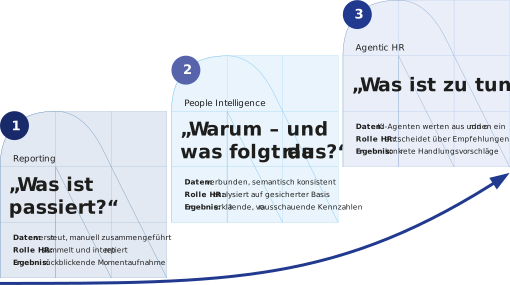
This is the approach taken by People Intelligence, the standard offering for HR analytics in this environment. For SAP experts, this is less of a complete overhaul and more of a shift in strategy: moving away from isolated reporting toward data products designed to enable analytics, self-service, and AI-powered queries on a common foundation. At the same time, this raises a concrete question for users: Is the standard solution sufficient, or does the real work begin only when payroll, time management, and other third-party systems come into play?
The German-Speaking SAP User Group (DSAG) articulated this skepticism very clearly in 2026. From a user’s perspective, the HR context is not just about new features, but about robust transition scenarios, transparent roadmaps, and functional integration paths. In the DSAG survey conducted for the 2026 HR Days, 56 percent of respondents rated the use of SAP Business Data Cloud or SAP Datasphere for HR data as somewhat to not at all relevant. This is not an argument against data-driven HR analytics. Rather, it shows how cautiously many companies are currently setting their priorities: first, stable core HR processes and sound governance; then, the next phase of expansion.
Standard—provides noticeable relief
Despite this caution, it would be wrong to dismiss People Intelligence as merely a promise for the future. For companies whose analytical needs rely heavily on SuccessFactors data, the standard can already deliver real value today. This is especially true in cases where HR and personnel controlling regularly have to answer the same questions: How are FTEs, turnover, age structure, or recruiting pipelines trending? How can key metrics be made available more quickly without having to trigger a manual custom report every time?
The difference lies less in a spectacular AI moment than in a quiet shift in the nature of the work. When data structures are properly prepared, HR spends less time gathering numbers and can focus sooner on meaning, actions, and priorities. In an anonymized real-world project example, the monthly compilation of relevant data alone used to take about three workdays. Such efforts don’t disappear overnight. But they do decrease when a standard model already provides structured answers to a large portion of the most common questions.
Why Payroll Remains the Litmus Test
This issue becomes critical when companies want more than just clean SuccessFactors reporting. That’s because, in many HR organizations, the business-critical questions arise precisely at the interfaces: between master and organizational data from SuccessFactors, payroll data, time management data, and other local sources. It is at this point, if not sooner, that it becomes clear just how far a standard product can take you.
This is particularly evident when it comes to pay transparency. In 2026, SAP announced new features within the People Intelligence package called EU Pay Transparency Insights. This is relevant. For HR and IT managers, however, the real work begins earlier: Is salary data from all relevant systems even available in a format that allows for comparable analyses? Are allowances, time types, and local specifics properly harmonized? If this foundation is missing, even the best specialized feature will be of limited help.
This is where NTT Data Business Solutions’ HR Boosters come into play. They are not an alternative to the SAP standard, but rather a pragmatic extension for companies with mixed landscapes. These are preconfigured but customizable data structures in the Business Data Cloud that consolidate SuccessFactors, payroll, time, and other non-SAP data faster than would be possible with a completely custom-built solution.
In this way, the boosters answer some of the questions that resonate within the DSAG perspective—not theoretically, but operationally. They don’t resolve every roadmap debate. But they can significantly shorten the gap between SAP standards and customer reality. Especially for companies that haven’t yet fully migrated payroll to the cloud or that operate across borders with varying definitions, this is often the real game-changer.
Learning and Skills in a Network
The situation is similar when it comes to employee development, skills, and learning. Viewed in isolation, a learning system quickly provides activity metrics. This data only becomes strategically relevant when it is linked to roles, succession planning, recruiting pipelines, or organizational changes.
If you just want to see how many training sessions have been completed, you'll get a number. If you want to know where skill gaps are emerging or which positions are virtually impossible to fill internally, you'll need a more sophisticated data foundation.
This is precisely where it is determined whether individual data points will actually form a reliable basis for decision-making. As long as each source has its own logic, even good dashboards remain vulnerable to political criticism. Only when definitions, roles, and structures are harmonized can analyses be produced that truly hold up in management.
In the German market, therefore, the question of people intelligence goes beyond mere functionality. It leads directly to data protection, access permissions, and employee participation. From a technical standpoint, spaces, roles, and access permissions can be defined in the Business Data Cloud.
From an organizational standpoint, however, the question remains: Who is authorized to view which HR data at which level, and who is responsible for these rules? This is precisely why the works council is not an issue for the final acceptance but rather for the project kickoff.
Governance and Acceptance
This is more than just a precautionary measure. By involving the works council, data protection, and HR IT early on, you can clarify not only access rights but also the limited purpose of data use, limits on data analysis, and user acceptance. Many projects fail not because features are missing, but because trust and governance are established too late in the process.
What matters most here is not so much the technology itself as the ability to effectively align product standards, project realities, and employee participation.
What Decision-Makers Need to Clarify
For HR and IT managers, the situation thus boils down to three practical questions.
First: Are SuccessFactors data and standard content already sufficient to solve the most important reporting issues?
Second: In which areas do payroll, time management, recruiting, or learning become so critical that additional data products are needed?
Third: Is governance part of the architecture from the very beginning, or is it added later?
The benefits arise when manual reconciliation efforts are transformed into reliable routines: fewer Excel loops, faster reports, and fewer fundamental debates about the reliability of key metrics. The market is still in its early stages in the HR sector.
This makes a clear starting point all the more important: first, assess what the standard is already capable of, and then make a well-informed decision about where additional data products and extensions would be useful.
To the partner entry:

 Deutsch
  English
  Español
  Français