
AI Exit for Existing SAP Customers




Agnostic AI Models
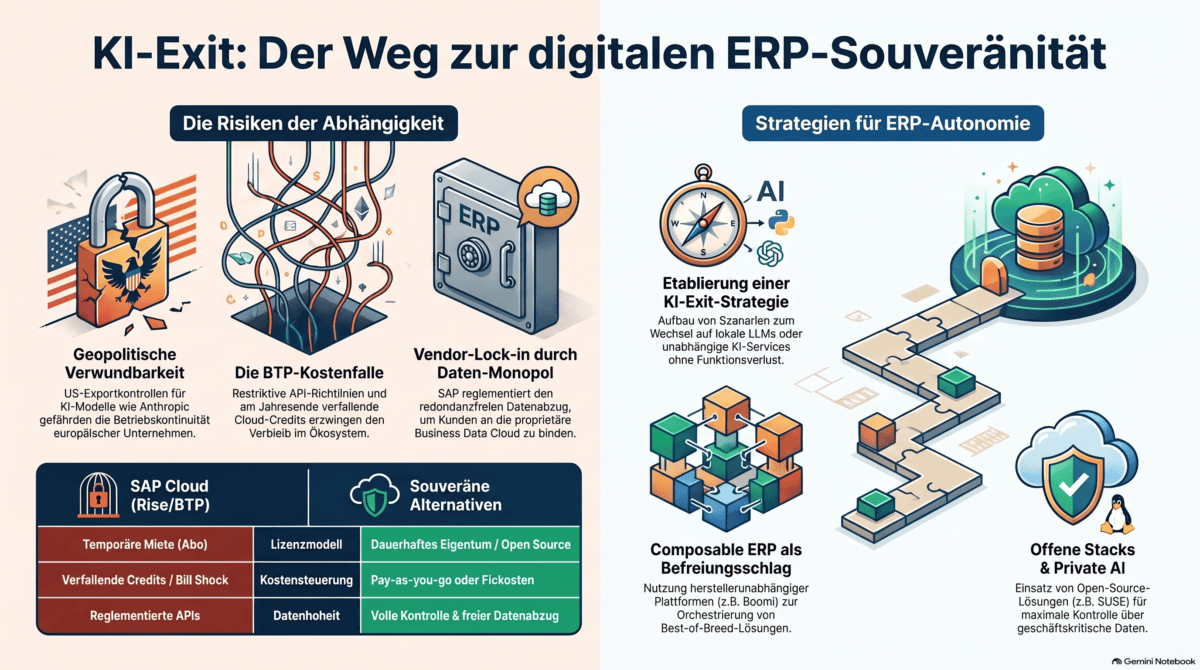
A technical way out of AI dependency lies in agent-agnostic models. This approach aims to completely decouple business-critical process knowledge and process logic from the underlying AI platforms. The goal is to ensure that the AI platform can be replaced relatively quickly when necessary or in the event of unforeseeable market consolidations, thereby keeping the investments made and the process know-how within the company rather than having them irretrievably flow to external, often non-European platforms.
Another alternative to BTP lies in the development of hybrid IT landscapes and the concept of composable ERP, in which independent integration platforms (iPaaS) such as Boomi handle process orchestration. Instead of submitting to BTP’s licensing requirements, ERP users leverage platforms such as Boomi to feed SAP core data seamlessly—and without complex development—into any cloud data lake or external AI models. This enables existing SAP customers to develop scalable, cloud-native, and AI-driven data strategies that are completely vendor-neutral and keep control over autonomous AI agents firmly in their own hands.
For existing SAP customers who are hesitant to move to the public cloud for reasons of data protection, compliance, or cost efficiency, specialized open-source operating platforms such as Red Hat OpenShift AI or SUSE AI (see also the E3 cover story, September 2026) offer a reliable and secure solution for running artificial intelligence entirely on-premises.
Instead of transferring sensitive corporate data to U.S. hyperscalers or the SAP Cloud for processing, local open-source large language models (LLMs) such as Llama or Mistral can be run on these platforms using the company’s own hardware or in the private cloud. Architecturally, in this side-by-side model, the SAP system remains the backend for structured business data, while the actual AI logic runs on a separate infrastructure and communicates solely via standardized interfaces such as OData, MCP Server, or REST.
This radical decoupling not only guarantees absolute data sovereignty but also enables a seamless switch between language models at any time as part of an AI exit strategy, without disrupting existing SAP core processes.
SAP Business AI and the Knowledge Graph
SAP CEO Christian Klein and his executive team announced the "Autonomous Enterprise" at the company's Sapphire conferences, a concept in which hundreds of specialized AI agents are expected to handle business processes largely on their own. Technically, this scenario rests primarily on two pillars: SAP Business AI and SAP Knowledge Graph (HANA).
The fundamental problem with using generic large language models (LLMs) in a business setting is their lack of business context. LLMs are unfamiliar with specific table relationships or internal approval policies. The Knowledge Graph (SAP HANA) serves as the semantic compass, helping to maintain an overview within the highly complex ERP universe, which contains over seven million data fields.
By automatically generating ontologies from SAP HANA Cloud metadata, the HANA Graph Engine links relational data structures, business objects (such as customers, orders, and invoices), and customer-specific extensions into a semantic network. This semantic foundation enables the AI assistant Joule and the cooperating agents to draw precise and logical conclusions and drastically reduce the dreaded “hallucinations” of AI models.
SAP HANA Cloud Graph Engine
The HANA Cloud Graph Engine serves as the technical database engine in the background; since the update in the first quarter of 2025, it has offered native support for storing and querying knowledge graphs. This allows SAP to close a functional gap, as customers previously had to run different systems (such as Neo4j) in parallel for relational data and graph databases.
Now, both worlds can be consolidated into a single database and accessed using graph-based query languages such as openCypher or SPARQL. An LLM can thus translate natural-language queries into a SPARQL query and execute it without developers having to laboriously program rigid APIs in advance. From a technical perspective, this approach is an elegant way to harmonize data.
The BTP framework and the rebranding to SAP BAIP
From a business perspective, however, this Hana architecture masks a commercial and licensing strategy aimed at restricting the hard-won independence of existing SAP customers. The Business Technology Platform is the exclusive venue for SAP’s AI scenarios. To centralize control over the entire data and AI ecosystem, SAP merged the BTP, the Business Data Cloud (BDC), and Business Transformation Management into a single, consolidated stack in 2026 under the name SAP Business AI Platform (BAIP).
The renaming of the BTP to BAIP competency took effect on June 30, 2026, while the new, stricter requirements for AI delivery capability are set to take effect in January 2027. For existing SAP customers, this strategic shift means one thing above all: the adoption of artificial intelligence is inextricably linked to the restrictive BTP licensing model and the requirement to enter into cloud contracts.
Anyone who wants to use the AI assistant Joule or the Generative AI Hub must sign up for expensive BTP contract models such as the Cloud Platform Enterprise Agreement (CPEA) or the BTP Enterprise Agreement (BTPEA), which involve confusing billing based on so-called Capacity Units (CUs) and token usage.
The SAP user group DSAG sharply criticizes this mandatory BTP requirement: Since usage-based AI points cannot be carried over to the following year, unused quotas expire at the end of the year, while any overage is billed at list prices without a discount. In addition, the SAP API Policy—which will be tightened in April 2026—blocks the direct outflow of data and drastically restricts the unlicensed integration of third-party AI agents, further cementing the BTP requirement and the associated transaction fees.
Alternatives to the SAP Platform: Simplifier and Boomi
Existing SAP customers are by no means defenseless against this licensing dictate. There are vendor-neutral alternatives that take the need for technical autonomy seriously. For those who want to develop side-by-side while still avoiding SAP BTP license fees, Simplifier offers a prominent alternative in the low-code space.
While BTP ties users ever more tightly to the proprietary SAP SaaS framework, Simplifier relies on open web standards and the UI5 framework, thereby avoiding vendor lock-in. Simplifier enables midsize companies to develop Fiori applications up to ten times faster, flexibly integrate SAP and non-SAP systems, and at the same time keep the S/4 core completely clean (Clean Core).
Boomi’s vendor-neutral iPaaS platform is well-suited for data orchestration and integration. Boomi has established itself as a market leader alongside BTP in the Gartner Magic Quadrant, but distinguishes itself through its open philosophy. Boomi’s strategic partnership with Red Hat, announced in May 2026, provides the decisive leverage here. By combining Boomi’s AgentStudio with Red Hat AI, companies can build a robust, Kubernetes-native open-source AI stack. This stack enables a true private AI strategy and a toll-free AI exit strategy.
Token Panic: Intelligent Routing and Open Source
The unregulated use of generative AI is currently causing costs to skyrocket in many companies. Given the expensive frontier models from OpenAI (such as GPT-5) and Anthropic (such as Claude/Fable), market observers are already speaking of a global “token panic,” in which token expenditures are overshadowing actual value creation. To effectively reduce or entirely avoid these costs, IT architects are increasingly turning to so-called LLM gateways and LLM routers.
Open-Source Models
The market is shifting dramatically toward locally hosted open-source models. Powerful systems such as Meta’s LLaMA, Mistral, or Chinese OpenWeights models like DeepSeek, Qwen, and Kimi are technically only a few months behind the Frontier models, but cost only a fraction of the price. Even Microsoft CEO Satya Nadella is exploring the use of DeepSeek for the company’s own Copilot to safeguard margins. An existing SAP customer can run these open-source models cost-effectively and in compliance with data protection regulations on their own hardware, completely eliminating the need for the expensive detour via BTP billing.
The informative answer to the question of whether an existing SAP customer is required to use in-house solutions such as Joule, the SAP Knowledge Graph, or Business AI is: No, there is no technical or functional requirement to do so. The SAP community and innovative ERP users have long since moved beyond where SAP’s development department stands. The DSAG Investment Report 2026 shows that the majority of existing SAP customers and DSAG members implement their production AI use cases using third-party solutions rather than SAP tools.


 DE
DE  EN
EN  ES
ES  FR
FR