
ERP Architectures with SUSE



Anyone analyzing developments in the global ERP landscape in 2026 will find themselves facing a heated and contentious situation. The U.S. government’s latest export controls—such as the ban on Anthropic’s advanced foundational cognitive models for foreign markets—have sent shockwaves through the industry, revealing just how vulnerable the European continent’s digital economy has become. At the same time, the Walldorf-based software giant SAP is relentlessly driving its existing customers into dependence on the major American hyperscaler clouds as part of aggressive sales initiatives such as “Rise with SAP.”.
Anyone who naively embarks on this forced path of transformation runs the risk of completely losing not only control over their financial budget but also their fundamental digital sovereignty. Without a viable and legally sound exit option (cloud exit and AI exit strategy), the ERP system—the nerve center of existing SAP customers—risks becoming a victim of foreign legislation and unpredictable cost models. In this complex landscape marked by uncertainty, one player is moving to the center of strategic considerations for existing SAP customers—a player that in the past often acted as a reliable but quiet foundation in the background: SUSE. Founded in Nuremberg, this European open-source pioneer embodies, now more than ever, the technical antithesis to proprietary vendor lock-in. With an estimated market share of 80 to 90 percent in the SAP HANA in-memory database sector, SUSE Linux Enterprise Server (SLES) for SAP Applications is the undisputed lifeline of the global SAP community.
SAP Basis with Open Source
SUSE has demonstrated that it understands in detail the real pain points faced by users of SAP Basis (Customer Center of Competence, CCoE). Whether it’s avoiding the VMware cost trap through SAP-certified KVM virtualization, orchestrating modern, decentralized side-by-side extensions via SUSE Rancher, or enabling highly secure, privacy-compliant access to artificial intelligence through the SUSE AI Factory.
SUSE’s importance within the global SAP community can therefore be considered vital. For every CIO, IT manager, CCoE director, and enterprise architect who does not want to sacrifice the future viability of their ERP on the altar of SAP marketing, integrating SUSE open-source technology into the ERP roadmap is a strategic imperative. Only those who build their digital foundation on a robust open-source basis will retain control over their own actions in the age of artificial intelligence.
In the age of agentic AI, Kubernetes clusters, and the dismantling of traditional virtualization structures, SUSE’s relevance to existing SAP customers extends far beyond the provision of an operating system. SUSE is currently positioning itself as an enabler of digital sovereignty. It offers small and medium-sized businesses and large enterprises the necessary safeguards and tools to operate innovations such as artificial intelligence and highly flexible, containerized applications—whether on-premises, in hybrid environments, or in sovereign cloud environments—completely vendor-independently, and supports Cleanfield, the SAP Clean Core concept, in collaboration with the startup Nova Intelligence, founded by Professor Alexander Zeier.
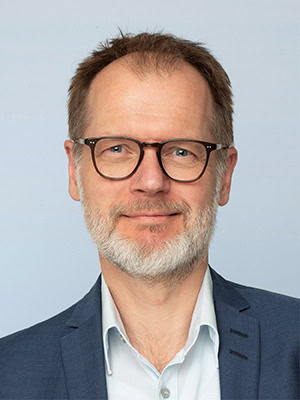
„Modern AI-based tools, such as those from Nova Intelligence, make it possible to automate large parts of custom code analysis and transformation.”
Joachim Hackmann,
Cluster Head BAS,
PAC
The technical symbiosis between SAP and SUSE is not a product of the current AI hype, but rather the result of a deep-rooted partnership spanning more than 25 years. As early as 1999—with the historic founding of the SAP Linux Lab in Walldorf—both companies laid the groundwork for running business-critical enterprise software on an open-source basis. This collaboration was a deliberate break from the dominance of expensive, proprietary Unix systems at the time and established Linux as the new industry standard. When SAP finally decided to radically consolidate the market with the introduction of the in-memory database HANA, Linux was declared the sole permissible operating system foundation.
Architectural Continuity
For existing SAP customers, this track record means one thing above all else: investment security and architectural continuity. While proprietary IT vendors change their licensing models and support structures at irregular intervals, the open-source approach guarantees reliable predictability. SUSE’s guiding principle is to provide existing SAP customers with the same technical solutions, features, and security capabilities—regardless of whether the company opts for a traditional on-premises data center, a private cloud, or a hybrid scenario with one of the major public cloud providers.
From a business perspective, an ERP system is not just an ordinary IT system, but the heart of operational value creation. Unplanned system outages (downtime) often cost companies in the manufacturing sector or global trade tens of thousands of euros per minute. The overarching goal of every modern SAP Basis infrastructure is therefore „Towards Zero Downtime“—uninterrupted, round-the-clock operation.
This highlights the difference between a generic enterprise Linux distribution and the specially optimized SUSE Linux Enterprise Server (SLES) for SAP Applications. The latter is not merely an operating system, but a specialized, SAP-certified software and service package that was specifically developed to meet the extreme demands of memory-intensive in-memory environments.
Those who ignore these open-source tools and rely on cheaper, non-optimized operating system derivatives are cutting corners in the wrong place. In the event of a crisis, existing SAP customers pay for these supposed savings with incalculable downtime and a drastic increase in administrative overhead at the SAP Basis (CCoE).
For over a decade, the virtualization of SAP environments was considered the industry standard, dominated almost exclusively by VMware’s vSphere platform. However, the acquisition of VMware by the chipmaker Broadcom has shaken up this market. The radical shift in licensing models toward more expensive subscription contracts, the dismantling of the proven partner ecosystem, and the forced bundling of software packages have created a TCO scenario that threatens the very existence of existing European SAP customers. The standard hypervisor has evolved from a neutral infrastructure tool into an unpredictable, strategic cost risk.
SAP Virtualization 2.0
In this emergency situation, SUSE occupies a unique position in the market. The company is currently the only provider offering a fully open-source-based virtualization alternative based on KVM (Kernel-based Virtual Machine) that has been fully validated and certified by SAP. The strategic and economic advantage of this approach is clear: Since the KVM hypervisor is directly embedded as an integral part of the SLES for SAP Applications operating system subscription (see below), separate hypervisor license fees are eliminated entirely. Existing SAP customers can continue to use their existing server hardware in their own data centers without any disruption and without the need for new investments.
While the transition from VMware to SUSE KVM is not a trivial “lift-and-shift” project—since proven vSphere features must be architecturally reimplemented— However, in collaboration with specialized global IT service providers such as SoftwareOne or the hosting specialist FIS-ASP, this transition can be carried out in a controlled, low-risk manner with a measurable return on investment (ROI).
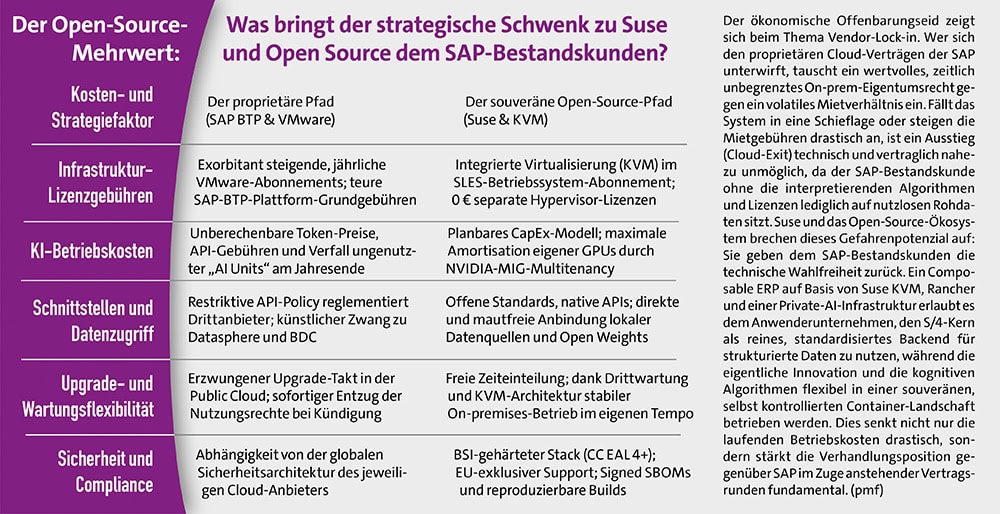
The discourse in computer science in 2026 will inevitably be dominated by AI and Agentic AI. But while SAP CEO Christian Klein is trying to push users toward the expensive Business Technology Platform (SAP BTP) and its Generative AI Hub—in order to generate new revenue streams through usage-based AI units and token prices that are difficult to calculate—resistance is growing at the grassroots level. The unresolved core question is: How can sensitive, business-critical ERP data—the crown jewels of the company—be enhanced with modern AI models without exposing it to the uncontrollable black boxes of American hyperscalers?
The answer lies in the strategic combination of general open-source technology, Kubernetes, and the concept of so-called “open weights.” In the field, “Open Weights” refers to highly advanced large language models (LLMs) such as Meta’s Llama, Mistral AI, or IBM Granite, where—unlike in closed systems such as GPT-4 or Claude—the trained neural weights are freely available. This makes it possible to run these state-of-the-art models entirely in your own data center (on-prem) or in a controlled private cloud.
It is precisely for this promising use case that SUSE has developed an AI platform (and the SUSE AI Factory concept) based on the SUSE Rancher Kubernetes management platform. SUSE AI serves as a digital safe harbor for the company.
Cleanfield and AI Strategy
This architecture enables existing SAP customers to establish a customized private AI strategy that is characterized, among other things, by the following unique selling points: cost predictability instead of a “token trap”; Companies transition from the unpredictable, usage-based API transaction costs of the public cloud to a predictable investment model (CapEx). By implementing end-to-end zero-trust concepts, native software bills of materials (SBOMs—Software Bills of Materials), and the option for fully isolated, network-decoupled deployments (air-gapped deployments), companies can meet even the strictest regulatory requirements for sensitive industries on their own.
Through open AI stacks, SUSE frees existing SAP customers from the geopolitical stranglehold of proprietary U.S. labs. Intelligence returns to where it belongs: within the company itself, controlled by its own ERP department.
One challenge in modernizing legacy SAP infrastructures (ECC 6.0) is the burden of custom in-house developments (Z modifications). Over the course of decades, internal developers have modified the SAP standard with millions of lines of ABAP code to map specific process requirements. This organizational and technical proliferation makes subsequent release upgrades or the migration to S/4 HANA a risky undertaking.
This is where SAP’s “Clean Core” doctrine comes into play: The S/4 core must remain untouched, while necessary modifications and process-related enhancements are consistently managed in a decentralized manner according to the side-by-side model within a separate, agile application architecture.
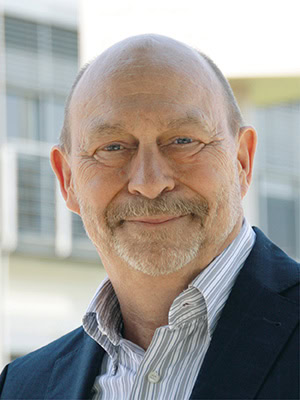
Jens Adam,
Global Sales Director, Fujitsu Alliance,
Suse
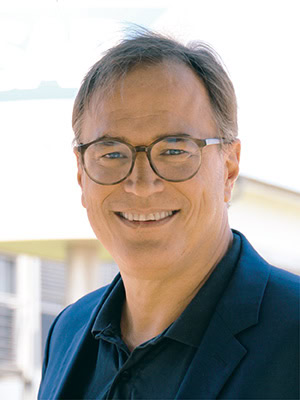
Thomas Herrmann,
SAP Consultant,
SoftwareOne
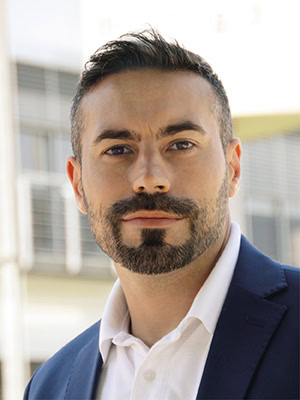
Virtualization alternative,
which has already proven to be a successful solution in the past for hyperscalers such as
such as AWS and GCP, has proven itself.“
Jens Gleichmann,
Managing Director,
XLC-Crossload Consulting
In this transformation scenario, the partnership between SUSE and AI platforms such as Nova Intelligence realizes its full potential. Nova Intelligence acts as a cognitive bridge for the Clean Core transition: Guided by the “Cleanfield” approach, the platform uses autonomous AI agents to analyze legacy ABAP code, reconstruct the business intent behind the code, and translate it into near-standard S/4 structures or cloud-native microservices. Nova orchestrated a virtual requirements specification based on ECC 6.0.
Kubernetes is the technical platform on which decentralized side-by-side extensions and AI agents are securely orchestrated in production. Here, SUSE builds the crucial bridge with its container management platform, SUSE Rancher for SAP Applications: This integration enables a scalable and flexible infrastructure that is specifically suited for modern, cloud-native ERP satellites.
Sovereign Premium Support
With SUSE Sovereign Premium Support, the open-source company is taking a decisive step forward in meeting the compliance requirements of sensitive sectors. This dedicated service package guarantees that all support data is stored and encrypted exclusively within the borders of the European Union. In addition, technical support is provided exclusively by specialized support engineers based in the EU, which legally and physically precludes any unauthorized access by foreign authorities (such as under the U.S. Cloud Act).
SUSE translates these complex requirements into a structured, practical process model: the Cycle of Digital Sovereignty. This holistic consulting and technology approach supports SAP administrators through four systematic phases—from analyzing dependencies to evaluating sovereign open-source architectures to conducting business continuity testing—to build a compliant, resilient ERP infrastructure.
For the discerning existing SAP customer, SUSE proves to be the indispensable, vendor-neutral foundation for securing their own IT sovereignty amid the forced hype surrounding the cloud and AI. The optimized operating system platform SLES for SAP Applications ensures business-critical continuity at the core of ERP through integrated high availability (HAE), automated system optimization (SAPtune), and uninterrupted live patching. In light of the Broadcom-VMware dilemma, SUSE also offers KVM as an SAP-certified virtualization alternative that eliminates the need for expensive third-party subscriptions and prevents hardware lock-ins.
For SAP’s Autonomous Enterprise, SUSE provides a safety net against uncontrolled data leaks and geopolitical blockades: SLES 16 is the first Enterprise Linux distribution to be AI-ready for automated system management and root-cause analysis through the implementation of the Model Context Protocol (MCP) directly in the kernel; SUSE Rancher for SAP Applications enables the stable orchestration and operation of containerized side-by-side extensions—such as the local SAP Edge Integration Cell (EIC); and the SUSE AI Platform allows users to run their own large language models (LLMs) entirely on-premises in their own data center.
This robust open-source stack enables an efficient private AI strategy. It protects sensitive corporate ERP data from the “black boxes” of U.S. hyperscalers, ensures compliance with strict European regulations, and provides existing SAP customers with a genuine, toll-free AI exit strategy free from the restrictive SAP BTP framework.
To the partner entry:


 Deutsch
  English
  Español
  Français