




Artificial intelligence is driving the expansion of data centers—including in Germany. Data centers for AI currently account for around 15 percent of the total capacity installed in Germany. By 2030, AI data centers are expected to account for 40 percent of Germany's total capacity.
A total of 2,000 data centers with a connected load of more than 100 kilowatts each are currently installed in Germany, including 100 larger data centers with a capacity of more than 5 megawatts. The power output of all German data centers will have grown by 9 percent to 2,980 megawatts by 2025, with the hundred largest data centers accounting for half of this. The 3,000-megawatt mark is expected to be exceeded for the first time in early 2026, and the 5,000-megawatt mark in 2030.

Compared to 2024, Germany's data center capacities will then have almost doubled. These are the findings of the latest Bitkom study, „Data Centers in Germany: Current Market Developments – Update 2025,“ which was conducted by the Borderstep Institute. This growth is being driven primarily by the increasing demand for artificial intelligence and cloud computing.
„Artificial intelligence is becoming a decisive factor in the performance of our economy and our administration,“ says Bitkom CEO Bernhard Rohleder. „Germany must ensure that we have sufficiently powerful data centers. Without data centers, there can be no AI. This is the only way we can strengthen our digital sovereignty and catch up with the international technology leaders. To achieve this, data center operators need improved regulatory conditions, faster planning and approval procedures, and, above all, a stable supply of affordable electricity.“
billions in investments
This year, operators are investing €12 billion in IT hardware and €3.5 billion in buildings and technical building equipment – a new all-time high. Of this, approximately €2.5 billion is being spent on air conditioning, power supply, and other building technology equipment and systems. However, compared to other countries, development in Germany is rather sluggish. Unlike in the US or China, there are still no mega data centers in Germany that are operated exclusively for AI applications.
The powerful IT systems in German data centers are significantly smaller than those in other countries. In 2024, the US already had ten times as much data center capacity as Germany plans to have by 2030. Every year, more than four times as much capacity is added in the US as is installed in Germany. Rohleder: „When it comes to data centers, the federal and state governments must go ‚all in‘ and radically lower the barriers to investment. This will determine whether Germany becomes a data colony or remains a sovereign country in the digital age.“
The drivers of current growth are cloud offerings for AI and other applications, which are set to increase by around 17 percent to 1,450 megawatts in the current year. This means that cloud infrastructures currently account for half (49 percent) of German data center capacity, up from 45 percent a year ago and just 29 percent in 2019.
The market for edge data centers is also gaining momentum, but with a connected load of around 240 megawatts in 2025, it is still at a comparatively low level. Edge data centers are located closer to the end customer or the desired application, resulting in very short response times. Traditional data centers will continue to operate, but are now showing a downward trend (2025: 1290 MW).
The US and China pull ahead
Despite strong growth, however, the German data center market cannot keep up in international comparison. The US and China in particular are pulling ahead. In China, IT connection capacity amounted to 38 gigawatts in 2024. And in the US, data centers already had a capacity of 48 gigawatts last year – 16 times as much as in Germany in 2025. The ten largest US data centers alone are as powerful as all 2,000 German data centers combined.
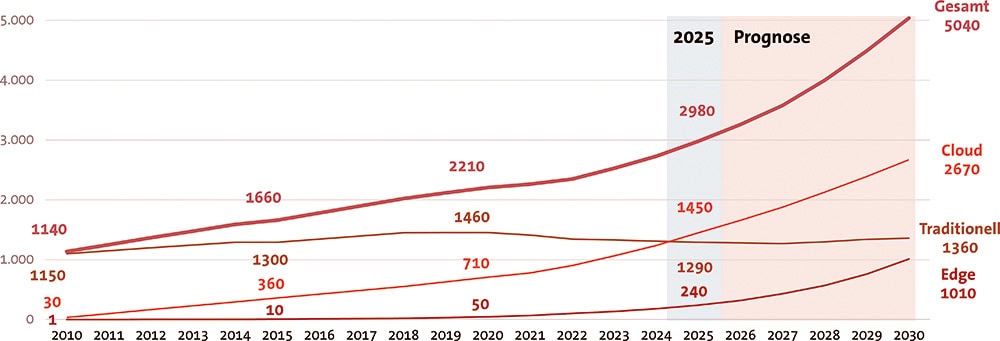
Power will increase to more than 5000 MW in 2030. Capacity of data centers and smaller IT installations (IT power in MW). Source: Bitkom
Source: Bitkom


 DE
DE  EN
EN  ES
ES  FR
FR