
H4S4, SuccessFactors and AI




A survey of members of the German-speaking SAP User Group (DSAG) revealed two key findings: SAP SuccessFactors appears to be firmly anchored in the HR IT roadmaps of many of the companies surveyed. And the changeover to SAP HCM for S/4 Hana (H4S4) is currently a topic that is driving many companies.
„The survey of our members in the HR IT environment confirms the high relevance of H4S4 and SuccessFactors conversions as well as the clear areas of action in the field of artificial intelligence (AI), cloud and the digitalization of HR processes in general,“ summarizes Hermann-Josef Haag, DSAG Board Member for Human Resources and Public Sector.

71 percent still on-prem
When asked which SAP systems they currently use in HR, 71% of respondents stated that they still work with SAP ECC HCM (on-prem). 39 percent use SAP SuccessFactors, 23 percent SAP S/4 Hana HCM (H4S4) on-premises and 9 percent SAP S/4 Hana HCM in the private cloud.
Multiple answers were possible for this question. „The answers clearly show how heterogeneous the digital transformation in HR and IT is - and that it is currently in full swing,“ says Haag.
Protect core
As part of the survey, DSAG also used free text to find out which conversions companies are currently undergoing and what they are planning. The majority of respondents stated that they are currently working on the conversion to SAP S/4 Hana HCM (H4S4) (on-premises or private cloud). This suggests that many customers are migrating to H4S4 to protect their existing investments and the core. „On the one hand, the imminent end of maintenance of previous ERP HCM solutions is forcing companies to plan with future-proof platforms. On the other hand, many companies are faced with the challenge of reconciling data migration, process harmonization and hybrid strategies - with a simultaneous need for planning security and resources,“ says Haag. For many companies, the changeover to H4S4 does not initially represent a fundamental functional reboot. Above all, it is a necessary step to ensure maintenance security for existing core HR processes. „The pure migration from SAP HCM to H4S4 is technically manageable in many cases,“ explains Haag. The transformation becomes more complex when companies combine the HR changeover with a greenfield approach for S/4 Hana, with other modules such as Finance or with the introduction of SuccessFactors. Many companies therefore deliberately opt for a step-by-step approach. Initially, the focus is on securing the existing HR landscape with H4S4, while the modernization of processes and functions - via SuccessFactors, for example - takes place at a later stage. From DSAG's point of view, clear roadmaps, transparent dependencies and reliable migration aids are needed to make this path predictable so that companies can realistically manage the effort, resources and transformation steps.
Potential of SuccessFactors
When asked what role SAP SuccessFactors plays in the HR IT roadmap, just under 4 percent said they had fully implemented the cloud solution, while just under 40 percent had partially implemented it and 11 percent were planning to do so.
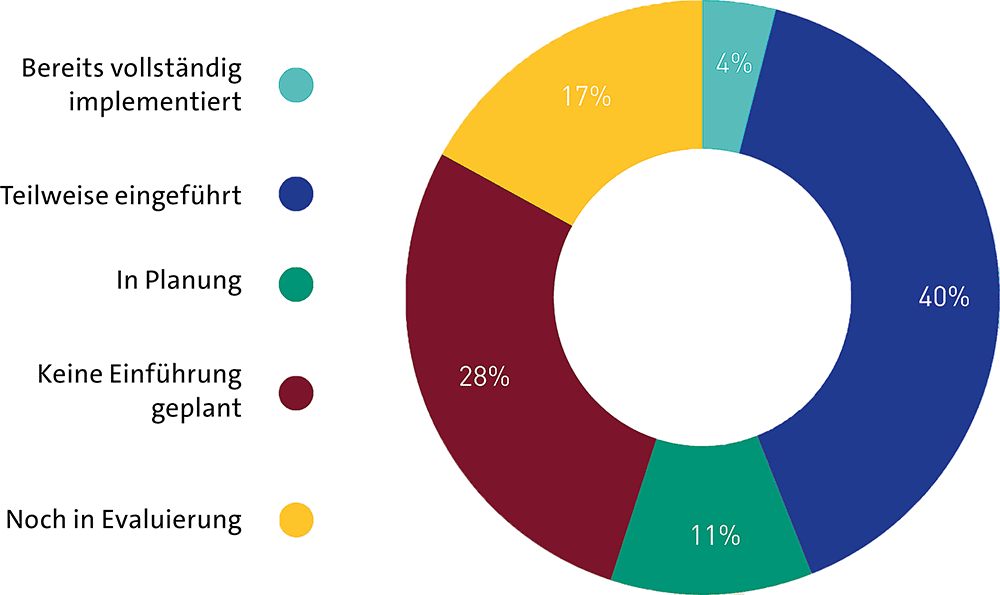
28% of respondents are not planning to introduce SuccessFactors and 17% are still evaluating it. „The results clearly show that although many companies have already taken their first steps towards the cloud, the reality is still very much characterized by hybrid scenarios,“ says Haag, adding: „Especially in the HR sector, cloud transformation is a complex process in which basic functions, integrations and industry-specific requirements must work together seamlessly. It is therefore crucial that SAP offers clear development and integration paths for SuccessFactors, H4S4 and hybrid architectures.“
This heterogeneous transformation landscape is also reflected in the use of SuccessFactors modules. SAP SuccessFactors Recruiting (41%), Employee Central (39%), Learning (37%) and Performance and Goals (34%) - i.e. those modules that quickly offer noticeable added value in day-to-day HR operations - are particularly popular. Onboarding (26%) and Compensation (19%) follow with medium prevalence. Payroll-related modules such as Employee Central Payroll (8 percent) or Time Tracking (9 percent) are still used comparatively sparingly.
Integration of SmartRecruiters
In this context, SAP's announcement of a strategic integration of SmartRecruiters into the SAP SuccessFactors portfolio is also interesting. „The plan here is to also make SmartRecruiters AI capabilities available to SuccessFactors Recruiting customers. In the future, SmartRecruiters will replace SuccessFactors Recruiting. For DSAG members, it is therefore important to start thinking about this strategic SAP decision now. They should get an overview of the potential opportunities and risks for their corporate strategy. The DSAG Personnel Days offer a good opportunity to do this,“ summarizes Haag.

“Companies in the HR IT context are currently primarily concerned with fundamental structural issues.”
Hermann-Josef Haag,
Human Resources and Public Sector,
DSAG
Against the background of the results relating to SAP SuccessFactors, the question was also asked whether the use of SuccessFactors as a SaaS solution is expected to reduce dependency on the IT department. The answers show a differentiated picture: 21% of respondents assume that IT dependency will decrease, 47% see no change and 32% cannot assess this. „The results reflect the reality of hybrid transformation landscapes,“ says Haag. „Cloud-based modules such as Recruiting, Learning or Employee Central quickly offer noticeable added value for HR departments. However, more strategically and technically complex functions often remain IT-dependent. Relief for IT is therefore not automatic, but requires accompanying process and interface adjustments as well as clear integration paths.“ Although the introduction of SuccessFactors offers opportunities to relieve the burden on IT, the actual effect depends heavily on the respective organizational structure, the modules used and the degree of integration.
Top HR challenges
It is striking that topics such as the use of the SAP Business Data Cloud or SAP Datasphere for HR data are considered to be of little to no relevance by 56% of respondents. 52 percent see the migration from SAP HCM to SuccessFactors as currently of little to no relevance to their company and 46 percent feel the same about the integration of hybrid working models. From DSAG's perspective, this makes it clear that many organizations must first stabilize their existing HR IT landscapes and master legal and organizational requirements before they can deal more intensively with data-driven or strategically expanded scenarios.
In response to the question „Which SAP/HR trends will have the greatest impact on your work in the next one to three years?“, a clear picture emerges: artificial intelligence in the HR context is named as the most influential trend by 65% of participants. This was followed by automation and robotic process automation (RPA) with 53% and people analytics and predictive HR with 34%. The shortage of skilled workers and digital training also remain a dominant field of action with 50 percent.
From DSAG's perspective, these results underline the fact that companies are increasingly seeing an impact on their future where intelligent technologies, data-based HR processes and automation directly unleash efficiency and innovation potential. „The results show that AI, automation and people analytics are becoming strategic levers in HR - but only if they are properly integrated technically, used responsibly and create real benefits for employees and organizations,“ says Haag. From DSAG's point of view, clear licensing models are also needed so that the costs of use remain calculable and the investments pay off. (Source: DSAG)



 DE
DE  EN
EN  ES
ES  FR
FR