
Switching ERP to SAP




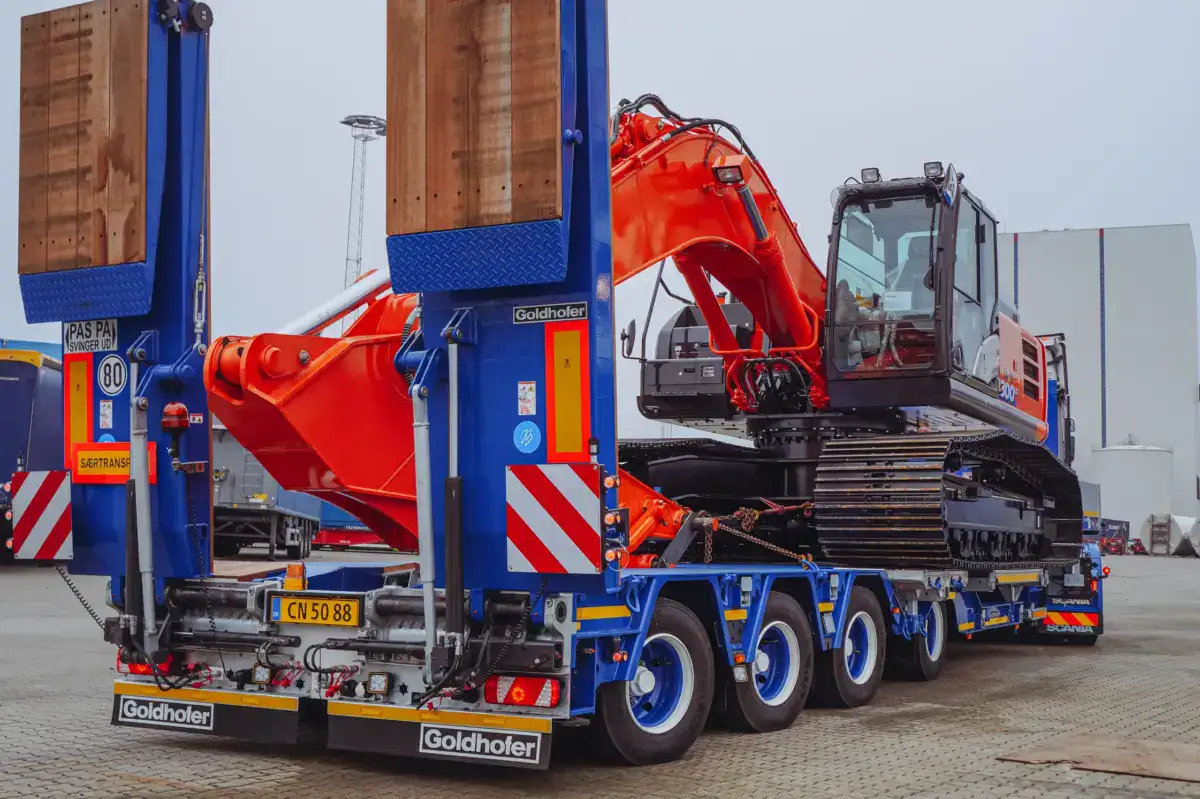
The success story began as a forge over 300 years ago: Goldhofer is now active worldwide and today forges plans for solutions in heavy-duty and special transportation. The company has made a name for itself with extremely robust and intelligent transport systems for road, off-road and airport applications.
At the heart of the brand are the uncompromisingly application-oriented design of vehicles, a focus on the highest production quality and a customer-oriented approach to all company processes. The one-off manufacturer has been managing these in SAP since 2024.

The old ERP had had its day
„Over the years, we had continued to adapt the former system to our internal processes, modified the standard and reached the limits of maintainability,“ says Andreas Blanarsch, Head of Industrial Engineering at Goldhofer, explaining the ERP change. There were many reasons for the migration to the market leader. Last but not least, scalability, a future-proof modular structure and regular updates were crucial. The company-wide changeover also confronted the work planning department. The company has been relying on HSi's web-based solution for many years.
Manual table for the software
Before the introduction of planning software, planned times were determined using manually managed planned time tables. Later, the data from the planned time tables was transferred and totaled in the former ERP. Work plans were then generated there. As the analogue process was not digitized despite the software, the disadvantages remained: each value had to be calculated manually, there was no reproducibility or copying function, the values were prone to errors and the data quality was uncertain.
Preparations were made to introduce a solution for creating work schedules. The aim was to improve data quality, create planning reliability in work preparation, ensure transparency and traceability in production and reduce throughput times. The objectives also included consistent processes and a shared database with high data quality. „A key criterion at the time was the individual expandability of the planning software. Users needed to be able to update technology data, rules and masks independently,“ Andreas Blanarsch reports on the requirements.
Use grown data in SAP
After sounding out the market, HSplan/ES was chosen. The solution was then connected bidirectionally to the ERP at the time and took over the automatic work plan creation. This enabled Goldhofer to significantly reduce the planning effort, as the master data stored in the ERP could be transferred semi-automatically by the work planning solution and used by the modules and rules.
The final work plan is created step by step using intuitive menu navigation. Once the planning process is complete, the work plan is sent back to the ERP, where the production order can then be created. „This has enabled us to increase data quality and planning reliability. We were able to reduce the processing time for a project in work preparation by around 50 percent,“ says Andreas Blanarsch. The work planners at Goldhofer did not want to do without these advantages even after switching to SAP. So it was clear: HSplan had to go. The fact that the work planning solution was already SAP-certified and that the team at the Erfurt software company HSi, where HSplan was developed, had extensive experience with SAP was a decisive factor.
„We were able to use the data, rules and tables that had already grown over the years in the web version one-to-one in SAP. That was a decisive criterion, because the SAP conversion alone is already very complex. We were glad that we didn't have to adapt the database,“ says Anton Zeller, key user of HSplan at Goldhofer. HSplan was ready to go in the first of the three SAP test phases before the go-live.
SAP work planning in real time
With the integration of HSplan/IS SAP, the processes in the SAP process overview are extended by an additional level, the work stages. If a new process is selected, the editing function takes you to the work stage level in SAP. There, users have almost all the same options as in the web version. All parameters entered are then automatically stored in the time calculation of the work plan in the SAP operations. „HSplan/IS SAP is a fully integrated component in SAP. Users don't even notice that they are using the functionalities of our application in the background,“ says Christian Müller, Head of Sales and Project Management at HSi. The entire work planning process runs seamlessly and in real time. However, there is one fly in the ointment: „Previously, we were able to edit the entire work plan and compare process sequences clearly. In the integrated version, we can only edit one sequence at a time due to SAP specifications,“ says key user Anton Zeller, summing up the before and after.
However, the company is already in close contact with the experts at HSi and hopes to be able to access the full range of functions again soon. Goldhofer relies on the many years of fruitful cooperation, on the basis of which solutions have been developed for all growing requirements. „We meet regularly in online workshops. We approach HSi there with our requirements. At the next meeting, HSi then reliably comes up with promising solutions. This is followed by feedback rounds and finally the IT experts retire to the quiet room for development,“ says Andreas Blanarsch, describing the well-established collaboration. This is followed by a test phase and if the solution meets the users' expectations, the go-live follows.
Robust work plans
Where before the introduction of the software, planning was still done with paper, pencil and calculator, since the introduction of HSplan, work plans at Goldhofer have been created on the basis of transparent, comprehensible and high-quality data. Time-consuming searches in Excel lists and other systems are no longer necessary. If parameters change, these are automatically adopted for all linked work plans. Rules and tables can be set up by the work planners on a company-specific basis.
In this way, the work planning software adapts to the growing structures at Goldhofer. „Where knowledge used to be hidden away in drawers, it is now digitally accessible to all colleagues. Everyone has the same database and therefore arrives at the same result. We now base our decisions on reliable calculations,“ summarizes Andreas Blanarsch. It is also possible to see in detail how a time is made up: „If a machine needs twenty minutes to turn a component, HSplan also shows that this is divided into eight minutes of set-up time, five minutes of non-productive time and seven minutes of machining time. These details also allow us to leverage previously untapped potential,“ he adds.
The aim is to drive forward partial automation in the future. The aim is to reduce the time required for work planning. The aim is then to take a closer look at this potential and make production more efficient and, ideally, more cost-effective. (Source: HSI)
Goldhofer
Since its foundation in 1705, Goldhofer, based in Memmingen, has developed from a blacksmith's shop into a globally recognized premium provider of transport solutions. Today, the company employs around 1000 people and generates an annual turnover of around 300 million euros. With branches in Europe, North America, India and the Middle East, Goldhofer has an international presence.
Goldhofer develops tailor-made solutions that set new standards. Sustainability, transparency and employee orientation characterize our actions. The portfolio comprises two areas: Transport Technology with solutions for heavy-duty, special and long material transports and Airport Technology for aircraft and freight transports. As a foundation-owned company, Goldhofer operates independently and for the long term.



 DE
DE  EN
EN  ES
ES  FR
FR