
E-bill now mandatory

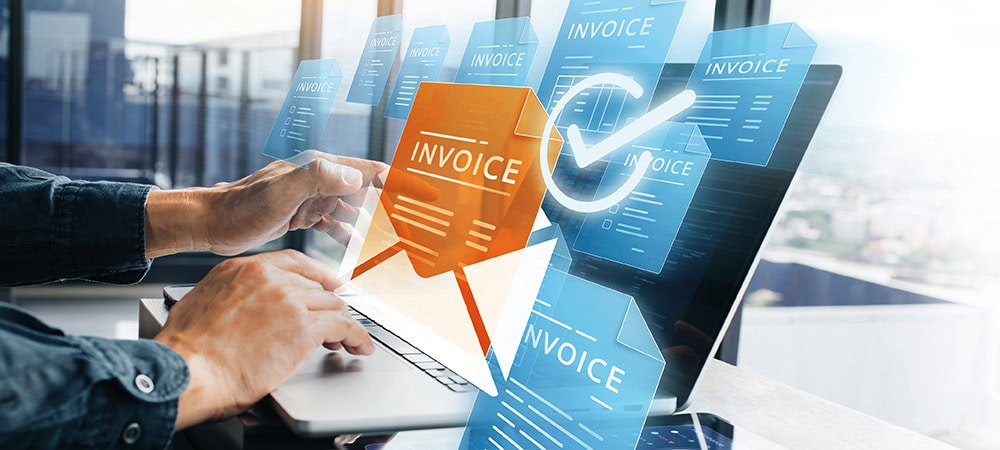


The obligation to send e-invoices will follow next year. Many companies are facing the challenge of integrating these new requirements efficiently.
E3-magazine: From 2027, companies will be obliged to send e-invoices. What challenges do you see?

Ulrich Winter, Nagarro: Basically, too much time is still spent entering, checking and processing invoice data manually. The processes are very inefficient and errors often occur, leading to media disruptions. This effort costs time and is at the expense of other tasks. The new obligations mean that there is no longer much scope to deal with the issue and introduce your own solutions, which is why IT and finance departments in companies should take action quickly.
E3: Which solution is recommended?
Winter: A fully integrated solution that enables end-to-end invoice processing is best suited. All processes then run via a standardized platform so that users no longer have to leave the system, and the data also remains in one system. This integration ensures consistent and secure data and simplifies system maintenance. Ideally, the solution works equally well for SAP S/4 Hana - public cloud, private cloud and on-premises - SAP ECC and third-party systems. The latter can be implemented via programming interfaces, so-called APIs, which is also how we do it at Nagarro. If the solution is hosted on SAP BTP, updates are carried out automatically in the background. This means that customers are always legally up to date.
E3: What should the solution do?
Winter: Invoices should be easy to import into the system in just a few steps. First, the invoice is submitted, i.e. you upload the paper or PDF invoice from the respective source to the tool and have it automatically converted into a supplier invoice. In other words, the processing of invoices is digitized for various e-invoice formats such as XRechnung, ZUGFeRD or Peppol. Ideally, the process can be tracked via a monitoring app; employees then only have to approve the invoice and the tool does the rest. Another important aspect is that the invoices are not stored on servers and are only processed by servers in the EU. The process should therefore be GDPR-compliant. For outgoing invoices, it is also important that they are created directly in the specific system where all the information is available anyway. Here in particular, it is advisable to have a solution that is hosted on SAP BTP, for example, so that national format changes can be made in the background.

“There is not much scope for dealing with the issue and introducing your own solutions.”
Ulrich Winter
Head of Application Development,
Nagarro
E3: What technical requirements does this entail?
Ulrich Winter: The technical connection to the systems can be handled by experienced service providers, including possible API integrations for non-SAP systems. The same applies to hosting in the SAP BTP. An SAP Cloud Connector must be provided for the connection of on-premises systems. There are actually no other technical requirements. Modern AI/ML engines are now mandatory for recognizing invoice content when invoices are received. These must be able to extract precise data from invoices with complex layouts or different formatting and at the same time learn from experience.
E3: What advantages do companies have?
Ulrich Winter: The advantage is the direct integration into the SAP systems. The data remains in the system for both incoming and outgoing invoices. This also speeds up the entire process considerably - incoming invoices can be processed more quickly and discounts can be taken advantage of. In the outgoing invoice process, invoices can be sent easily so that payment is received earlier. Another advantage is certainly that the customer master data is more accurate; efficient invoice processing can only take place with correct master data.
E3: What will change for end users?
Winter: Not much, users create their invoices directly in the SAP system as usual - everything else happens in the background.
E3: How quickly can solutions be introduced and what conditions do companies need to create?
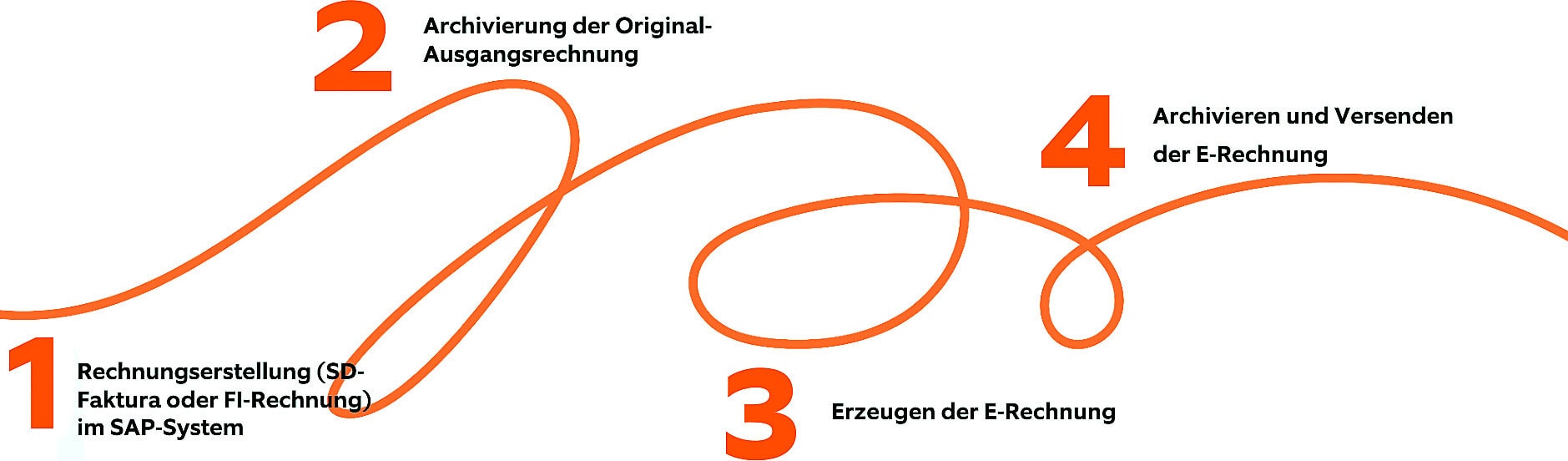
Winter: It is perfectly possible to install tools in a few days, then test them and go live within four weeks. If we are brought in as a partner, we need access to the SAP system and authorization to process and send e-bill emails on behalf of the customer. Technical requirements relate to on-premises systems that require a cloud connector in order to be linked between the SAP system and BTP. At a business level, this mainly involves information on master data such as tax numbers and recipient addresses as well as company codes. Once the go-live has been completed, the hypercare phase usually follows, in which we provide advice and support. This relates to the topic of e-invoicing, but also to further potential in the area of digitalization and new legal rulings.
E3: For example on the subject of Peppol?
Winter: That's right - there are plans to integrate Peppol as a mandatory transmission channel for e-invoicing in Germany and other EU countries in the future. The aim of the network is to handle procurement processes electronically, standardized and automated across borders without any problems. The advantage is that e-invoices are then delivered securely. Ways of transmitting e-invoices via Peppol include the use of an existing Peppol service provider and membership of Open-Peppol. We at Nagarro are already in the process of being certified as a provider.
Continue to the partner entry:



 DE
DE  EN
EN  ES
ES  FR
FR