
Digital sovereignty against the kill switch



The Lünendonk study „Digital Sovereignty: From Risk to Resilience“ surveyed the status quo and priorities of digital sovereignty at companies in the DACH region.
According to the survey, 83% of companies consider it a realistic scenario that a cloud provider could unilaterally restrict or switch off access to critical IT services - a so-called kill switch. Nevertheless, only 57% of companies have an exit strategy for switching cloud providers, and almost half of them have no plan B in the event of an emergency. In order to reduce risks and strengthen digital sovereignty, sovereign hyperscaler models with a local EU operator, IT service providers based in Germany for managed infrastructure and German cloud providers are becoming increasingly important.
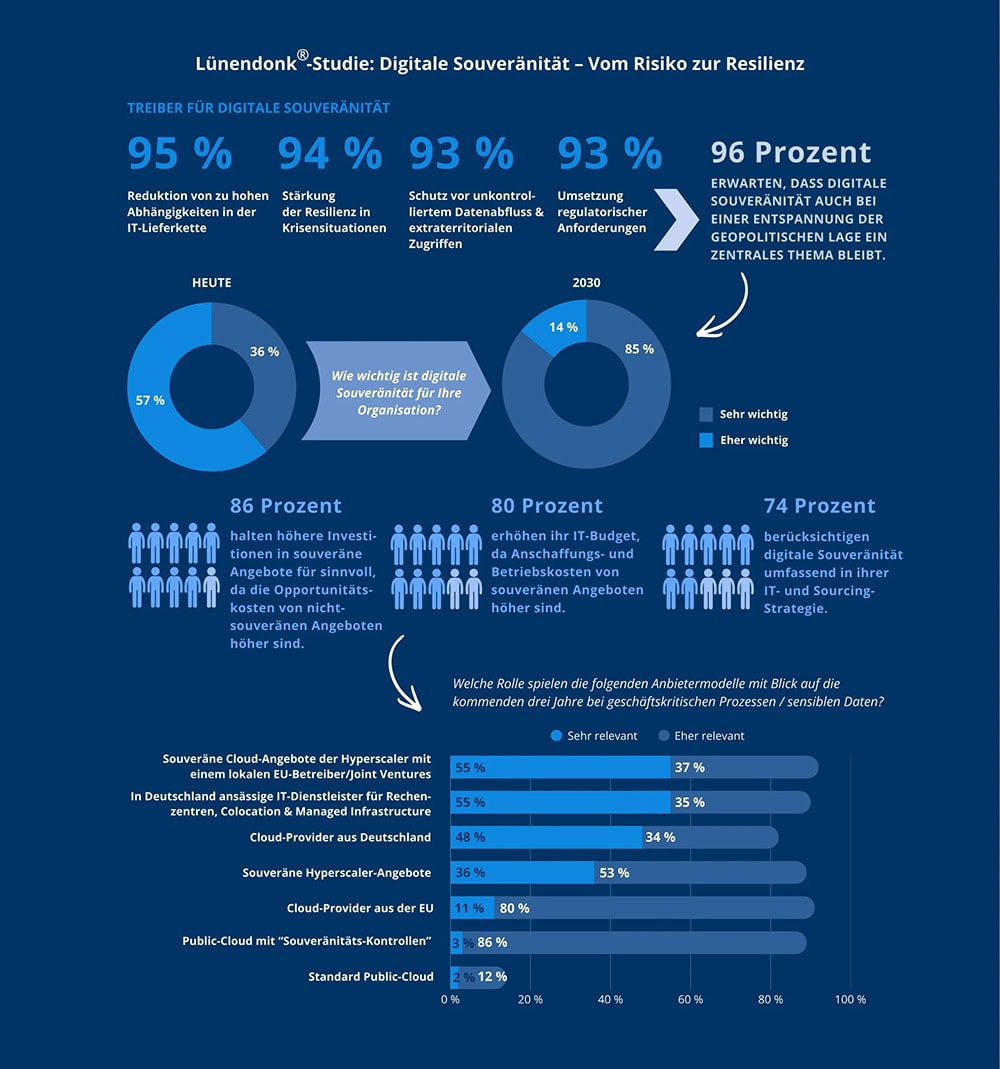
Digital sovereignty is already highly relevant for 36% of the companies surveyed. 96% expect its importance to increase further over the next three years, even if the geopolitical situation eases and transatlantic relations improve. Key drivers for digital sovereignty are high dependencies on individual IT and cloud providers as well as the need to strengthen resilience - especially in crisis situations - in order to protect against access blockades or a „kill switch“ and prevent extraterritorial data access. However, historically evolved system landscapes, limited transparency regarding data inventories and holistic process chains, complex multi-cloud structures and increasing regulatory requirements make digital sovereignty a complex, strategic transformation project. „Digital sovereignty cannot be delayed. Simply being aware of the problem is not enough. Companies must now summon up the courage to actively reduce dependencies, even if this is inconvenient and costly,“ says Tobias Ganowski, Senior Consultant at Lünendonk and Hossenfelder and author of the study.
Dependence on hyperscalers
When it comes to the cloud, there is still a high level of dependency on hyperscalers, but sovereign alternatives are increasingly being examined. 55% of the companies surveyed rate sovereign cloud offerings from hyperscalers with a local EU operator and IT service providers based in Germany for data centers, colocation and managed infrastructure as very relevant. Cloud providers from Germany are developing into superscalers and follow with 48%. Hyperscalers with sovereign offerings are very relevant for 36% of companies. Multi-cloud architectures are therefore gaining in importance: 42% of companies already have a multi-cloud architecture, while a further
46 percent are planning to set them up - to reduce dependencies and provide back-up capacities for critical business processes.
Hybrid, differentiated future
„Requirements differ depending on the industry and use case. Traditional hyperscaler offerings should not be replaced, but rather supplemented with sovereign alternatives in order to cover regulated and sovereignty-critical scenarios. The future of IT is therefore hybrid and differentiated,“ explains Mario Zillmann, Senior Partner at Lünendonk and Hossenfelder. According to the study, 93% of companies consider European cloud providers to be quite competitive with hyperscalers at infrastructure level. However, there are clear deficits in platform, AI and ecosystem services. Accordingly, only 3% of the companies surveyed currently consider European cloud providers to be competitive with hyperscalers. The outlook for the future also remains skeptical: only 2% expect a functional parity by 2030. (rk, source: Lünendonk)
About the study
For the Lünendonk study „Digital Sovereignty: From Risk to Resilience“, a total of 155 interviews were conducted between December 2025 and January 2026 with IT department heads, GRC and security managers, IT purchasers, CIOs and C-level managers. The companies surveyed from Germany, Austria and Switzerland come from various sectors, including industry, critical sectors, banks and insurance companies. Half belong to upper mid-sized companies and half to large corporations.

 Deutsch
  English
  Español
  Français