
AI as an Opportunity Instead of a Threat




Laura Cepeda, E3 Magazine: How does Workday intend to compete with other ERP giants such as SAP?
Rob Enslin, Workday: We don't think about the competition the way most people would think we think about the competition. We think about changing the discussion with customers in order to get them ready for what AI is going to bring to them, and how to make certain that they understand the speed of which change is happening today, and that we're enabling that speed of change to take place. That's our focus. That's our dream.

Cepeda: Can you explain this in more detail?
Enslin:The biggest piece of competition, irrespective of who the competitor is, is going to be the talent. The combination of AI-native people and experienced people is a very, very interesting question. AI-native people think through problems very differently. And so the companies that are really going to think through it are those that have the ability to attract the world class AI talent. And we look at what we think we've got: Peter Bailis and Garrit Kazmaier and Joel Hellermark and so on. We think this is the level of talent that will make the big difference in the competitive world.
Cepeda: Some people find it a bit scary, what AI can currently do. I think we need to wait and see how it develops. What are your thoughts?
Enslin:I don't think it's scary. Every big change finds its rhythm. We forget that the smartphone is not yet 20 years old. In 2007, the iPhone was released, so it's basically 18 years old.
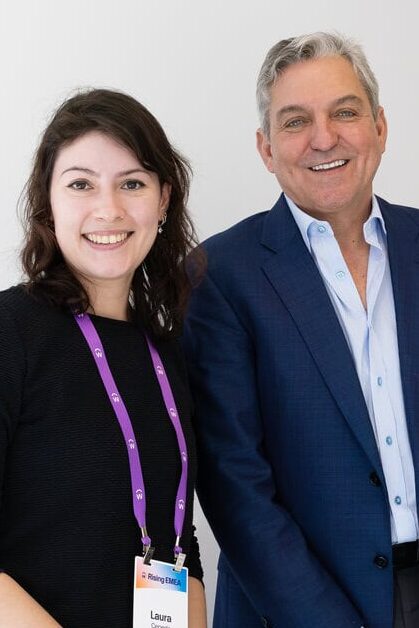
Laura Cepeda with Rob Enslin at Workday Rising in Barcelona in November 2025.
And how did this transform us? You look at e-commerce platforms, even in South Africa, with home delivery. Can you imagine if the pandemic had happened in 2005? We didn't have smartphones, and we had distribution with humans and physical warehouses. So, the progression of technology really helped deal with unique problems. And I feel the same will be true for the future.
My view is that governments are going to have to figure out how to help enable because it becomes a more level playing field. It's much more level than it is when you look at other technologies. And I always go back to my Google days and, you know, Sergey and Larry always used to say, there's somebody in the Philippines that has the exact same information that the professor at Stanford has. The quality in sharing that information is equal. And so this is another way of leveling the playing field that can massively move humanity forward in a really positive way.
Cepeda: What do you say to people that focus more on the downsides of AI?
Enslin:Yeah. I'm not going to say anything about Europe. My view in life is the naysayers are always the loudest, right? The negatives always seem to rise to the top, even if it's a small percentage. But I think our job is to help educate and deliver it in a trusted, secure way so that people can trust what we're doing.
And as software companies, we've all got to do that in a very trustworthy way. And I think there will be some level of regulation that comes out, similar to GDPR. GDPR came out around ten years ago. Everybody was kind of against it first, but it ended up being totally fine. And so I think the same thing will happen, and we'll get to a trusted true north. This technology will absolutely not go backwards. This technology will, in many ways, force companies to adopt it. Because if they don't, they will be outcompeted. Their competitors will crush them in the market. There really will be winners and losers with this technology. And it's much more about people than it's ever been. So when you think about the human-centric behavior of helping somebody have a better experience at work, the work becomes more meaningful.
Cepeda: How can you ensure that the AI always works? That there are never any glitches or hallucinations?
Enslin:That this is one of the big challenges: how to actually do this. In many ways, a lot of the acquisitions we did this year was to assist in that, and also to make certain levels open, so that multiple agents from different vendors or different companies can communicate with the agents inside of Workday. When we release agents, we build trust and security, validation, and the understanding of the data into them. We validate it by having knowledge about what the data is, what exists in the data. Every tenant inside of Workday, every field inside Workday is exactly the same. We know right now exactly what every bit of every customer's data is. So, there's zero hallucination on the data that we have. And as we combine the AI stuff with outside, we have to validate it to make certain that the data matches the hallucination.
Then we actually have to have audit logs that the customer themselves can then validate and say: okay, if I make a decision on hiring and these are the decisions, what was the criteria? What decisions? How did I make that decision. So, we actually logged that audit, so the customer can look at it themselves. That's how we make certain that we have zero hallucination. We're not releasing thousands of workflows or agents. We're releasing the ones that have the biggest business impact for our customers.



 DE
DE  EN
EN  ES
ES  FR
FR