
Why Logistics Transformations Fail




Many logistics transformations fail not because of the technology, but because they get off to the wrong start. While modernizing logistics is high on the agenda for many, the operational reality is often still characterized by fragmented structures, manual workflows, and isolated process silos between warehousing, transportation, and handling. Systems are often not integrated, and media breaks and paper-based processes remain widespread. These structures are usually kept afloat by employees’ experience, communication, and improvisation. At the same time, there is a lack of transparency and data quality needed to effectively tap into optimization potential.
With increasing supply chain complexity, cost pressures, a shortage of skilled workers, new technologies, and the end-of-life of established SAP logistics solutions, the pressure to act continues to grow. Logistics transformation is therefore no longer an optional improvement, but a strategic imperative.
Thesis 1
„Logistics transformations don’t fail because of the technology, but because of a wrong start“: This situation reveals a key pattern—transformations rarely fail because of the technology, but often fail right from the start due to a wrong approach. Many initiatives begin with a purely functional discussion. The focus is on what features a solution offers, what automation capabilities are available, or whether AI is integrated. Alternatively, attempts are made to transfer existing processes unchanged into new systems or to standardize them across the board using global templates.
Both approaches prevent the true potential of transformation from being realized. Instead of structural improvements, there is merely a technological replacement without any real added value. Choosing the right logistics solution depends on the initial situation, the complexity of the processes, and the company’s strategic goals. The choice of the right logistics solution depends on the initial situation, the complexity of the processes, and the company’s strategic goals.
Thesis 2
„The key lies in a clearly articulated value proposition“: The decisive factor for success is a clearly articulated value proposition. The starting point for any transformation is an honest analysis of existing weaknesses and opportunities for improvement. In transportation and warehouse logistics, this manifests itself in a lack of transparency regarding freight costs, insufficient control over planned and actual costs, long turnaround times in goods receiving, or inefficient processes that prevent financial benefits—such as cash discount periods—from being realized. These opportunities must be identified, prioritized, and translated into concrete objectives. Only then can decisions be made regarding the appropriate technological solutions.
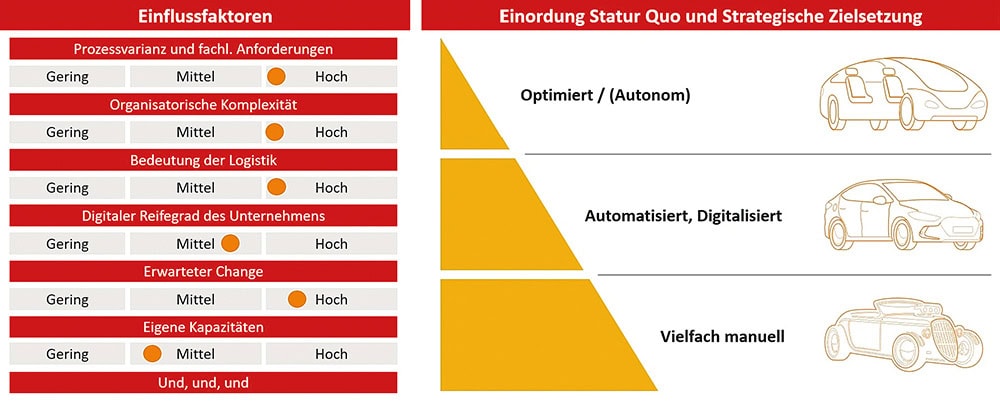
A successful transformation follows a structured, value-driven approach: Measures are prioritized based on their value potential and implementation effort and rolled out in phases to create visible added value early on, build acceptance, and drive the transformation forward in a targeted manner. In the SAP environment, several logistics solutions are available for this purpose: powerful systems for complex structures as well as leaner cloud solutions for less complex scenarios. The crucial shift in perspective is this: from a feature-based mindset to value contribution—moving away from „What function do I want?“ toward „What added value do I want to achieve?“ There is no one-size-fits-all solution. The system landscape must be tailored to the requirements of each specific location: Large, complex logistics sites require a different set of functions than smaller or less critical units.
Successful architectures therefore combine different solutions in a meaningful way within a hybrid approach. With AI, too, added value does not come from the technology itself, but from its targeted use. For example, AI can guide users through process configuration and reduce manual tasks. In the long term, the goal is to create an autonomous enterprise in which systems handle routine tasks and employees focus on oversight and exceptions. Clean processes and sufficient data quality remain prerequisites; without this foundation, the benefits of AI remain limited.
Thesis 3
„The success of the transformation begins before the actual implementation“: Another crucial factor lies in the preparation for the transformation. The greatest driver of a project’s success is not the implementation itself, but rather the upstream analysis and design phase. This includes a thorough understanding of the actual processes, which often goes beyond the documented workflows. Equally important is a realistic assessment of data quality and the integration requirements between systems.
A consistent end-to-end view of the processes is essential to avoid isolated optimizations. Organizational change management is also particularly often underestimated. The implementation of new solutions requires not only technical adjustments but also changes in work practices, responsibilities, and ways of thinking. (Source: Leogistics)
Causes of Failure
The five most common reasons why logistics transformations fail:
- underestimating the complexity
- an unclearly defined scope
- insufficient stakeholder engagement
- a lack of an end-to-end view, as well as
- Shortcomings in the integration and coordination of the systems.


 Deutsch
  English
  Español
  Français