
The Future Is Private Enterprise AI




Today, as companies move beyond the purely experimental phase—the so-called “POC playground”—and aim to deploy productive AI workloads with a measurable business return on investment (ROI), IT decision-makers are under significant pressure.
By thoughtlessly using AI services from the public clouds of major hyperscalers for business-critical SAP data, companies are exposing themselves to a dangerous vendor lock-in through proprietary ecosystems at the level of language models and infrastructure. Added to this is the drastic risk of a sudden and unpredictable withdrawal of model access: Just how real this danger is was demonstrated, for example, when Anthropic models were taken off the market at short notice due to changes in U.S. government export control regulations. Companies that were completely dependent on these specific models at that time were left with nothing—the continuity of their entire business operations was acutely threatened. Furthermore, they lose control over their most sensitive corporate data and fall into the so-called “egress trap”: Data transfer fees charged by hyperscalers can quickly eat up 30 to 50 percent of total monthly costs, compounded by unpredictable pay-per-token billing models. Another critical issue is corporate security, because with public cloud services, SAP users are effectively just renting their intelligence and entrusting their most important data to an uncontrollable third-party “black box.”.
Private Enterprise AI
The future-proof solution to this dilemma is Private Enterprise AI and the uncompromising pursuit of digital sovereignty. It is crucial to understand that „private“ in this context refers first and foremost to operating AI entirely under one’s own control—it by no means refers solely to traditional operation in a private cloud. Rather, this approach ensures that companies can never be denied access to their models and that any risk of data compromise by external third parties is eliminated. The concept of Private Enterprise AI defines an architecture that guarantees maximum control, the highest level of data protection, and strict compliance by running AI models directly in the company’s own data center, at the network edge, or in a dedicated, highly secure private cloud. Sovereign AI, therefore, means retaining absolute control over the hosting, the models, and, above all, the underlying hardware infrastructure.
The fact is: A company cannot reliably secure its business processes unless it controls the foundation upon which its artificial intelligence is built and draws conclusions. Private Enterprise AI ensures that your intellectual property is fully protected, that you comply with legal requirements such as the EU AI Act, and that you benefit from the efficiency gains of modern AI without ever relinquishing control.
Get off the POC playground
To make this vision of Private Enterprise AI tangible and scalable for the enterprise sector, SUSE offers „SUSE AI Factory,“ an open, highly secure infrastructure platform. SUSE AI Factory enables the seamless deployment of generative AI solutions and MLOps across data centers, cloud, and edge environments without compromising flexibility or data control. SUSE AI Factory serves as the technological backbone for the industrialization of these complex AI processes. It transforms fragmented AI experiments into secure, predictable, highly repeatable, and highly standardized production environments.
At its core, SUSE AI Factory is an integrated software layer built on top of SUSE Rancher Prime. Its primary purpose is to replace the error-prone and manual integration of typically 15 to 20 different open-source tools. Instead, the solution establishes a reproducible „digital production line“ for deploying and scaling AI workloads. This is made possible by pre-validated, version-controlled blueprints (master templates) that have been specifically developed for the most demanding enterprise use cases.
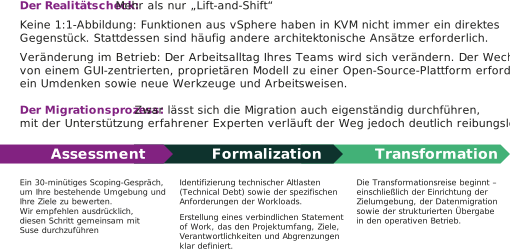
For IT teams managing critical SAP environments, this means eliminating operational disruptions. Instead of wasting highly skilled developer resources on maintaining the underlying AI infrastructure, teams can focus on the actual value creation associated with the model. SUSE AI Factory integrates seamlessly into existing Linux and Kubernetes environments and enables a smooth transition from intuitive „ClickOps“ user interfaces to highly scalable „GitOps“ automation. This ensures that no unwanted deviations (environmental drift) occur between the sandbox development environment and production operations.
Predictability with SUSE AI Factory
In addition, the SUSE AI Factory solves the key problem of predictability: Companies are shifting from the unpredictable API costs of the public cloud to a controllable CapEx model, in which expensive hardware resources are utilized to the fullest through features such as fractional GPU scaling (e.g., NVIDIA MIG) and AI-powered observability. On the IT security front, the platform acts as a digital safe harbor: With end-to-end zero-trust concepts, native Software Bills of Materials (SBOMs), and the capability for fully isolated, air-gapped deployments, it offers a 100% auditable AI supply chain. This ensures that even the most sensitive SAP financial or HR data can be securely processed by large language models.
Experts and innovators are the missing piece of the puzzle needed to move AI from the lab into the heart of enterprise IT. They combine the analytical capabilities of on-premises LLMs and agents with the highly complex reality of existing SAP landscapes, enabling the automation of use cases, which leads to immense improvements in operational excellence. While Suse AI Factory provides the open foundation and the guidelines for data sovereignty, partners such as Nova Intelligence and PAC ensure that AI is deeply integrated into companies’ core processes. Through this synergy, AI becomes an integral, highly secure component of the SAP world, operates fully in accordance with data sovereignty principles, and generates measurable added value directly from the company’s own data center.
Sovereignty as a Driver of Returns
As this cover story has made clear, the strategic shift to open virtualization technologies such as KVM and SUSE Virtualization is the fundamental first step toward shedding the crushing burden of expensive, proprietary hypervisor costs. Successful real-world examples, such as the FIS Group’s consistent implementation of secure, container-based AI workloads in its German data centers, impressively demonstrate that highly available SAP infrastructures and Private AI can already be implemented today with high performance, security, and—above all—cost efficiency. The future of SAP-driven value creation inevitably lies in private AI. Platforms such as the SUSE AI Factory pave the way for companies to fully harness the massive potential of AI without losing their sensitive data to the „black boxes“ of public cloud hyperscalers. They ensure adherence to the strictest compliance guidelines and protect every company’s most valuable asset.
For SAP decision-makers and IT leaders, this is a wake-up call to free system landscapes from proprietary constraints and unpredictable cost models. Powerful, KVM-based infrastructure, combined with sovereign private AI, provides an independent, future-proof foundation. The concepts, ecosystem, and tools for an AI-ready SAP environment are ready—make your IT independent and future-proof now.
To the partner entry:


 Deutsch
  English
  Español
  Français